





D Finders
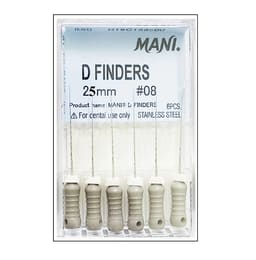
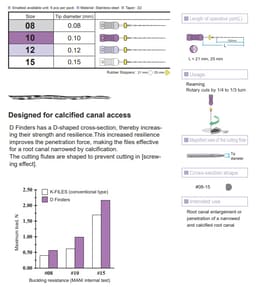
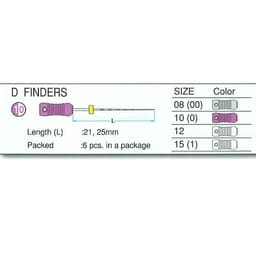
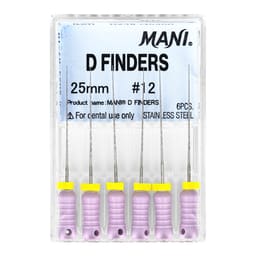
D-Finders are extra-stiff stainless-steel endodontic hand files, made by Mani, used to negotiate narrow, calcified, or blocked root canals and scout a glide path before shaping. Their added rigidity and sharp tip let them probe a tight canal that a flexible file would buckle in. Sold in fine ISO sizes and 21 mm and 25 mm working lengths for canal finding.
 Recommended
 Price- High to LowPrice- Low to High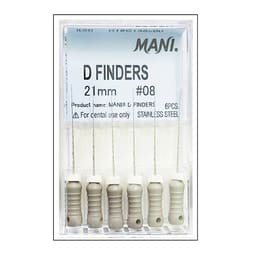




D-Finders
A D-Finder is the file an operator reaches for when a canal will not accept a standard instrument — a narrow, sclerosed, or partly obliterated canal that needs scouting before anything else can enter. It is stiffer than an ordinary hand file, so instead of flexing away from a blockage it transmits the operator's fingertip pressure to the tip and works its way apically. Finding and confirming a patent canal is its single purpose; once a glide path exists, the case moves on to shaping. It complements the standard K-files used for the rest of hand instrumentation.
Where D-Finders fit in canal negotiation
The D-Finder is a scouting instrument, used early and in fine sizes:
- First entry — a size 08 or 10 D-Finder probes a canal orifice that a flexible file skips over or bends against.
- Through a blockage — the stiffness carries the tip past a ledge, a calcification, or a tight curve where a soft file stalls.
- Glide path — once the file reaches length, it confirms a patent, reproducible path for the shaping files that follow.
Because the tip is sharp but the file is used with a gentle watch-winding motion, it negotiates rather than gouges. After the D-Finder confirms length, an apex locator reads the working length on the same fine file.
Stiffness — why not just a standard file?
The difference is rigidity, and it matters in a difficult canal:
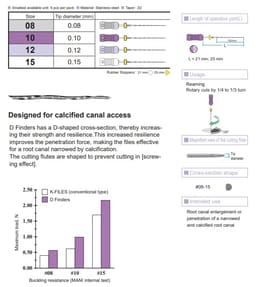
- Resists buckling — a standard 08 or 10 file is very flexible and folds against a hard blockage; the D-Finder pushes through.
- Better tactile feedback — the stiffer shaft transmits what the tip meets, so the operator feels a ledge or a false path.
- Controlled probing — it holds its direction into a calcified canal instead of deflecting to the path of least resistance.
A flexible file is right once the canal is open and being shaped, but for the first negotiation of a tight canal the extra stiffness is what gets the tip to length. It clears the way for the rotary files that do the bulk shaping afterwards.
Lengths and sizes
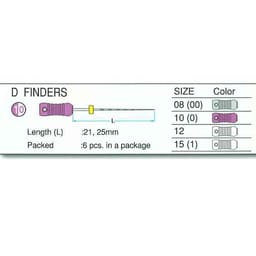
D-Finders are stocked in the two standard endodontic lengths and fine scouting sizes:
- 21 mm — the shorter file for front teeth, premolars, and cases where the patient cannot open wide.
- 25 mm — the everyday length that reaches most molar canals.
- Fine ISO sizes — the small diameters (around 06–10) used to first enter and negotiate a canal.
The length is chosen for the tooth and access; the size for how tight the canal is, starting fine and stepping up only as the path opens.
Buy D-Finders at Dentalkart
Dentalkart lists the genuine Mani D-Finder in both 21 mm and 25 mm — the difficult-canal files worth keeping in the kit before a sclerosed molar shows up on the day's list. Pricing and current stock for each length are on the product pages above.
Frequently Asked Questions (FAQs):
What are D-Finders used for?
D-Finders are stiff stainless hand files used to negotiate difficult root canals — narrow, calcified, ledged, or blocked ones — and to establish a glide path before shaping. Their rigidity lets the tip push through a blockage that a flexible file would bend against. They are a scouting instrument, used early and in fine sizes to find and confirm a patent canal.
How is a D-Finder different from a normal K-file?
A D-Finder is considerably stiffer than a standard K-file of the same size. That rigidity is deliberate: it stops the file buckling when it meets a calcification or ledge, so the tip advances instead of folding. A standard K-file, being flexible, suits shaping an already-negotiated canal, while the D-Finder is built for the harder first job of getting to length.
When should I reach for a D-Finder?
Reach for one when a canal resists a standard file — the tip will not advance, the file bends at an obstruction, or the canal is sclerosed and hard to locate. Starting with a fine D-Finder gives the stiffness and tactile feedback to negotiate the path. Once it reaches length and a glide path is set, you switch back to normal files and rotary shaping.
What sizes and lengths do D-Finders come in?
D-Finders are made in fine ISO scouting sizes, typically around 06 to 10, and in 21 mm and 25 mm working lengths. Pick 21 mm for front teeth or a limited mouth opening, and 25 mm for deeper molar canals. You start with the finest size that will enter the canal and step up only as the path opens and the canal accepts a larger file.
Do D-Finders replace rotary files?
Not at all — the two sit at different points in the case. A D-Finder scouts and negotiates the canal by hand to create a glide path; rotary files then follow that path to shape the canal efficiently. The D-Finder gets a stiff, fine tip to length in a difficult canal first, and the rotary system takes over the bulk shaping once a reproducible path exists.