Ultrasonic Scalers — Piezoelectric Scaling Units, Tips and Accessories
An ultrasonic scaler is a powered scaling instrument: a benchtop or portable unit drives a metal tip in the handpiece to vibrate at ultrasonic speed, while a water line feeds a fine spray over the working end. Held lightly against a tooth, the tip chips calculus loose as the spray cools it and — through cavitation and acoustic streaming — flushes plaque and biofilm out of the sulcus. It clears in minutes what a hand scaler takes far longer to do, which makes it the routine tool for a scaling-and-polishing visit. The units stocked here are piezoelectric, the type that drives the tip in a straight-line stroke.
Types of ultrasonic scaler
Piezoelectric and magnetostrictive — the two technologies
Two designs move the tip. A piezoelectric scaler flexes ceramic crystals to push the tip back and forth in a linear stroke, and that is the design of nearly everything in this range. A magnetostrictive scaler vibrates a metal stack so the tip traces an ellipse instead; it is less common in Indian practice and is not the format sold here. Piezo runs well around a light touch and accepts a wide library of tips.
Entry piezo units
For a first scaler or a spare chair, Woodpecker's UDS-P is the workhorse — a piezo driver with an autoclavable handpiece and a starter set of tips at a modest price. The Woodpecker UDS-P Ultrasonic Scaler ( With 5 periodontal Tips and 1 Endodontic Tip) ships with five periodontal tips and one endodontic tip.
LED and portable units
A lit handpiece throws light onto the working end, which helps in a posterior sextant or a deep pocket. The Woodpecker D600 LED Ultrasonic Scaler runs separate scaling, periodontal, and endodontic modes with LED illumination, and the UDS-P LED adds the same light to the entry unit.
Premium multi-function scalers
At the specialist end sit the NSK Varios units, tuned for fine feedback and multi-discipline use across periodontics, endodontics, and prophylaxis. The NSK Varios 970 Ultrasonic Scaler with 3 Tips (Y1001175) is the flagship, with the compact 370EU set below it.
Scaler tips
The tip does the real work and is swapped to the task: G-series tips for supragingival calculus, P-series for the periodontal pocket, and slim E-series tips for the canal, some diamond-coated for retreatment. The Woodpecker Scaler Tip G3 for UDS & EMS Scalers clears general supra- and subgingival deposit.
Water pumps, wrenches and holders
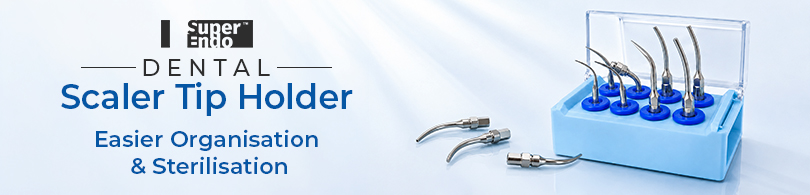
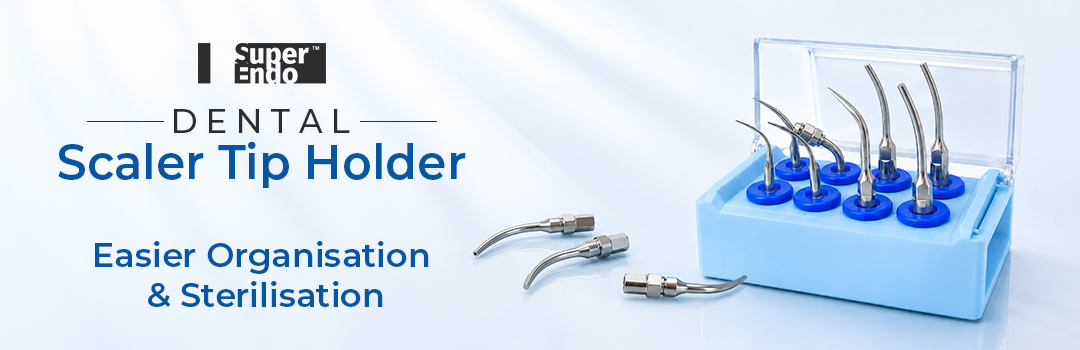
Around the unit sit the parts that keep it running: a water pump to feed the spray where a chair has no line, a torque wrench to seat each tip correctly, and an autoclavable stand to hold the tips. The Woodpecker Water Pump for Ultrasonic Scaler supplies the spray on a self-contained setup.
When an ultrasonic scaler is used
The scaler comes out across hygiene, periodontal, and endodontic work:
- Routine scaling and polishing to clear calculus, plaque, and stain
- Deep subgingival debridement and root planing in periodontal therapy
- Flushing and shaping support in the canal during root-canal obturation and retreatment
- Loosening a cemented crown or clearing set cement with the right tip
- Removing surface stain before a shade match or whitening
- Quick supragingival clean-ups between definitive appointments
How to choose an ultrasonic scaler
- Unit and mode set — a single-mode piezo for straightforward scaling, or a multi-mode unit (scaling, perio, endo) where one machine has to do more than prophylaxis.
- LED or plain — a lit handpiece earns its place on posterior and subgingival work; a plain handpiece costs less.
- Tip compatibility — check the tip thread matches the unit, since a UDS/EMS-type tip and a DTE/Satelec-type tip are not interchangeable.
- Tip seating — seat every tip with a D-Dent Scaler Tip Torque Wrench, since a hand-tight tip runs weak and an over-tight one can crack.
- Water supply — confirm the unit takes your chair's water line, or add a self-contained pump where there is none.
Ultrasonic scaler brands on Dentalkart
Woodpecker and NSK account for nearly all of it. Woodpecker covers the everyday ground — the UDS-P units, the D600, and the largest tip library — at prices a general practice can standardise on.
NSK sits above it with the Varios line, chosen where the operator wants finer feedback and multi-discipline reach; the NSK Varios 370EU Ultrasonic Scaler Complete Set (Y1001389) is the compact way into that line, while D-Dent and Waldent supply the tips, holders, and wrenches around both.
Why buy an ultrasonic scaler from Dentalkart
A scaler unit runs daily for years, while the tips are the part that wears and gets replaced, so the choice really comes down to a dependable handpiece, a tip system you can keep feeding, and the water and seating bits that keep it working right. The range here covers that whole chain — the Woodpecker entry units, the NSK Varios machines, the G-, P-, and E-series tips for each job, and the pumps, wrenches, and holders around them — so a clinic can settle on a scaler and still pull its replacement tips and spares from the same shelf as they wear through.












 Recommended
 Price- High to Low