

Bone Grafts
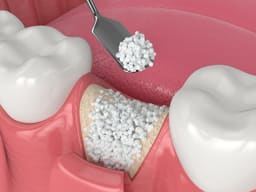
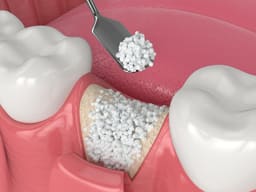
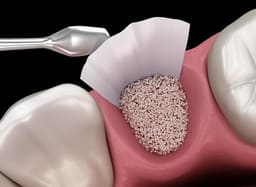
Bone grafts are sterile particulate or mouldable materials a surgeon packs into a defect to regrow alveolar bone lost to extraction, gum disease or a peri-implant gap. Acting as a scaffold — and, in some grades, an active stimulus — for the patient's own bone, they underpin socket preservation, ridge augmentation and sinus lifts across xenograft, bioactive glass, hydroxyapatite, β-TCP and DBM.
 Recommended
 Price- High to LowPrice- Low to High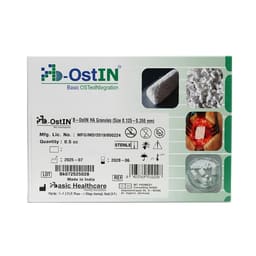
 7
7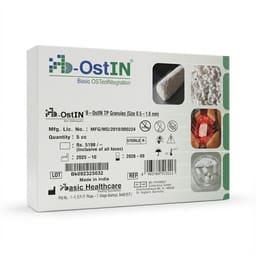
Bone Grafts — Rebuilding Ridge Volume for Implants and Repair
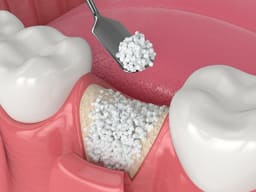
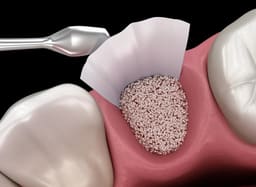
When a tooth comes out or periodontal disease eats into the ridge, the bone that supported it starts to shrink, and an implant, bridge or regenerative procedure needs that volume back. A bone graft fills the gap with a mineral framework the body can colonise: the patient's own cells migrate in, lay down new bone, and over months replace or integrate the graft. The materials here span every common chemistry — from slow-holding bovine mineral to fully resorbable synthetics — for socket, ridge, sinus and periodontal work in implantology, periodontics and oral surgery.
The five graft families
Xenograft — bovine mineral scaffold
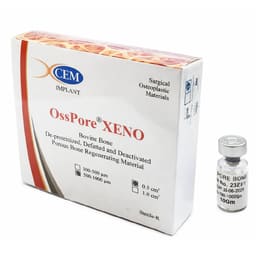
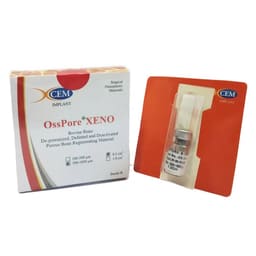
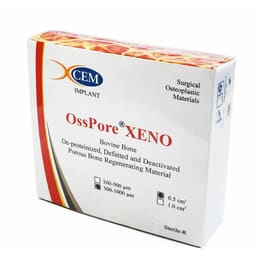
Xenograft is cancellous bovine bone stripped of its protein down to the mineral, leaving the natural porous architecture intact. It resorbs slowly, so it holds ridge and sinus volume for months while host bone grows through it — the reason it is a mainstay of delayed-implant and large-augmentation cases. The Geistlich Bio-Oss Collagen is a collagen-bound xenograft of this kind.
Bioactive glass
Bioactive glass is a synthetic calcium-phosphosilicate that bonds chemically to bone and releases calcium, phosphate and silica ions, which nudge the surrounding cells toward new bone. It handles contained ridge defects and periodontal intrabony pockets well. The NovaBone Perioglas is a bioactive-glass alloplast in this group.
Synthetic hydroxyapatite
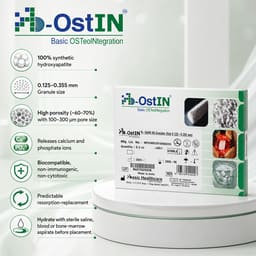
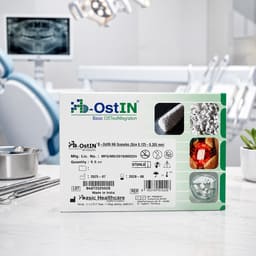
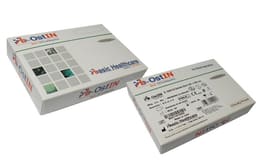
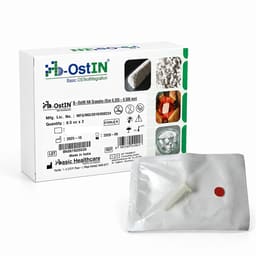
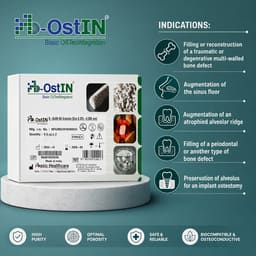
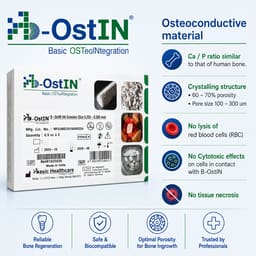
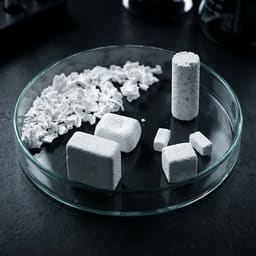
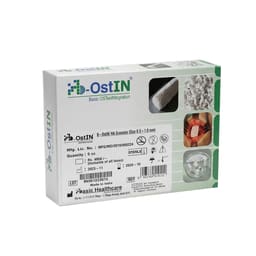
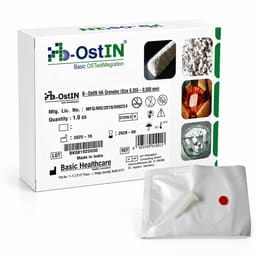
Hydroxyapatite is a lab-made version of the mineral in natural bone, offered in graded granule sizes so the particle can be matched to a socket, a GBR site or a sinus. Being fully synthetic, it removes any animal- or donor-source concern. The B-Ostin HA Nano is a synthetic hydroxyapatite graft.
β-tricalcium phosphate
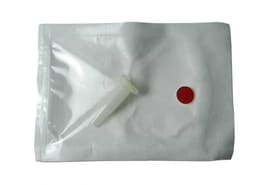
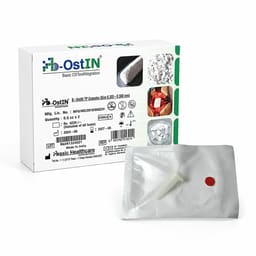
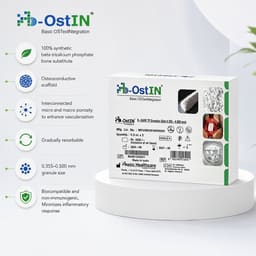
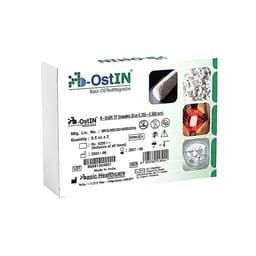
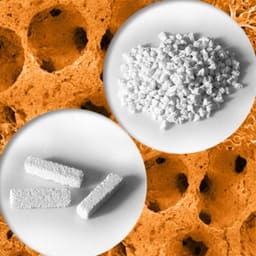
β-TCP is a resorbable ceramic that dissolves fully as new bone takes its place, leaving no permanent residue — useful for small contained defects and cases where a clean, complete turnover is wanted. The B-Ostin TP is a synthetic β-TCP graft.
Demineralised bone matrix
DBM is cortical bone with the mineral removed but its bone-forming proteins retained, so it adds genuine osteoinduction on top of a conductive scaffold — its niche is demanding ridge augmentations and stubborn intrabony defects. The Advanced Biotech Osseograft DMBM is a demineralised matrix graft.
Where they're used in practice
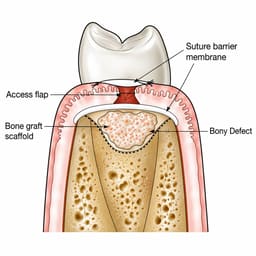
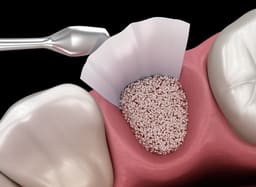
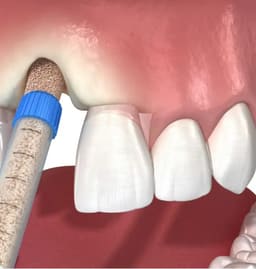
Grafting runs through implant, periodontal and oral-surgical work wherever lost ridge volume has to be restored before the next step. Typical cases are socket preservation right after an extraction, guided bone regeneration over an implant dehiscence, crestal or lateral sinus floor elevation, periodontal intrabony and furcation repair, horizontal or vertical ridge augmentation ahead of staged placement, and filling a cyst cavity after enucleation. Most of these pair the graft with a barrier — the resorbable collagen and non-resorbable PTFE sheets in the membranes range cover that GBR/GTR workflow.
Matching the graft to the case
Start with resorption rate: a slow xenograft stabilises a ridge for a delayed implant, while a fully resorbable ceramic suits a defect you want entirely replaced by host bone. Weigh the biology next — a plain osteoconductive scaffold covers straightforward fill, whereas an osteoinductive matrix earns its place in compromised or large defects. Then calibrate particle size to the site, keep animal- and donor-source considerations in mind, and check the handling form (granule, putty or collagen-bound) against how well the graft must stay put. For a fuller breakdown of graft origins, our guide to allograft vs xenograft vs synthetic compares them.
Bone graft brands at Dentalkart
The shelf carries grafts and matched placement instruments from Geistlich, NovaBone, B-Ostin, Advanced Biotech, Xcem, Fredna, Ammdent and MedPark, covering xenograft, bioactive glass, hydroxyapatite, β-TCP and demineralised matrix, plus condensers, carriers and collector kits. Each product page lists the particle-size grade, vial volume and lot expiry, so a clinician can confirm the exact specification before ordering.
Why order bone grafts from Dentalkart
A graft reaches a surgical field only if every vial is verifiable, sterile and in date. Each item here is bought directly from the producing company or its appointed Indian distributor and ships sealed with the lot number and expiry visible, so a clinic can trace what it is placing. Grafts sit in the same order as the membranes, tacks and instruments that go with them, delivery reaches pincodes nationwide, and staff can talk through graft choice and particle size when a case is borderline.
Frequently Asked Questions (FAQs):
What are dental bone grafts used for?
Dental bone grafts are used to restore alveolar bone lost to extraction, periodontal disease, infection or a peri-implant defect. The graft acts as a scaffold new bone grows into, which is what makes socket preservation, guided bone regeneration around implants, sinus floor elevation, periodontal intrabony repair and pre-implant ridge augmentation predictable rather than left to unassisted healing.
How do xenograft, alloplast and DBM differ?
Xenograft, alloplast and DBM differ in origin and biological action. Xenograft is bovine mineral — slow-resorbing and purely osteoconductive, holding volume long-term. Alloplasts such as bioactive glass, hydroxyapatite and β-TCP are synthetic, animal-free and range from slow to fully resorbable. DBM is demineralised cortical bone that keeps its bone-forming proteins, adding osteoinduction for the more demanding defects.
Which particle size of bone graft should I choose?
Match particle size to the defect. Fine 0.125–0.355 mm granules pack extraction sockets and small GBR sites, medium 0.355–0.500 mm granules suit routine regeneration around implants, and coarse 0.500–1.000 mm granules bulk-fill sinus cavities and ridge augmentations without washout. Ranges like B-Ostin span all three grades, so the granule can be sized to the case.
Is a barrier membrane needed with every bone graft?
A barrier membrane is needed whenever soft tissue could collapse into the graft — most GBR sites, sinus lateral windows and ridge augmentations — where it keeps the gum from invading the healing bone. A contained, four-wall extraction socket often heals well without one. Where a membrane is used, a bone tack or pin holds a non-resorbable membrane steady over the graft.
Are the bone grafts on Dentalkart genuine and CDSCO-compliant?
Yes — every bone graft on Dentalkart is genuine and CDSCO-compliant. Stock is sourced directly from the manufacturer or its authorised Indian distributor and arrives in sealed sterile primary packaging with the original lot number and expiry printed on each surgical SKU, so a clinic can verify authenticity and shelf life before the vial ever reaches the operating field.