





Instruments
Dental instruments are the hand tools a dentist reaches for at every stage of care — the mirror and probe to examine, excavators and carvers to fill a tooth, spreaders and pluggers for a root canal, scalers to clean, pliers to adjust braces, and forceps to extract. GDC, Waldent, Julldent and Hu-Friedy make most of them, in steel built to be autoclaved daily.
 Recommended
 Price- High to LowPrice- Low to High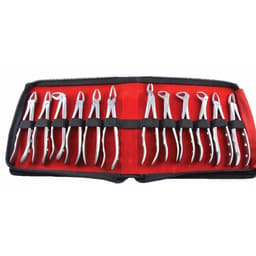

Only 5 Left
 649
649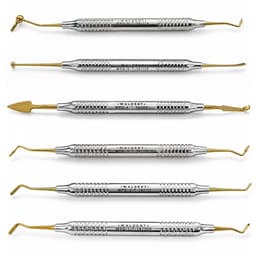
Only 1 Left
149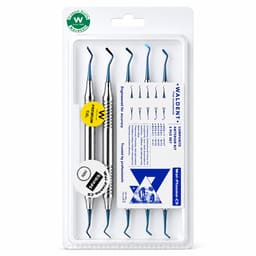
 14
14
 1
1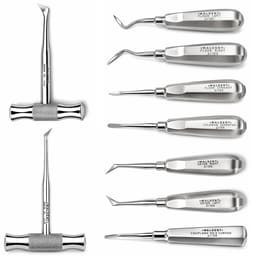
Only 2 Left
199
Dental Instruments — The Hand Tools Behind Every Procedure
Almost nothing in a clinic happens without a hand instrument. Before the material, the motor or the light comes into play, a dentist is holding a mirror, an excavator, a plugger or a plier — the small, precise steel tools that do the actual work in the mouth. This category gathers them by the job they do, from the three instruments on an examination tray to the specialist sets for a root canal or a surgical extraction, so a practice can build up each discipline’s tray and replace a worn or lost instrument from the same place.
One set per discipline
Examination — mirror, probe and explorer
Every appointment opens with the same three. The mouth mirror reflects and retracts for a view of the back of a tooth, the probe reads pocket depth around the gum, and the explorer catches decay and rough margins a mirror cannot show. A replaceable top like the Waldent Wal-Vision Rhodium Mouth Mirror Tops keeps the reflection sharp without replacing the whole handle.
Caries removal and filling
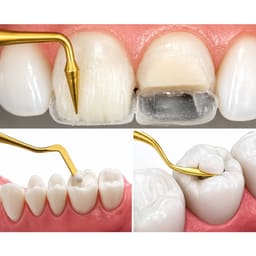
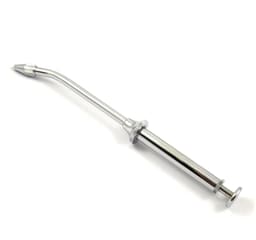
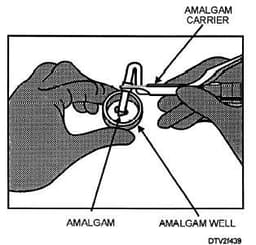
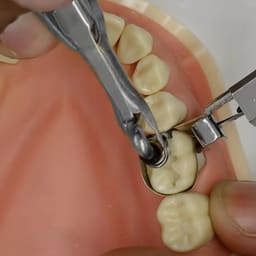
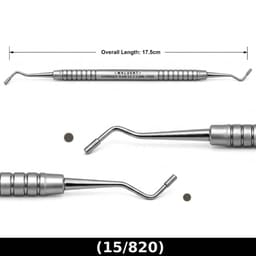
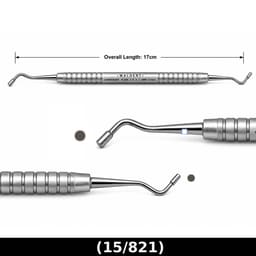
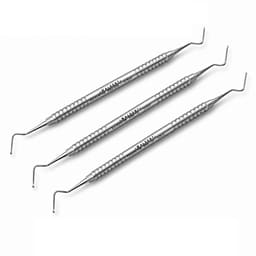
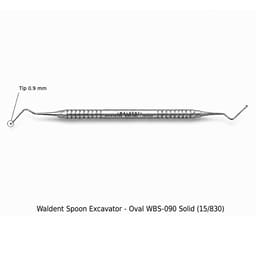
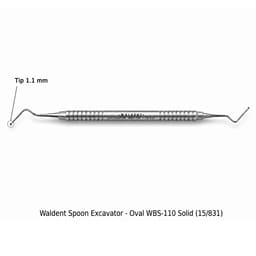
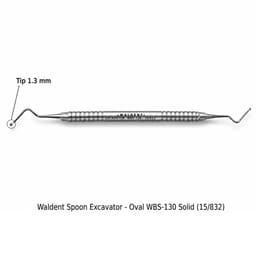
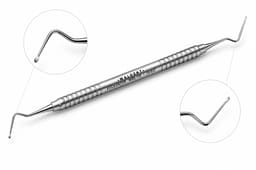
Once a cavity is found, hand instruments clear it and shape what fills it. A spoon excavator scoops out the soft, decayed dentine, condensers pack amalgam into the prepared cavity, and carvers cut the setting material back to a working bite. The Waldent Spoon Excavator is the double-ended tool for that first step.
Composite sculpting
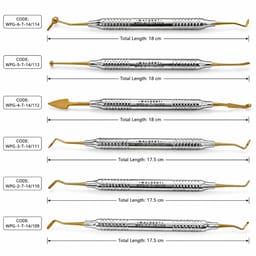
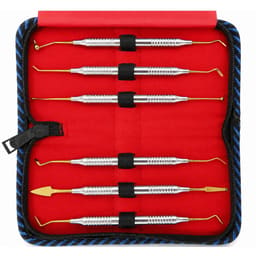
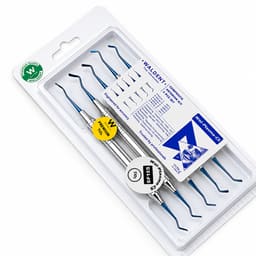
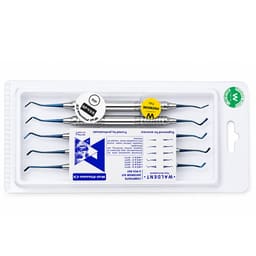
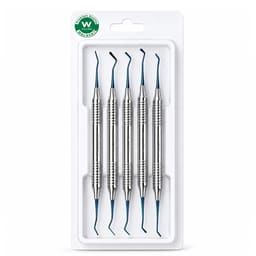
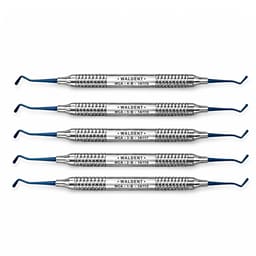
Tooth-coloured composite is sticky and unforgiving, so it needs its own instruments. Non-stick titanium-coated tips place and shape the resin without it pulling back onto the instrument, which is what lets an operator build anatomy layer by layer. The MIK Dental Composite Instrument is a coated placement instrument for that work.
Root-canal hand instruments
Obturation is done by hand pressure. Spreaders wedge sideways to make room for extra gutta-percha cones in cold lateral compaction, while pluggers press down to compact the filling vertically. Both live in the Pluggers & Spreaders range, sized to match the cones being packed.
Scaling and root planing
Cleaning below the gum needs sharp, angled edges. A scaler lifts hard calculus off the crown, and area-specific Gracey and universal curettes reach under the gum to plane the root smooth. The single-ended GDC Supra Gingival Scaler handles the calculus above the gumline.
Orthodontic pliers, extraction and sterilisation
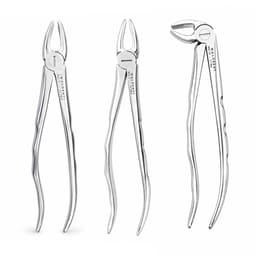
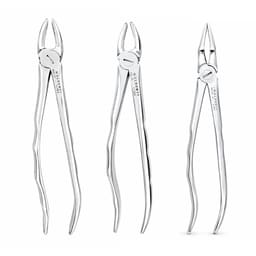
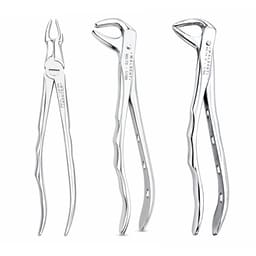
The rest of the tray is task-built. A wire plier such as the Koden Universal Plier forms loops and clasps, extraction forceps and elevators lift teeth (shared with the oral-surgery range), and soaking trays and cassettes hold everything through the sterilisation cycle between patients.
What leaves the tray, and when
- The mirror, probe and explorer at every examination and recall
- A spoon excavator to clear soft dentine before a filling
- Coated composite instruments to place and contour a resin restoration
- Amalgam condensers and carvers to pack and shape a silver filling
- Spreaders and pluggers to compact gutta-percha during obturation
- Scalers and curettes through a scaling and root-planing visit
- Orthodontic pliers to bend and adjust wire at brace appointments
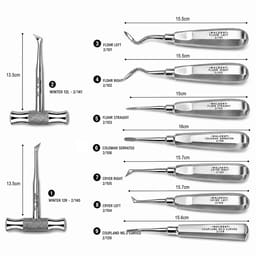
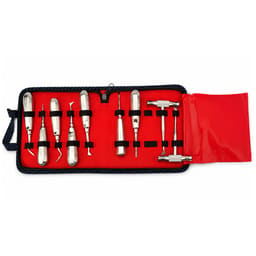
- Forceps and elevators for routine and surgical extractions
What separates a good instrument from a cheap one
- Steel that survives the autoclave — a quality medical-grade stainless keeps its edge and resists corrosion through daily 134 °C cycles; a poor one dulls, pits or rusts within months.
- Clean tips and joints — visible seam lines, uneven tips or a wobbly hinge are casting or finishing faults that make an instrument imprecise and harder to sterilise.
- The right pattern for the tooth — forceps beaks and curette angles are made for specific sites; the matched pattern does the job with less force and less risk of fracture.
- A non-stick coating where it counts — for composite, a titanium-nitride tip stops resin dragging back; for amalgam and glass ionomer, plain polished steel is fine.
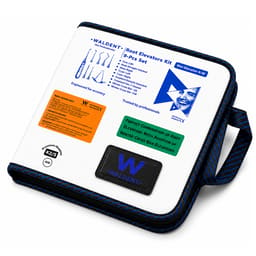
- Kit or single — a cassette kit keeps a full procedure’s instruments together and sterilised as a set, while individual pieces suit replacing one worn tool or a specialist’s short list.
The makers behind the steel
GDC and Waldent are the workhorses across almost every tray — diagnostics, excavators, condensers, carvers, scalers, forceps and cassette kits between them. Julldent and Veecare weight toward the periodontal and surgical end with curettes, elevators and micro-surgical instruments, while MIK, Oracraft and Hu-Friedy specialise in the non-stick composite instruments and Koden in orthodontic pliers.
Diagnostic sets and finer hand instruments also come from API and Hahnenkratt, and the sterilisation side — soaking trays and cassettes — is held by Life Steridex and GDC, so a clinic can equip the tray and its reprocessing from one category.
Buying instruments that last
An instrument is a long-term buy that gets used, dropped and autoclaved hundreds of times, so the choice is really about steel that lasts and patterns that fit the work. Keeping the diagnostic, restorative, endodontic, periodontal, orthodontic and surgical instruments together — as full cassette kits for a new setup or as single replacements for a broken tip — lets a practice build each tray to its own way of working and top it up the moment something wears out, without hunting brand by brand.
Frequently Asked Questions (FAQs):
How are dental instruments organised?
By the clinical job they do. Diagnostic instruments examine, excavators and carvers restore, spreaders and pluggers obturate a canal, scalers and curettes clean below the gum, orthodontic pliers adjust wire, and forceps and elevators extract. Most also come bundled into cassette kits arranged by procedure — a surgical set, an endodontic set, a restorative set — so the whole tray for one appointment is stored and sterilised together.
What is a PMT set and why is it on every tray?
PMT stands for probe, mouth mirror and tweezers — the three instruments used to start any examination. The mirror gives an indirect view and retracts the cheek or tongue, the probe measures gum pockets and checks surfaces, and the tweezers place and remove small items like cotton pellets. Because every appointment begins with looking before doing, the PMT set is the one tray laid out for literally every patient.
Why do composite instruments have a non-stick coating?
Because uncured composite resin sticks to bare steel and pulls back out of the cavity when the instrument lifts away. A titanium-nitride or similar non-stick coating on the working tip stops that, so the material stays where it is placed and can be sculpted cleanly layer by layer. For amalgam and glass ionomer, which do not cling the same way, an uncoated polished instrument works perfectly well.
How can I tell an instrument will last through repeated autoclaving?
Look at the steel and the finish. A quality medical-grade stainless holds its edge and resists rust through daily sterilisation at 134 °C, while a cheaper alloy dulls, stains or corrodes quickly. Check for a smooth, seamless surface, evenly finished tips, and a firm hinge with no play — visible casting seams or a loose joint are the usual signs of an instrument that will not wear well.
Is it better to buy an instrument kit or individual pieces?
It depends on the need. A cassette kit is the efficient choice for a new setup or a defined procedure — every instrument for that treatment is present, organised and sterilised as one unit, which cuts handling and the risk of a missing tool. Individual purchase makes sense once a clinic is running, for replacing a single worn or dropped instrument or for a specialist who only uses part of a standard set.