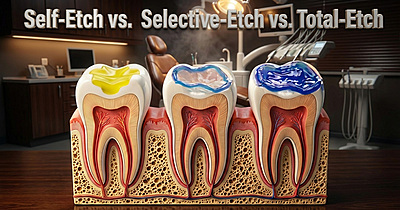
Self-Etch vs. Selective-Etch vs Total-Etch: A Clinical Decision Guide for Everyday Restorations

Dr. Bhavishya Arora
Chief Dental Editor
Introduction
In restorative dentistry, bonding success does not depend only on the composite resin or adhesive brand. More often than not, long-term success or failure depends on how the tooth was etched before bonding. Improper etching can lead to marginal leakage, post-operative sensitivity, and early restoration failure—even when high-quality materials are used.
With modern adhesive systems, especially universal adhesives, dentists now have multiple etching options. However, this flexibility can also create confusion. Many clinicians still follow one etching technique out of habit rather than selecting it based on the clinical situation.
This blog provides a clear, step-by-step clinical guide to self-etch, total-etch, and selective-etch techniques. The focus is on materials used, how to perform each technique, bonding agent generations, indications, limitations, and recent advancements, explained in a simple and practical manner.
Why Etching Strategy Matters

Etching determines how effectively the adhesive interacts with:
Enamel prisms
Dentin tubules
Smear layer
Incorrect etching may result in:
Poor marginal adaptation
Increased post-operative sensitivity
Weak bond strength
Reduced longevity of restorations
Selecting the appropriate etching technique improves bond durability, patient comfort, and clinical predictability.
1. Self-Etch Technique

What Is Self-Etch?
In the self-etch technique, etching and priming occur simultaneously using an acidic adhesive. There is no separate phosphoric acid application. The smear layer is altered but not completely removed, which helps protect dentin.
Materials Used
Self-etch adhesive or universal adhesive (self-etch mode)
Microbrush
Air syringe
Step-by-Step Clinical Procedure
Complete cavity preparation and remove debris
Gently air-dry without desiccating dentin
Apply self-etch adhesive actively for 20 seconds
Air-thin gently to evaporate solvent
Light cure according to manufacturer instructions
Clinical Indications

Advantages
Minimal dentin demineralization
Low technique sensitivity
Reduced post-operative sensitivity
Preserved dentin collagen structure
Limitations
Weaker enamel etching
Not ideal for uncut enamel margins
Risk of marginal staining over time
Clinical summary:
Self-etch is best when dentin protection and patient comfort are priorities.
2. Total-Etch (Etch-and-Rinse) Technique

What Is Total-Etch?
In total-etch technique, phosphoric acid is applied to both enamel and dentin, followed by rinsing and adhesive application. The smear layer is completely removed, allowing deep resin penetration.
Materials Used
35–37% phosphoric acid etchant
Etch-and-rinse adhesive or universal adhesive
Water spray
Microbrush
Light-curing unit
Step-by-Step Clinical Procedure
Apply phosphoric acid to enamel and dentin
Enamel: 15–20 seconds
Dentin: 10–15 seconds
Rinse thoroughly with water
Gently air-dry
Enamel: dry
Dentin: moist (avoid overdrying)
Apply adhesive with active scrubbing
Air-thin and light cure
Clinical Indications

Advantages
Strong enamel bond strength
Deep micromechanical retention
Excellent marginal integrity on enamel
Limitations
Highly technique sensitive
Risk of dentin collagen collapse
Increased likelihood of post-operative sensitivity
Clinical summary:
Total-etch provides maximum enamel bonding but requires strict technique control.
3. Selective-Etch Technique

What Is Selective-Etch?
Selective-etch is a combined approach:
Phosphoric acid is applied only to enamel
Dentin is bonded using self-etch chemistry
This technique takes advantage of strong enamel bonding while protecting dentin.
Materials Used
35–37% phosphoric acid etchant
Universal adhesive
Microbrush
Water spray
Light-curing unit
Step-by-Step Clinical Procedure
Apply phosphoric acid only on enamel margins
Etch enamel for 15–20 seconds
Rinse and gently air-dry
Apply adhesive to both enamel and dentin
Actively scrub, air-thin, and light cure
Clinical Indications

Advantages
Strong enamel bond
Reduced dentin sensitivity
Better marginal stability
More predictable than total-etch
Limitations
Requires precise etchant placement
Slightly longer chairside time
Clinical summary:
Selective-etch is the most balanced approach for everyday restorations.
Recent Advancements in Etching Techniques

Self-Etch Advancements
10-MDP functional monomers enabling chemical bonding to calcium
Ultra-mild self-etch systems reducing dentin demineralization
Improved solvent balance for better penetration and stability
Total-Etch Advancements
Nanofilled adhesives improving hybrid layer strength
Moisture-tolerant primers reducing collagen collapse
Enhanced photoinitiator systems for improved polymerization
Selective-Etch Advancements
Universal adhesives with dual bonding mechanisms
Lower post-operative sensitivity reported in recent clinical studies
Simplified protocols with fewer bottles and steps
Comprehensive Comparison Table

Final Clinical Takeaway
Etching technique should be chosen based on tooth structure, cavity depth, isolation, and patient sensitivity, not routine habit.
Self-etch protects dentin and minimizes sensitivity
Total-etch maximizes enamel bonding under ideal conditions
Selective-etch provides the most predictable outcome for daily restorative dentistry
FAQ’s
1. Which etching technique is best for routine posterior composite restorations?
For most routine posterior restorations, selective-etch is preferred. It provides strong enamel bonding while protecting dentin, resulting in reduced post-operative sensitivity and more predictable long-term outcomes in everyday clinical practice.
2. Why does self-etch reduce post-operative sensitivity?
Self-etch adhesives do not completely demineralize dentin. By preserving smear plugs and limiting dentinal tubule exposure, they reduce fluid movement within tubules, which significantly lowers the risk of post-operative sensitivity.
3. Is total-etch still relevant with modern universal adhesives?
Yes, total-etch remains relevant, especially for enamel-dominant restorations. When isolation is ideal and technique is precise, total-etch provides superior enamel bond strength, particularly for veneers and Class IV restorations.
4. Can universal adhesives be used with all etching techniques?
Universal adhesives are designed to work in self-etch, selective-etch, and total-etch modes. The clinician must choose the etching strategy based on cavity depth, enamel presence, and patient sensitivity rather than relying solely on the adhesive.
5. Why is selective-etch considered the most balanced approach?
Selective-etch combines phosphoric acid etching on enamel with self-etch bonding on dentin. This approach maximizes enamel bond strength while minimizing dentin sensitivity, making it ideal for most mixed-margin restorations.
Written by
Dr. Bhavishya Arora
BDS, MDSChief Dental Editor
A contributing clinician at Dentalkart Blogs, Dr. Bhavishya is a compassionate, detail-driven dentist known for thoughtful patient care, clear communication, and a calm chair-side manner that puts patients at ease. Beyond the clinic, she leads product content and category initiatives at Dentalkart India's largest dental marketplace where she bridges clinical understanding with commercial insight to help dentists make better-informed product choices.
Keep reading
Browse all →
Case Selection for Digital Occlusal Analysis
Case Selection for Digital Occlusal AnalysisA Clinical Decision Guide A digital occlusal analysis system provides objective, dynamic data on bite timing and for

Diagnosing Cracked Teeth With Fibre-Optic Transillumination
Diagnosing Cracked Teeth With Fibre-Optic Transillumination (FOTI)A Clinical Selection Guide Fibre-optic transillumination (FOTI) is a diagnostic method using a
When To Use a Light Cure Gingival Barrier?
When To Use a Light Cure Gingival Barrier?A Clinical Selection Guide. A liquid gingival barrier is a light-curable resin used to isolate and protect soft tissue