





Bracket Positioning Guage
4.8
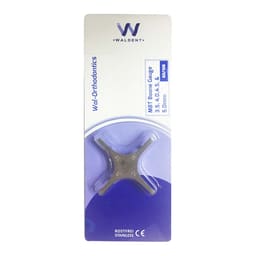
A bracket positioning gauge, classically the Boone gauge, is a graduated height gauge that sets each orthodontic bracket at the correct distance from the incisal or occlusal edge. Available from GDC, Waldent, and NDW as fixed-height and stepped versions, it is marked in millimetres — usually 3.5 to 5.0 mm for MBT. A consistent height is what lets a preadjusted bracket express its built-in prescription.
Sort by - Recommended
 Recommended
 Price- High to LowPrice- Low to High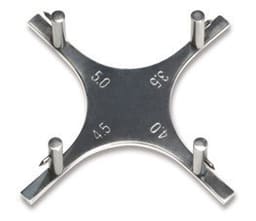
★ 5.0
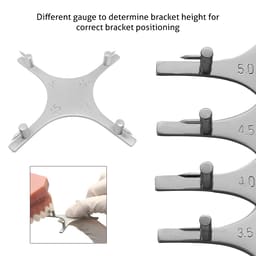
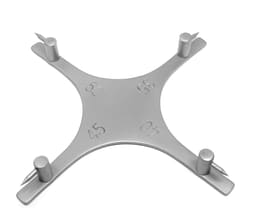
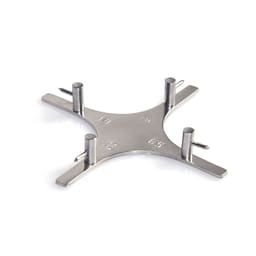
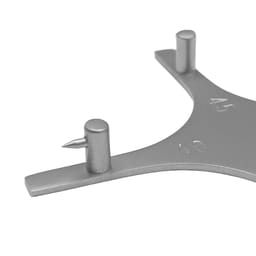
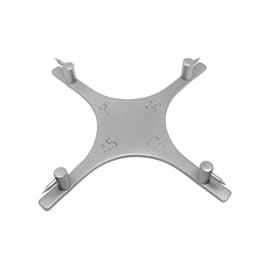
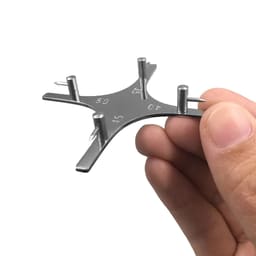
(1)Star shaped gauge to ensure vertical accuracy of brackets on the teeth
₹ 345₹ 800
56.88% Off
 15
15View Similar Products
Only 3 Left
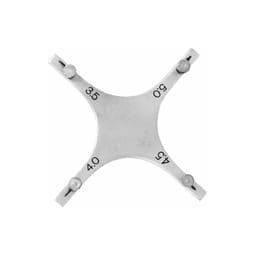
Boone Gauge with lid measures the height of bracket placement with extremely high accuracy.
₹ 1195₹ 2100
43.10% Off
24View Similar Products
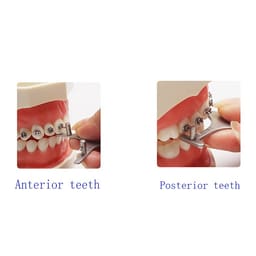
Only 4 Left
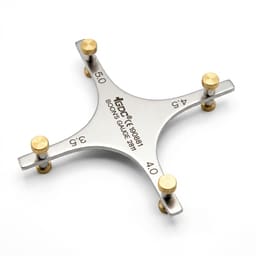
GDC Boon's Gauge used for accurately measures height of bracket placement.
₹ 720₹ 1200
40.00% Off
14View Similar Products
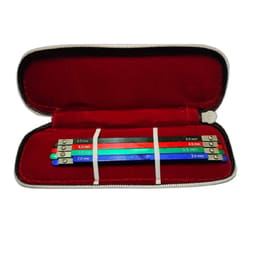
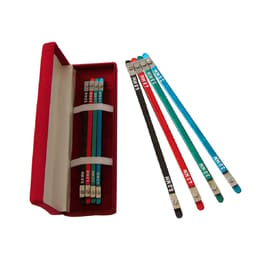
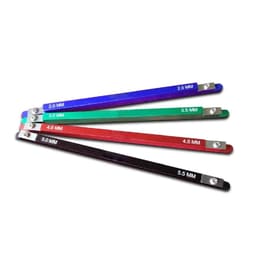

★ 4.5
(2)4 color coded MBT Gauge in different sizes to ensure vertical accuracy of brackets on the teeth
₹ 1090₹ 1380
21.01% Off
11View Similar Products
Filters
Sort By
RecommendedBracket Positioning Gauge
A bracket positioning gauge answers one question during bonding: how far from the incisal edge should this bracket sit? The gauge is a small graduated instrument, marked in millimetres, that rests on the incisal or occlusal edge and shows exactly where the bracket slot should land. Because a preadjusted bracket only expresses its built-in tip, torque, and rotation from the correct height, the gauge is what turns a prescription into an accurate result. It is one of the small orthodontic instruments reached for during bonding rather than wire adjustment.
Why bracket height matters
Bracket height is not cosmetic — it drives how the tooth finishes:
- Expresses the prescription — a preadjusted bracket only delivers its designed torque and tip when placed at the intended height; a millimetre off changes the finish.
- Levels the arch — consistent height across the arch is what lets a straight wire level and align the teeth predictably.
- Avoids re-bonding — a bracket bonded at the wrong height often has to be repositioned later, costing chair time.
Guesswork by eye varies between teeth and between operators. The gauge removes that variation, which is the whole reason it is used.
How the gauge is used
At bonding, the gauge sets the height before the adhesive cures:
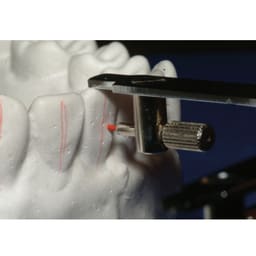
- Rest on the edge — sit the gauge foot on the incisal or occlusal edge of the tooth.
- Read the height — the marked step or scale shows the target slot position for that tooth.
- Place the bracket — position the bracket to the gauge, hold while excess adhesive is cleared, then cure.
Used on each tooth, the gauge keeps every bracket at a matched, prescription-correct height so the wire acts evenly. The bracket then carries the arch wire that also runs through the molar buccal tubes.
Height steps and the MBT prescription
Gauges come as a single set height or a stepped tool covering several:
- Single-height (Boone) — a fixed gauge for one target height, simple and quick for a routine setup.
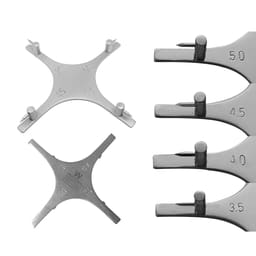
- Stepped / set of four — 3.5, 4.0, 4.5, and 5.0 mm steps, so different teeth each get their own correct height from a single tool.
The height chosen follows the prescription and tooth type — the MBT system, for instance, specifies heights that vary from incisors to premolars. Matching the gauge to the prescription in use is what keeps the placement consistent. The brackets it positions share an arch with the molar bands and tubes that anchor the appliance.
Buy bracket positioning gauges at Dentalkart
Dentalkart carries the GDC Boone and Boon's stainless gauges, the Waldent MBT stepped gauge, and the NDW four-piece set, so a practice can pick a single-height or full-step tool to match how it bonds. Each is an authentic branded gauge with delivery across India, and it can be added to the same order as the brackets, tubes, and adhesive the case needs.
Frequently Asked Questions (FAQs):
What is a bracket positioning gauge used for?
A bracket positioning gauge sets the height at which each orthodontic bracket is bonded, measured from the incisal or occlusal edge of the tooth. It is a graduated instrument, marked in millimetres, that removes guesswork so every bracket sits at a consistent, prescription-correct height. Accurate height is what lets a preadjusted bracket express its built-in tip and torque.
Why does bracket height matter so much?
A preadjusted bracket only delivers its designed torque, tip, and rotation when it sits at the intended height. Bond it a millimetre too high or low and the tooth finishes in the wrong position, often needing a re-bond later. A gauge fixes the height precisely, so the arch levels predictably and the case finishes closer to the planned result.
Why does a gauge have several millimetre steps?
The steps — 3.5, 4.0, 4.5, and 5.0 mm — are the bracket heights measured from the incisal edge, and they differ by tooth. An MBT setup places incisor and premolar brackets at different heights, so a stepped gauge or a set of four carries each value in one tool. The operator simply reads off the height for the tooth being bonded.
Should I get a fixed-height Boone or the stepped set?
A fixed-height Boone gauge is quick and simple when most teeth are bonded to one target height. The stepped gauge or set of four suits an operator who wants each tooth placed at its own prescription height without swapping tools mid-bond. A lot of clinics keep the set so every MBT height is covered by one tool.
Does the gauge work with any bracket system?
The gauge measures height from the tooth edge, so it works with any bonded bracket, but the height you set should follow the prescription in use. MBT, Roth, and other systems specify their own bracket heights, so read the value for that system and tooth. The instrument is universal; the height value comes from your bracket prescription.