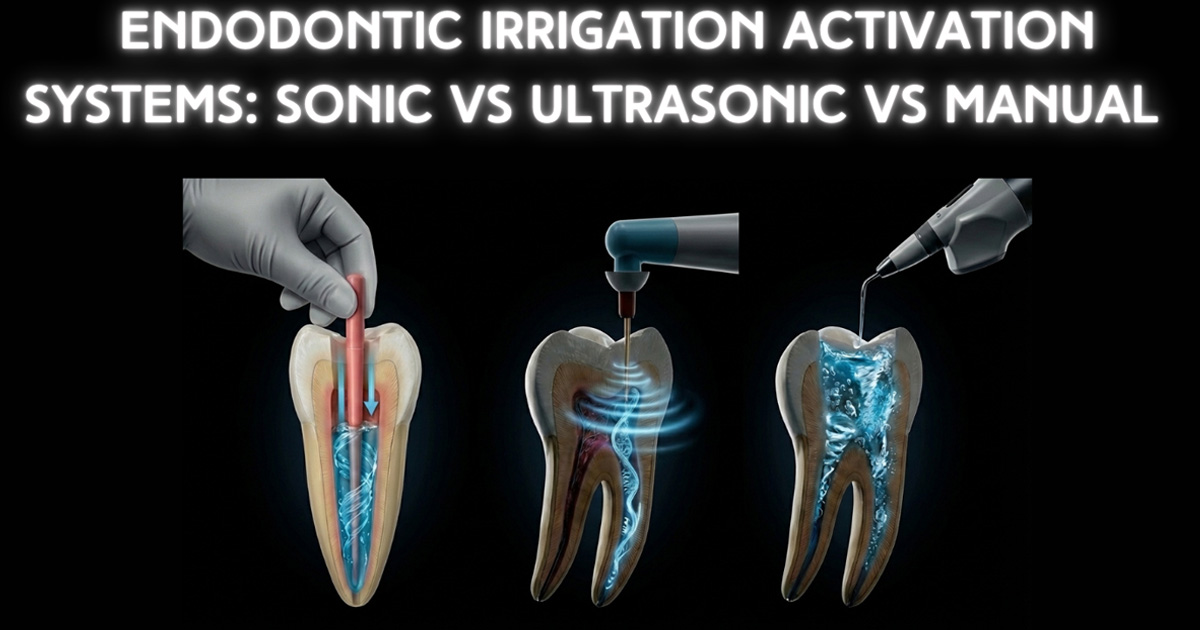
Endodontic Irrigation Activation Systems: Sonic vs Ultrasonic vs Manual

Dr. Prerna Sahrawat
Contributing Dental Clinician
Introduction
Successful root canal treatment is not achieved by instrumentation alone. While modern rotary and reciprocating systems shape the canal efficiently, a significant portion of the root canal system including lateral canals, isthmuses, fins, and apical deltas remains untouched by files.

This is where irrigation plays a crucial role. Root canal irrigants are responsible for dissolving organic tissue, eliminating bacteria, and removing debris from areas that instruments cannot reach. However, conventional syringe irrigation has limitations, particularly in the apical third, where stagnant irrigant and the vapor lock effect reduce cleaning efficiency.

To overcome these challenges, irrigation activation systems have become an essential part of modern endodontic protocols. These systems enhance irrigant penetration and effectiveness through improved fluid movement and agitation.The most commonly used activation methods include manual agitation, sonic activation, and ultrasonic activation. Understanding how each system works helps clinicians choose the most suitable option for predictable and efficient root canal outcomes.
Why Is Irrigant Activation Important in Endodontics?
Irrigants are only effective when they come into direct contact with canal walls and infected areas. Without activation, irrigants tend to remain static and follow the path of least resistance.
Irrigant activation helps to:
- Improve penetration into the apical third
- Disrupt bacterial biofilms
- Enhance removal of smear layer and debris
- Reduce stagnant zones within the canal system
Rather than replacing conventional irrigation, activation enhances the chemical action of irrigants, leading to improved canal cleanliness.
Manual Irrigation Activation or Manual Dynamic Agitation (MDA)

What Is Manual Irrigation Activation?
Manual dynamic agitation involves activating the irrigant by repeatedly inserting and withdrawing a well-fitting gutta-percha cone to the working length after irrigation.
How It Works
The push-pull motion creates fluid displacement inside the canal, helping reduce the apical vapor lock effect and improving irrigant exchange compared to static syringe irrigation.
Clinical Advantages
- Simple and cost-effective
- Requires no additional equipment
- Better than syringe irrigation alone
Limitations
- Limited hydrodynamic force
- Reduced effectiveness in complex canal anatomy
- Operator-dependent results
Manual agitation serves as a basic enhancement to irrigation but may be insufficient in cases requiring deeper disinfection.
Product Recommended: Waldent Gutta Percha Points Protaper
Sonic Irrigation Activation

How Sonic Irrigation Activation Works
Sonic irrigation systems operate at lower frequencies (1-6kHz) and use flexible polymer tips that vibrate inside the canal. These vibrations generate acoustic streaming, improving fluid movement without cutting dentin or altering canal anatomy.
Clinical Benefits
- Improved irrigant penetration compared to manual methods
- Safe for curved and narrow canals
- Flexible tips reduce the risk of ledging or transportation
- Easy to incorporate into routine practice
Sonic activation is commonly preferred for routine root canal treatments, especially when safety and ease of use are priorities.
Limitations
- Lower energy output compared to ultrasonic systems
- Limited cavitation effect
- May be less effective in severely complex anatomy
Sonic activation offers a balanced improvement in cleaning efficiency while maintaining a high safety margin.
Product Recommended: SuperEndo Sonic Flush Endo Irrigator LED
Ultrasonic Irrigation Activation

Mechanism of Action
Ultrasonic activation operates at much higher frequencies (25–40 kHz), producing strong acoustic streaming and cavitation within the irrigant. These effects create powerful fluid movement capable of dislodging debris, tissue remnants, and bacterial biofilms.
Ultrasonic activation is commonly performed using non-cutting files during final irrigation, a technique known as passive ultrasonic irrigation.
Clinical Benefits
- Superior debris and tissue removal
- Enhanced smear layer disruption
- Effective irrigant penetration in complex canal systems
- Useful in retreatment and necrotic cases
Limitations
- Technique-sensitive
- Reduced effectiveness if the file contacts canal walls
- Higher equipment cost and learning curve
When used correctly, ultrasonic activation provides one of the most effective methods for enhancing irrigation.
Product Recommended: Waldent Endo X UltraSonic Activator
Sonic vs Ultrasonic vs Manual: A Clinical Comparison


Clinical Outcomes and Patient Considerations
Enhanced irrigation has been associated with improved canal cleanliness and may contribute to reduced postoperative discomfort in some patients. However, no activation system alone guarantees long-term success.

Factors such as:
- Proper canal shaping
- Correct working length determination
- Appropriate irrigant selection
- Controlled activation technique
remain critical to treatment outcomes.
Care should also be taken to avoid excessive force during activation, as improper technique may increase the risk of irrigant extrusion.
Which Irrigation Activation System Should You Choose?
There is no single activation method suitable for every case. The choice depends on canal anatomy, infection status, clinician experience, and practice requirements.
- Routine cases: Manual agitation or sonic activation may be sufficient
- Curved canals: Sonic activation offers safety and flexibility
- Necrotic or retreatment cases: Ultrasonic activation provides enhanced disinfection
- Advanced or high-volume practices: Ultrasonic systems offer long-term value

Many clinicians combine techniques, using sonic or manual activation during shaping and ultrasonic activation during final irrigation.
Conclusion

Irrigation activation plays a vital role in modern endodontics by enhancing the effectiveness of chemical disinfection. Manual, sonic, and ultrasonic activation systems each have their place in clinical practice, offering varying levels of efficiency, safety, and complexity.
Rather than replacing conventional irrigation, these systems should be viewed as adjuncts that improve treatment predictability and canal cleanliness. Selecting the appropriate activation method based on clinical requirements leads to better outcomes and more consistent endodontic success.
Frequently Asked Questions (FAQs)
Ultrasonic activation generally produces stronger fluid movement and debris removal, while sonic activation offers better safety and ease of use. Both techniques are clinically valuable depending on the case.
Syringe irrigation alone may not effectively clean complex canal anatomy. Activation significantly improves irrigant penetration and cleaning efficiency.
While not mandatory in every case, activation is strongly recommended in necrotic teeth, retreatment cases, and canals with complex anatomy.
Sonic activation systems with flexible tips are considered safer for curved canals.
Written by
Dr. Prerna Sahrawat
Contributing Dental Clinician
Dr. Prerna Sahrawat is a dentist with over 4 years of experience in clinical dentistry and dental content writing. She is passionate about simplifying complex dental concepts into practical, evidence-based content that helps dentists make informed clinical and purchasing decisions while staying updated with the latest advancements in dentistry.
Keep reading
Browse all →Navigating Gates-Glidden Drill Sizes
Navigating Gates-Glidden Drill SizesA Clinical Selection Guide Gates-Glidden (GG) drills are latch-type, side-cutting rotary instruments for shaping the coronal

Gauging Canal Status with Absorbent Paper Points
Gauging Canal Status with Absorbent Paper PointsA Clinical Selection Guide Using absorbent paper points for diagnosis provides critical, real-time feedback on c

Ideal Cases for Intraligamentary Anaesthesia
Ideal Cases for Intraligamentary AnaesthesiaAn Evidence-Based Guide Intraligamentary anaesthesia is a supplemental injection technique that forces a local anaes