
Dr. Bhavishya Arora
Chief Dental Editor
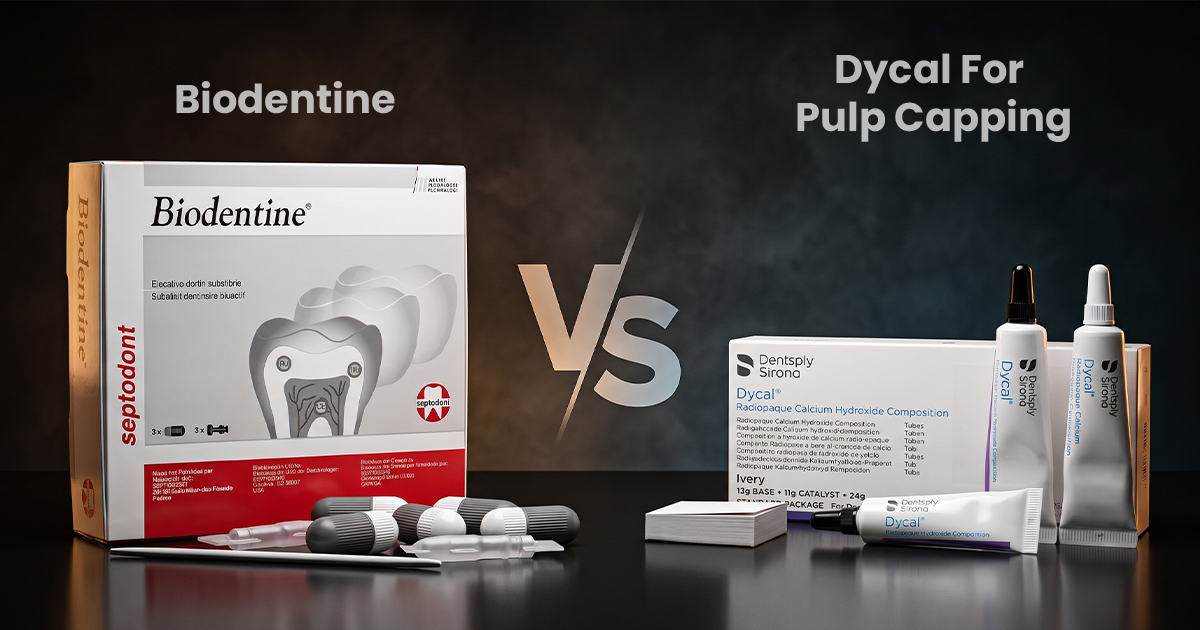
Biodentine vs. Dycal For Pulp Capping
A Case Selection Guide
The choice between Biodentine and Dycal as pulp capping materials hinges on bioactivity and seal quality; Biodentine provides a superior bioactive seal for complex cases, while Dycal offers a rapid, predictable set for simpler exposures. This ensures predictable success in preserving pulp vitality.
Table of Contents
Key Material Differences: Biodentine vs. Dycal
The primary difference lies in their composition and mechanism: Biodentine is a tricalcium silicate-based bioceramic that actively stimulates tertiary dentin formation, whereas Dycal is a traditional calcium hydroxide liner that relies on its high pH for antibacterial effects and passive stimulation.
Biodentine's tricalcium silicate composition hydrates to form a crystalline structure that chemically bonds to dentin, creating a tight seal and releasing calcium hydroxide to promote a high-quality dentin bridge. Dycal, a two-paste system, sets via a chelation reaction, providing a high pH of approximately 11-12 which is bacteriostatic but offers lower compressive strength and can degrade over time, compromising the long-term seal. This makes it less suitable under restorations subject to high occlusal forces.
- Sealing Ability: Biodentine creates a gap-free, mineral-infiltrated zone, minimizing microleakage. Dycal is prone to dissolution and marginal breakdown over months.
- Compressive Strength: Biodentine reaches ~300 MPa, comparable to dentin, allowing its use as a temporary restoration. Dycal's strength is significantly lower, typically under 20 MPa.
- Bioactivity: Biodentine actively releases calcium ions and promotes apatite formation, leading to a more organized and thicker dentin bridge.
- Setting Time: Dycal sets rapidly in 2-3 minutes. Biodentine requires an initial set of 10-12 minutes before the final restoration can be placed.
| Property | Biodentine (Septodont) | Dycal (Dentsply Sirona) |
|---|---|---|
| Composition | Tricalcium Silicate | Calcium Hydroxide |
| Sealing Ability | High (Mineral Infiltration) best | Low (Prone to Dissolution) |
| Compressive Strength | ~300 MPa | < 20 MPa |
| Bioactivity | High (Active Ion Release) | Moderate (High pH Stimulation) |
| Setting Time | 10-12 minutes (initial) | 2-3 minutes value |
| Bonding to Dentin | Micromechanical & Chemical | Mechanical Retention Only |
Ideal Cases for Biodentine Pulp Capping
Biodentine is the material of choice for direct pulp capping in cases with large mechanical or carious exposures (>1.5 mm) in vital, asymptomatic teeth, where a superior long-term seal and robust dentin bridge formation are critical.
Its high compressive strength and excellent sealing ability make it ideal for situations where the final restoration might be delayed or where the overlying restorative material could exert significant stress. The bioactive properties provide a more predictable healing response for larger exposures, minimizing the risk of post-operative sensitivity and pulp necrosis. A well-stocked inventory of endodontic products is crucial for managing these demanding vital pulp therapy procedures.
- Large Pulp Exposures: For exposures >1.5 mm in diameter, Biodentine's biological response and seal are superior to traditional liners.
- Deep Carious Lesions: When a carious exposure is encountered during excavation in a tooth with no history of spontaneous or lingering pain.
- Traumatic Exposures: In young, permanent teeth with open apices where preserving vitality is paramount for continued root development (apexogenesis).
- Dentin Replacement: Use as a base to replace significant amounts of lost dentin structure under a final composite or crown restoration.
Biodentine Suitability Checklist
The tooth must respond normally to pulp testing with no history of spontaneous, lingering pain.
Bleeding from the exposure site must be controlled within 5 minutes using sterile saline or sodium hypochlorite.
The tooth must be restorable with a definitive restoration that provides a complete coronal seal.
Indicated when the exposure is not a pinpoint mechanical event but a more significant breach of the pulp chamber.
When to Still Prefer Dycal for Pulp Capping
Dycal remains a practical choice for small, iatrogenic (mechanical) pinpoint exposures in otherwise healthy teeth where speed and simplicity are prioritized over long-term structural support.
Its rapid 2-3 minute setting time is highly advantageous in a busy practice, especially for minor exposures encountered during routine cavity preparation. When the exposure is minimal (<0.5 mm) and bleeding is easily controlled, Dycal's high pH is sufficient to provide an antibacterial barrier and stimulate a localized repair response without the longer setting time and higher cost of Biodentine. A failure of pulp capping may necessitate endodontic therapy using instruments like rotary files and endomotors.
- Pinpoint Mechanical Exposures: Accidental exposures <0.5 mm during cavity preparation in an asymptomatic tooth.
- Indirect Pulp Capping: As a liner over a thin layer of remaining sound dentin when you are close to the pulp but not exposed.
- Time-Sensitive Procedures: In a high-volume setting where the 12-minute initial set of Biodentine would significantly disrupt workflow.
- Cost-Constrained Cases: When budget is a primary consideration and the clinical indication is for a simple, low-risk exposure under a stable restoration.
Dycal
- Very fast set time (2-3 mins)
- Simple two-paste application
- Lower material cost per application
- Prone to dissolution over time
- Low compressive strength
- Weaker long-term seal
Biodentine
- Superior biological seal
- High compressive strength
- Promotes quality dentin bridge
- Can be used as a dentin substitute
- Longer setting time (10-12 mins)
- Higher material cost
How Lesion Depth Influences Material Choice
The depth of the carious lesion directly dictates material selection: shallow to moderate lesions may not require a liner, deep lesions nearing the pulp are ideal for indirect capping with Dycal or a GI liner, and frank carious exposures demand a bioactive material like Biodentine.
For deep lesions where a thin layer of affected or sound dentin remains (e.g., <0.5 mm Remaining Dentin Thickness), the goal is to protect the pulp and promote remineralization. However, once the pulp is exposed by caries, the inflammatory state and bacterial contamination are higher. This scenario requires a material like Biodentine that can create a superior bacterial seal and more predictably stimulate a reparative dentin bridge, reducing the likelihood of failure and the subsequent need for root canal therapy with root canal sealers.
- Indirect Pulp Cap: Remaining dentin is <0.5 mm thick but intact. Dycal or Glass Ionomer is indicated.
- Small Carious Exposure (<1.5 mm): The pulp is breached during caries removal. Biodentine is strongly recommended due to its superior sealing ability and bioactivity.
- Large Carious Exposure (>1.5 mm): Significant pulp exposure. Biodentine is the gold standard; endodontic therapy is a likely alternative if symptoms are present.
- Reversible Pulpitis: The diagnosis must confirm reversible pulpitis. If signs of irreversible pulpitis (spontaneous pain, lingering pain to cold) exist, pulp capping is contraindicated.
Decision Matrix: Lesion Depth vs. Pulp Capping Material
Conclusion: Case Selection is Key
The most critical factor in successful pulp capping is not just the material, but meticulous case selection and diagnosis. Biodentine should be your go-to material for all carious exposures and large mechanical exposures due to its superior seal and bioactivity. Reserve Dycal for very specific, low-risk scenarios like pinpoint mechanical exposures where speed is the overriding factor. Ultimately, a correct diagnosis of pulp vitality determines the outcome more than any material property.
- Biodentine Indication: Use for any carious pulp exposure or mechanical exposures larger than 1.5 mm in asymptomatic, vital teeth.
- Dycal Indication: Reserve for pinpoint (<0.5 mm) mechanical exposures where a fast 2-3 minute set is clinically necessary and the tooth is under low occlusal load.
- Diagnosis First: Never perform pulp capping on a tooth with a history of spontaneous pain or signs of irreversible pulpitis; this is a contraindication for both materials.
- Seal is Paramount: A well-sealed, permanent overlying restoration is non-negotiable for the long-term success of any pulp capping procedure.
Frequently Asked Questions
The main advantage is its superior sealing ability and higher bioactivity. Biodentine forms a chemical bond with dentin and creates a mineral-infiltrated zone, preventing microleakage. It also promotes the formation of a thicker, more organized reparative dentin bridge compared to the passive stimulation provided by calcium hydroxide's high pH.
Biodentine's 10-12 minute initial setting time is due to its hydraulic setting reaction, necessary for forming a stable crystalline structure. To manage this chairside, you can place a moistened cotton pellet over the Biodentine and place a temporary restoration, scheduling a second visit for the final restoration. Alternatively, many clinicians place the final bonded restoration in the same visit after the initial set is complete.
Yes, Dycal is a commonly used and suitable material for indirect pulp capping. In these cases, it is placed over a thin layer of remaining dentin to protect the pulp and stimulate tertiary dentin formation. Its established history, antibacterial properties, and ease of use make it a practical choice for this specific indication, often placed under a stronger base material.
The most common reason for failure is incorrect case selection, specifically applying pulp capping materials to a tooth with undiagnosed irreversible pulpitis. The second most common cause is a poor coronal seal. If the overlying restoration fails and allows bacterial leakage, the pulp cap will invariably fail, regardless of whether you used Dycal or Biodentine.
Pulp capping materials are dental biomaterials placed directly on an exposed pulp (direct pulp capping) or on a thin layer of dentin close to the pulp (indirect pulp capping). Their purpose is to protect the pulp, stimulate a reparative dentin bridge, and maintain vitality, avoiding the need for root canal treatment which requires materials like gutta percha points and specialized obturation systems.
Written by
Dr. Bhavishya Arora
BDS, MDSChief Dental Editor
A contributing clinician at Dentalkart Blogs, Dr. Bhavishya is a compassionate, detail-driven dentist known for thoughtful patient care, clear communication, and a calm chair-side manner that puts patients at ease. Beyond the clinic, she leads product content and category initiatives at Dentalkart India's largest dental marketplace where she bridges clinical understanding with commercial insight to help dentists make better-informed product choices.
Keep reading
Browse all →Navigating Gates-Glidden Drill Sizes
Navigating Gates-Glidden Drill SizesA Clinical Selection Guide Gates-Glidden (GG) drills are latch-type, side-cutting rotary instruments for shaping the coronal
Gauging Canal Status with Absorbent Paper Points
Gauging Canal Status with Absorbent Paper PointsA Clinical Selection Guide Using absorbent paper points for diagnosis provides critical, real-time feedback on c

Ideal Cases for Intraligamentary Anaesthesia
Ideal Cases for Intraligamentary AnaesthesiaAn Evidence-Based Guide Intraligamentary anaesthesia is a supplemental injection technique that forces a local anaes
