
Dr. Bhavishya Arora
Chief Dental Editor
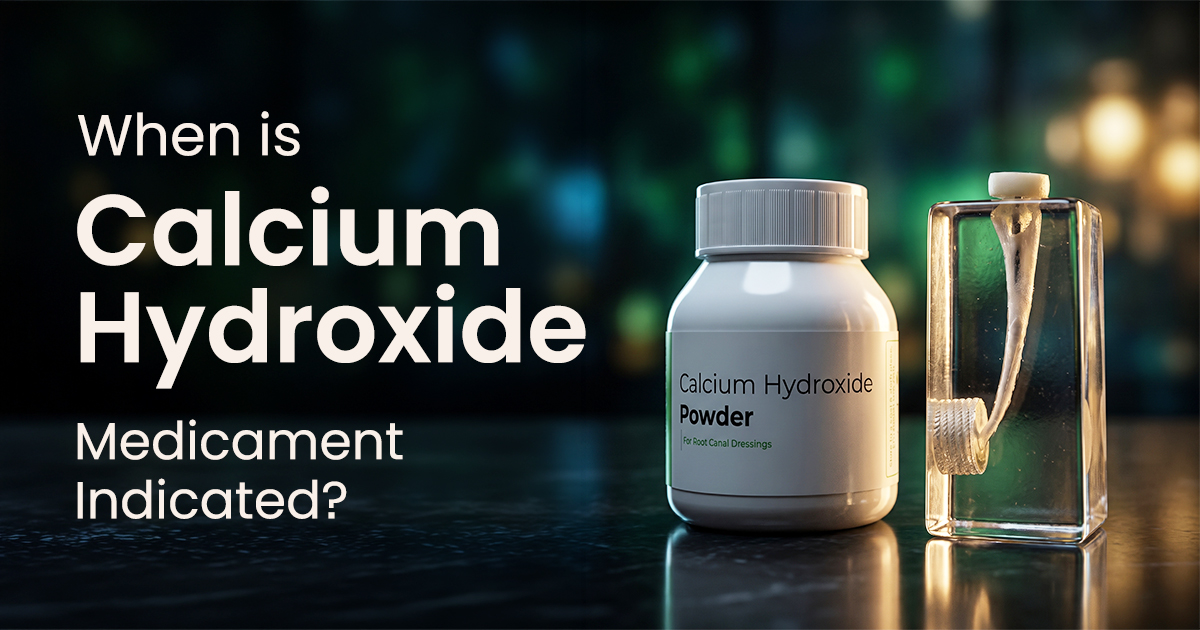
When is Calcium Hydroxide Medicament Indicated?
A Clinical Case Selection Guide.
Calcium hydroxide paste is indicated as an intracanal medicament for infected necrotic canals, apexification, and managing inflammatory resorption due to its high pH and antibacterial action. Precise case selection is crucial for leveraging these properties while avoiding its biological limitations for predictable outcomes.
Table of Contents
Primary Clinical Indications for Ca(OH)2
Calcium hydroxide is primarily indicated in cases of pulpal necrosis with apical periodontitis, for apexification in immature permanent teeth, and to control inflammatory root resorption. Its efficacy stems from its high pH of approximately 12.5, which denatures bacterial proteins and lipopolysaccharides (LPS), creating an environment hostile to microbial survival and conducive to periapical healing.
This alkaline environment also stimulates hard tissue repair by activating tissue enzymes like alkaline phosphatase, a key factor in its success for apexification and perforation repair. For practising Indian dentists, its long shelf-life and cost-effectiveness make it a go-to material for multi-visit endodontic products protocols.
- Necrotic Pulps with Apical Periodontitis: Used between appointments to disinfect the root canal system and reduce bacterial load before obturation.
- Apexification: Induces the formation of a hard tissue apical barrier in non-vital immature teeth, typically over several months.
- Weeping Canals: Its hygroscopic nature helps to dry persistently wet canals (suppuration/exudate) that would otherwise compromise the seal of the final obturation.
- Root Resorption: Arrests inflammatory external and internal resorption by eliminating bacteria and neutralizing the acidic environment favoured by clastic cells.
Indication Decision Guide
Avoid Calcium Hydroxide in These Cases
Calcium hydroxide is contraindicated for routine vital pulp capping and in single-visit endodontics where thorough disinfection can be achieved chemo-mechanically. Its highly caustic nature causes superficial liquefaction necrosis on contact with vital tissue, making it less suitable than biocompatible materials like MTA or bioceramics for preserving pulp vitality.
Furthermore, its effectiveness against specific resilient microorganisms, such as Enterococcus faecalis, which is commonly found in failed root canal treatments, is limited. In such retreatment cases, an alternative or adjunctive disinfectant may be required for predictable success. The choice of modern root canal sealers with antibacterial properties can also influence the need for an inter-appointment medicament.
- Vital Pulp Capping: Bioceramics (MTA, Biodentine) provide a better seal and promote higher quality dentin bridge formation without causing extensive necrosis.
- Routine Single-Visit Cases: Not necessary if the canal can be adequately debrided and dried in one appointment.
- Known E. faecalis Infections: Ca(OH)2 is less effective; consider 2% chlorhexidine (CHX) as a supplementary irrigant or medicament.
- Severe Anatomic Complexities: In cases with fins, webs, or C-shaped canals, Ca(OH)2 may not penetrate effectively; activated irrigation is more critical.
Risk of Dentin Fracture
Leaving calcium hydroxide in the canal for more than 30 days for routine disinfection can significantly weaken the root. The high pH degrades the organic collagen matrix of dentin, making the tooth more susceptible to cervical root fracture over the long term.
How Long Should Ca(OH)2 Remain in the Canal?
The optimal duration for calcium hydroxide medicament is 7 to 14 days for routine disinfection of necrotic canals, while apexification protocols require placement for 3 to 6 months. The antibacterial effect is not immediate; it relies on the sustained release of hydroxyl ions to raise the environmental pH, a process that takes several days to reach maximum efficacy within the dentinal tubules.
While a minimum of 7 days is needed for its antimicrobial action, extending the duration beyond 4 weeks in standard cases offers no additional benefit and increases the risk of dentinal weakening. After medicament removal, the canal is ready for final shaping with rotary files and obturation with gutta percha points.
- Routine Disinfection: A 7-day period is sufficient to eliminate most common endodontic pathogens.
- Persistent Infection/Exudation: A 14-day application may be necessary to resolve stubborn symptoms.
- Apexification: Requires 3-6 months, with the paste being replaced every 1-3 months to maintain its potency.
- Inflammatory Resorption: An initial placement of 4 weeks is typically required to arrest resorptive cell activity.
1-2 Weeks: Standard Disinfection
Ideal for most necrotic cases to eliminate bacteria and neutralize endotoxins before obturation.
4-6 Weeks: Resorption Control
Required to effectively alter the acidic environment and arrest osteoclastic/dentinoclastic activity.
3+ Months: Apexification
Long-term application needed to stimulate apical barrier formation in immature, non-vital teeth.
Vehicle Selection: Paste vs. Aqueous Solution
The choice of vehicle—aqueous (like saline) or viscous (like glycerin)—directly impacts the rate of ionic dissociation and therefore dictates the clinical application. The vehicle determines the paste's flow, handling characteristics, and how quickly it exerts its biological effect within the root canal system prepared by an endo motor.
Aqueous vehicles allow for rapid dissociation, leading to a fast but short-lived antimicrobial action. In contrast, viscous vehicles slow down the release of hydroxyl ions, providing a sustained effect suitable for long-term treatments. Most pre-mixed commercial pastes available in India use a viscous vehicle for ease of use and suitability for a broader range of cases, including those requiring longer medication periods before using obturation systems.
- Aqueous Vehicles (e.g., Saline, Anesthetic Solution): Provide rapid ion release. Best for short-term use (1-2 weeks) in standard disinfection cases.
- Viscous Vehicles (e.g., Glycerin, Propylene Glycol): Ensure slow, sustained ion release. Indicated for long-term applications like apexification or resorption.
- Premixed Syringes: Offer convenience and controlled placement but are less customizable than chairside mixing.
- Chairside Mixing: Allows the clinician to control consistency, but achieving a homogenous, void-free mix is technique-sensitive.
Aqueous Vehicle
- Rapid ion dissociation for faster effect.
- Easier to remove from the canal during the next visit.
- Shorter duration of action; not ideal for long-term cases.
- Can be difficult to pack densely into the apex.
Viscous Vehicle
- Sustained ion release for long-term efficacy.
- Better flow and handling for dense packing.
- Ideal for apexification and resorption cases.
- More difficult to completely remove from the canal.
Frequently Asked Questions
The primary antibacterial mechanism of calcium hydroxide paste is its high pH of approximately 12.5. This extremely alkaline environment destroys bacterial cell membranes, denatures essential metabolic enzymes, and damages their DNA. This action is broad-spectrum but non-specific, effectively killing most endodontic pathogens and neutralizing their toxic byproducts like lipopolysaccharides (LPS).
Failure often stems from incomplete chemo-mechanical debridement, allowing bacteria to persist in canal isthmuses, fins, or deep within dentinal tubules. The infection may also be dominated by resistant species like *E. faecalis*. Ensure the canal is enlarged to at least an ISO size 35-40 for adequate irrigation and consider using an adjunct disinfectant like chlorhexidine if Ca(OH)2 is ineffective after two weeks.
To achieve a dense, void-free fill, inject a premixed paste with a fine-gauge tip 2-3 mm short of the working length. Then, use a hand file or plugger in a counter-clockwise spinning motion to gently work the paste apically. Alternatively, a lentulo spiral filler on a slow-speed handpiece, also used in reverse (counter-clockwise), effectively carries the paste towards the apex while minimizing air entrapment and extrusion.
Calcium hydroxide is a single-agent medicament that relies on high pH for a broad-spectrum, non-specific antibacterial effect. In contrast, a triple antibiotic paste (TAP) combines three specific antibiotics (e.g., metronidazole, ciprofloxacin, minocycline) for targeted bacterial elimination. TAP is generally reserved for regenerative endodontic procedures or highly resistant infections, whereas Ca(OH)2 is a standard for routine inter-appointment disinfection.
For apexification, the calcium hydroxide dressing should be changed every 1 to 3 months. This is necessary because the medicament's ionic activity diminishes as it is slowly dissolved by tissue fluids and its components are used in the hard tissue formation process. Regular replacement ensures a sustained high pH at the apex to stimulate continuous apical barrier formation and maintain a disinfected canal.
Written by
Dr. Bhavishya Arora
BDS, MDSChief Dental Editor
A contributing clinician at Dentalkart Blogs, Dr. Bhavishya is a compassionate, detail-driven dentist known for thoughtful patient care, clear communication, and a calm chair-side manner that puts patients at ease. Beyond the clinic, she leads product content and category initiatives at Dentalkart India's largest dental marketplace where she bridges clinical understanding with commercial insight to help dentists make better-informed product choices.
Keep reading
Browse all →Navigating Gates-Glidden Drill Sizes
Navigating Gates-Glidden Drill SizesA Clinical Selection Guide Gates-Glidden (GG) drills are latch-type, side-cutting rotary instruments for shaping the coronal
Gauging Canal Status with Absorbent Paper Points
Gauging Canal Status with Absorbent Paper PointsA Clinical Selection Guide Using absorbent paper points for diagnosis provides critical, real-time feedback on c

Ideal Cases for Intraligamentary Anaesthesia
Ideal Cases for Intraligamentary AnaesthesiaAn Evidence-Based Guide Intraligamentary anaesthesia is a supplemental injection technique that forces a local anaes
