
Dr. Yashasvi Sharma
Contributing Dental Clinician
Choosing Self-Ligating Brackets: A Clinical Guide
Active vs. Passive Systems
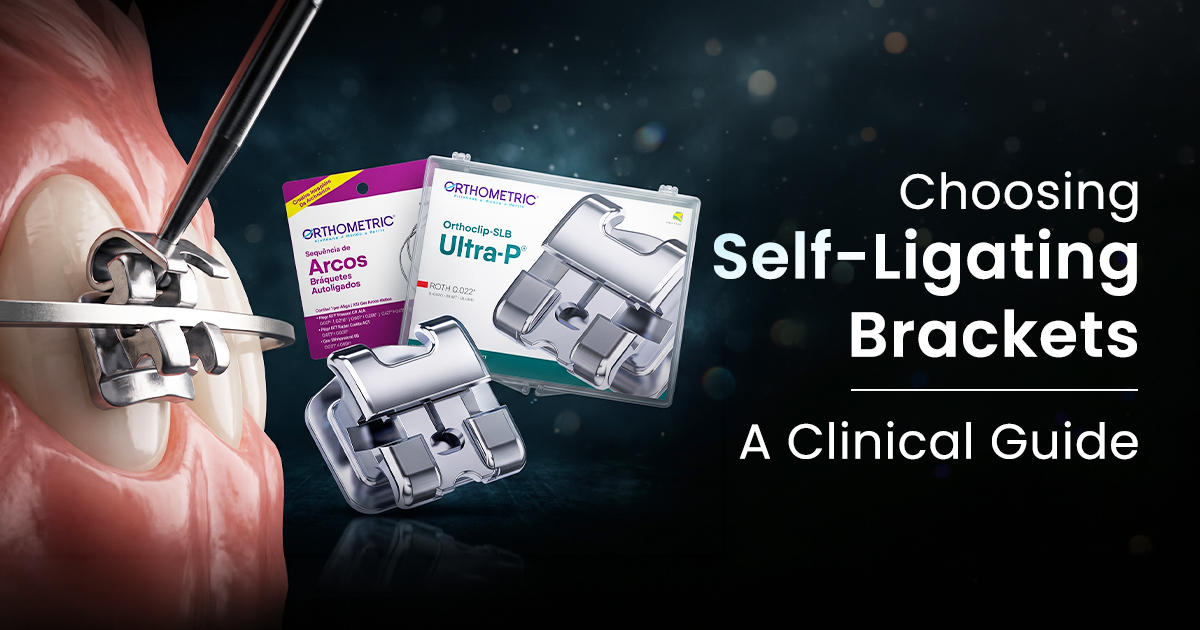
Self-ligating brackets are orthodontic appliances that use a built-in clip or door to secure the archwire, eliminating the need for elastomeric or steel ligatures. This design reduces friction and can improve treatment efficiency, making the choice between systems critical for clinical outcomes.
Table of Contents
Active vs. Passive Self-Ligating Brackets
The primary clinical difference between active and passive self-ligating brackets lies in how they engage the archwire. Passive brackets feature a simple slide or door mechanism that allows the wire to move freely, while active brackets have a flexible clip that presses against the wire to exert positive force.
Passive systems excel in initial leveling and aligning stages due to minimal friction, allowing for lighter forces and faster tooth movement. Active systems provide greater rotational and torque control in later treatment stages as the clip actively seats larger rectangular wires into the slot base. This active engagement becomes clinically significant with wires larger than 0.019' x 0.025' in a 0.022' slot.
- Friction Mechanics: Passive systems offer lower static and kinetic friction, which is ideal for sliding mechanics and en-masse space closure.
- Three-Dimensional Control: Active systems deliver superior control for finishing and detailing, ensuring precise torque expression.
- Force Levels: Passive brackets are designed for low-force, low-friction philosophies, often utilizing heat-activated NiTi archwires.
- Clinical Application: Use passive systems for initial alignment and active systems for mid-to-late treatment when torque and rotational control are paramount.
| Feature | Passive Systems | Active Systems |
|---|---|---|
| Mechanism | Tube-like slide or simple door | Flexible spring clip |
| Friction | Very Low | Higher (in later stages) |
| Wire Control | Lower (free movement) | Higher (active seating) best |
| Ideal Stage | Initial leveling & aligning | Mid-to-late treatment |
| Primary Advantage | Sliding mechanics | Torque & rotation control |
How Slot Size Affects Bracket Selection
The choice between a 0.018' and 0.022' slot in self-ligating brackets dictates the entire mechanical approach, influencing friction, torque control, and archwire selection. The 0.022' slot is more common in India for its versatility, while the 0.018' slot offers greater control with smaller dimension wires.
A 0.022' slot provides more play with initial round wires, creating a lower-friction environment for alignment. However, achieving full torque expression requires larger dimension rectangular wires, which can increase force levels. Conversely, the 0.018' slot engages wires earlier and provides effective torque with smaller, more flexible wires like a 0.017' x 0.025' steel wire, but may exhibit higher friction during sliding mechanics.
- 0.022' Slot: Offers lower friction with initial wires and is better for sliding mechanics, but requires larger finishing wires for full torque expression.
- 0.018' Slot: Provides tighter control and earlier torque with smaller wires, but can bind more during space closure.
- Force Levels: The 0.018' system generally uses lighter forces due to the smaller, more flexible wires required for full engagement.
- Inventory Management: The 0.022' slot is compatible with a wider range of orthodontic wires, simplifying inventory for many clinics.
Choosing Between 0.018" and 0.022" Slots
Optimal Archwire Sequences for Self-Ligating Systems
Optimal archwire sequences for self-ligating systems leverage their low-friction properties by starting with light, round, superelastic NiTi wires and progressing gradually to larger dimension rectangular wires. A typical sequence differs from conventional systems by often skipping intermediate wire sizes to maximize efficiency.
The low-friction environment allows for full expression of light forces from heat-activated NiTi wires, promoting rapid initial alignment. A common sequence for a 0.022' slot might be 0.014' NiTi, followed by 0.018' NiTi, then progressing to a 0.014' x 0.025' or 0.016' x 0.025' NiTi. The final working archwire for torque expression is often a 0.019' x 0.025' stainless steel or TMA wire.
- Phase 1 (Alignment): Start with 0.013' or 0.014' round, heat-activated NiTi wires to maximize sliding with minimal force.
- Phase 2 (Leveling/Control): Progress to larger round (e.g., 0.018' NiTi) or small rectangular NiTi wires (e.g., 0.014' x 0.025').
- Phase 3 (Finishing): Use full-sized rectangular wires (e.g., 0.019' x 0.025' SS or TMA in a 0.022' slot) for final torque and root positioning.
- Appointment Intervals: Allow 8-10 weeks between archwire changes in the initial stages to permit full expression of the wire's properties.
Stage 1: Initial Leveling & Alignment (Months 1-4)
Use light, round, heat-activated NiTi wires (e.g., 0.014"). The goal is low-friction alignment and initial rotation correction.
Stage 2: Arch Form Development (Months 4-10)
Transition to larger round or small rectangular NiTi wires (e.g., 0.018" or 0.016"x0.022"). Begin consolidating spaces and establishing arch form.
Stage 3: Finishing & Detailing (Months 10+)
Introduce full-size rectangular wires (e.g., 0.019"x0.025" SS) for precise torque expression, root paralleling, and final detailing.
Managing Bracket Bonding and Debonding Challenges
The primary challenges in bonding self-ligating brackets are preventing adhesive from flowing into the clip mechanism and achieving a strong bond on their complex base designs. Proper isolation and meticulous flash removal are critical to prevent the gate from becoming permanently sealed.
The intricate sliding or clip mechanism is susceptible to being clogged by excess bonding composite. Using a paste composite with good body is preferable to a flowable one. During flash removal, use a fine-tipped explorer to clean around the entire periphery of the bracket base, especially near the gate opening, before light curing. Many modern orthodontic brackets feature micro-etched bases to improve bond strength, but this does not replace the need for a pristine, dry enamel surface.
- Adhesive Selection: Use a paste composite with sufficient viscosity to minimize slumping and flow into the mechanism.
- Flash Removal: Meticulously clear all excess adhesive from around the bracket base, paying special attention to the slot and gate area, prior to curing.
- Debonding Tools: Utilize manufacturer-specific debonding pliers; these tools engage the bracket body to safely fracture the bond at the adhesive-bracket interface.
- Mechanism Check: Always confirm that the gate opens and closes smoothly immediately after bonding and flash removal.
Critical Error: Adhesive in the Mechanism
Excess bonding composite flowing into the bracket's gate or slide will permanently lock it. This renders the self-ligating feature useless, forcing you to treat it as a conventional bracket or replace it entirely. Double-check the mechanism is clear *before* light curing.
Frequently Asked Questions
The main advantage is significantly reduced friction, as they use a gate mechanism instead of elastic ligatures to hold the archwire. This allows for the use of lighter, more biologically-compatible forces, which can lead to more efficient tooth movement, especially in the initial alignment stages, and potentially fewer and shorter appointments for the patient.
The choice depends on aesthetics versus durability. Ceramic self-ligating brackets offer superior aesthetics but can be more brittle and may cause enamel wear on opposing teeth. Metal brackets are more robust and cost-effective, with well-understood mechanics. For patients with high aesthetic demands, ceramic is ideal, while metal remains the workhorse for most cases.
Gate failure is uncommon with proper clinical handling. The most frequent cause is iatrogenic, from applying incorrect force with the wrong instrument, or from the patient consuming very hard foods. With correct technique and patient instruction, the mechanism failure rate is very low, typically less than 2-3% over the course of treatment.
For deep bite cases requiring significant torque control for incisor intrusion and proclination, active self-ligating brackets are often preferred. The active clip provides better engagement of rectangular archwires, delivering the consistent torque needed to effectively level the curve of Spee. Passive systems can also be used but may require auxiliary techniques to achieve comparable torque expression.
If a gate is stuck, first inspect it under magnification for debris or excess bonding composite. Attempt to gently clean the area with a fine-tipped probe. Do not apply excessive force, as this can break the clip. If it remains stuck due to bonding agent, the bracket must be replaced. If it's a mechanical jam, using the manufacturer-specific opening tool at the correct angle is crucial.
Written by
Dr. Yashasvi Sharma
Contributing Dental Clinician
Dr. Yashasvi Sharma is a contributing Dental professional at Dentalkart Blogs, where she distills chair-side clinical experience into evidence-based, practice-ready guides for Indian dentists. Her work bridges the gap between academic dentistry and everyday practice, translating global research into actionable insights tailored to the realities of Indian clinical settings.
Keep reading
Browse all →
Fabricating a Direct Bonded Lingual Retainer
Fabricating a Direct Bonded Lingual RetainerA Chairside Clinical Protocol A fixed lingual retainer is a passive, multi-stranded wire bonded to anterior teeth's

Elastomeric Chains vs. NiTi Coil Springs: A Clinical Guide
Elastomeric Chains vs. NiTi Coil Springs: A Clinical GuideSpace Closure Selection An elastomeric power chain delivers a high initial force that decays rapidly,

Rapid Palatal Expansion Case Selection Criteria
Rapid Palatal Expansion Case Selection CriteriaAn Orthodontic Clinical Guide A rapid palatal expander (RPE) is indicated for skeletal maxillary transverse defic