
Dr.Prerna
Dental Content Contributor
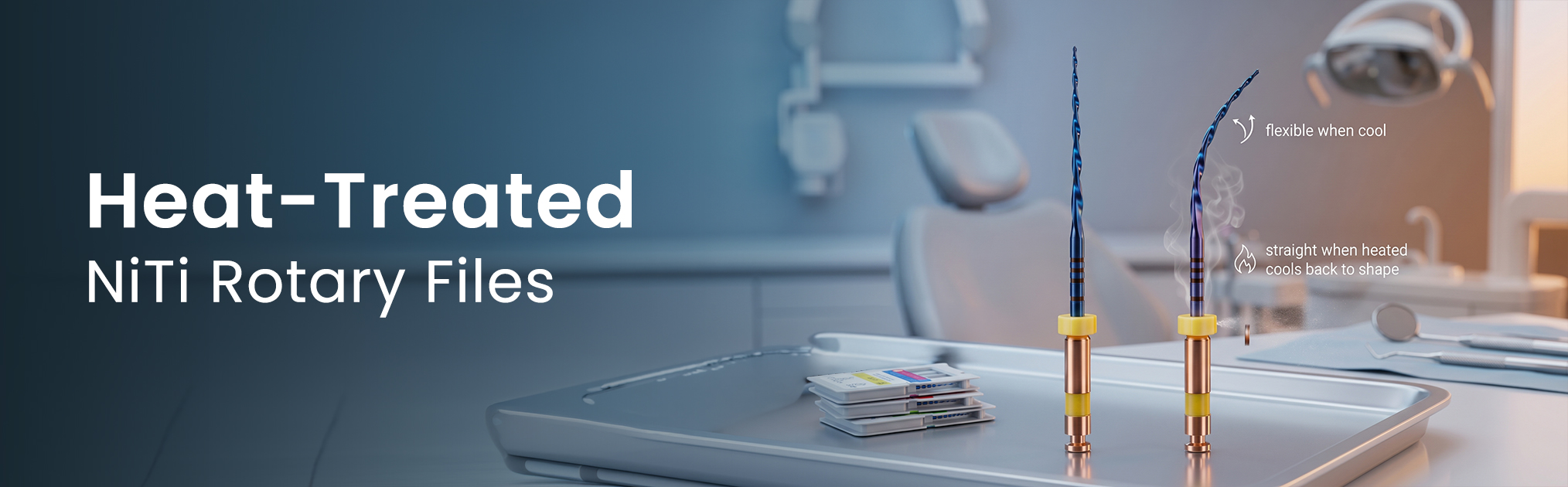
Heat-Treated NiTi Rotary Files
A Modern Alloy and Phase Guide
Heat-treated NiTi files are endodontic rotary instruments thermomechanically processed to enhance flexibility and cyclic fatigue resistance by controlling the alloy's crystalline phase structure. This advanced metallurgy allows for safer negotiation of curved and complex canals, reducing instrument separation.
Table of Contents
Understanding NiTi Alloy Crystalline Phases
NiTi alloy primarily exists in two crystalline phases: Austenite (stable, high-temperature) and Martensite (malleable, low-temperature). This phase transition imparts superelasticity and shape memory. Conventional files are predominantly austenitic at body temperature (~37°C), offering strength but limited flexibility. Heat treatment modulates the Austenite-finish (Af) temperature, increasing the martensitic content, thereby enhancing file flexibility at intra-canal temperatures.
- Austenite: A hard, stable parent phase with a body-centered cubic structure. It provides cutting efficiency but is more rigid.
- Martensite: A softer, more ductile, 'twinned' monoclinic structure. It is easily deformed and highly flexible, reducing stress on the canal wall.
- R-phase (Rhombohedral): An intermediate phase between Austenite and Martensite, exhibiting low stiffness and excellent fatigue resistance. Some advanced rotary files are engineered to remain in or near this phase.
- Stress-Induced Martensite (SIM): When an austenitic file is stressed within a canal, it can transform to martensite, absorbing energy that would otherwise fracture the file.
NITI CRYSTALLINE PHASE TRANSFORMATION
Rigid, stable structure at higher temperatures, providing strong cutting efficiency.
A transitional phase that offers improved flexibility and fatigue resistance.
Flexible, deformable structure at lower temperatures, ideal for curved canals.
Impact of Heat Treatment on NiTi Files
Heat treatment modifies the NiTi alloy's Austenite-finish (Af) temperature, enhancing file flexibility, cyclic fatigue resistance, and controlled shape memory. Specific heating and cooling cycles, applied before or after grinding, produce a file with higher martensitic content at body temperature. This metallurgical change makes the instrument less stiff and significantly more resistant to torsional and cyclic fatigue, with some treatments increasing fatigue life up to five times compared to conventional NiTi. This allows clinicians to pre-bend files and negotiate severe curvatures with greater confidence using their endomotors.
- Increased Flexibility: Martensitic files can be pre-curved, aiding in accessing difficult canals without bouncing off ledges.
- Enhanced Fatigue Resistance: The softer martensitic phase absorbs more stress before fracture, allowing for more rotations in a curved canal.
- Controlled Shape Memory: Some heat treatments eliminate shape memory, preventing the file from straightening out and transporting the canal apex.
- Visible Color Change: The treatment creates a surface titanium oxide layer, giving files their gold or blue color, which indicates the underlying metallurgical change.
Conventional NiTi
- High cutting efficiency
- Retains shape well
- Low flexibility in curves
- Higher risk of cyclic fatigue failure
Heat-Treated NiTi
- Superior flexibility
- High cyclic fatigue resistance
- Can be pre-curved
- Lower cutting efficiency (softer alloy)
Gold-Wire vs. Blue-Wire NiTi Files
Gold-wire and Blue-wire files primarily differ in their thermomechanical processing, leading to distinct flexibility, shape memory, and cutting efficiency. Gold-wire files are heat-treated and slow-cooled, creating a flexible, predominantly martensitic alloy with some shape memory. Blue-wire files undergo a proprietary process, yielding an even softer, more ductile file with virtually no shape memory, making them extremely flexible and fatigue-resistant but often less aggressive in cutting dentin.
- Gold-Wire: Balances flexibility and strength, more flexible than conventional NiTi but less than Blue-wire.
- Blue-Wire: Maximizes flexibility and fatigue resistance from its softer martensitic structure, ideal for extremely curved canals.
- Shape Memory: Gold files exhibit some rebound; Blue files offer controlled memory, holding a pre-bent shape.
- Cutting Efficiency: Gold files have moderate efficiency; softer Blue files generally exhibit lower cutting ability.
| Property | Gold-Wire Files | Blue-Wire Files |
|---|---|---|
| Flexibility | High | Very High best |
| Cyclic Fatigue Resistance | High | Very High |
| Shape Memory | Reduced | Controlled (Minimal) value |
| Cutting Efficiency | Moderate value | Lower |
| Primary Use Case | Moderately to severely curved canals | Extremely curved, S-shaped, or narrow canals |
Best NiTi Files for Calcified Canals
For calcified canals, a combined approach is often best, utilizing stiff conventional NiTi or stainless steel files for initial penetration, followed by highly flexible heat-treated files for negotiation. Calcified canals pose a dual challenge: initial penetration needs a stiff instrument to avoid buckling, while negotiating the curved apical third requires flexibility to prevent ledging or perforation. Once a glide path is established, flexible Gold or Blue-wire files are ideal to safely navigate the remaining canal length.
- Initial Entry: Use a small-sized (#10) stainless steel K-file to create the initial path into the calcified orifice.
- Glide Path Management: After initial entry, a dedicated pathfinder file (e.g., .02 taper, heat-treated NiTi) secures the path to the apex.
- Shaping: Utilize controlled-memory heat-treated NiTi files (Gold or Blue) to shape the canal, following the established path safely.
File Selection Guide for Calcified Canals
Frequently Asked Questions
Controlled memory in NiTi files refers to the thermomechanical property where a file can be pre-bent to a desired shape and will retain it at clinical temperatures. This is achieved through specific heat treatments that stabilize the martensitic phase. Unlike traditional superelastic files that spring back, controlled memory instruments allow for easier access into offset canals and reduce the risk of ledging in curved anatomies.
Heat-treated NiTi files are generally superior for managing curved or complex canals due to their enhanced flexibility and cyclic fatigue resistance. While conventional NiTi files offer better cutting efficiency and are suitable for straighter canals, heat-treated variants significantly reduce the risk of instrument separation. The choice depends on the specific canal anatomy being treated, not on one type being universally better.
Heat-treated NiTi files unwind or distort due to torsional stress exceeding the alloy's elastic limit, often caused by excessive apical pressure or binding in a tight canal. Unlike conventional files that might fracture abruptly, the softer heat-treated alloy deforms first, providing a visual warning of metal fatigue. If a file shows any sign of unwinding, it must be discarded immediately to prevent intracanal separation.
Beginners in rotary endodontics should start with a system using heat-treated NiTi files with a non-cutting tip and a simple sequence. Files with controlled memory (like Blue-wire types) are particularly forgiving, as their high flexibility and fatigue resistance minimize the risk of procedural errors like ledging and file separation. A system with fewer files simplifies the learning curve and builds confidence.
Most manufacturers and clinicians recommend single-use for heat-treated NiTi files, especially in complex or calcified canals, to prevent failure. Re-use significantly increases the risk of cyclic fatigue fracture and cross-contamination. While autoclaving is possible, it does not reset the fatigue life of the instrument, making single-patient use the safest protocol for predictable endodontic outcomes and patient safety.
Written by
Dr.Prerna
Dental Content Contributor
Dr.Prerna writes for Dentalkart Blogs on dental equipment, clinical workflows, and the everyday questions practitioners and patients face — translating evidence into practical guidance.
Keep reading
Browse all →MTA vs. Bioceramic Repair Materials — A Clinical Selection Guide
MTA vs. Bioceramic Repair MaterialsA Clinical Selection Guide Modern endodontics requires more than simple obturation. The choice between traditional MTA and ne
Choosing Your Root Canal Sealer — A Modern Material Guide
Choosing Your Root Canal SealerA Modern Material Guide The long-term success of root canal treatment hinges on the final obturation material. This guide explore
Fractured Endodontic Instrument Retrieval — A Practical Clinical Framework
Fractured Endodontic Instrument RetrievalA Practical Clinical Framework A broken file in the root canal system presents a challenging clinical scenario. This gu