
Dr. Yashasvi Sharma
Contributing Dental Clinician
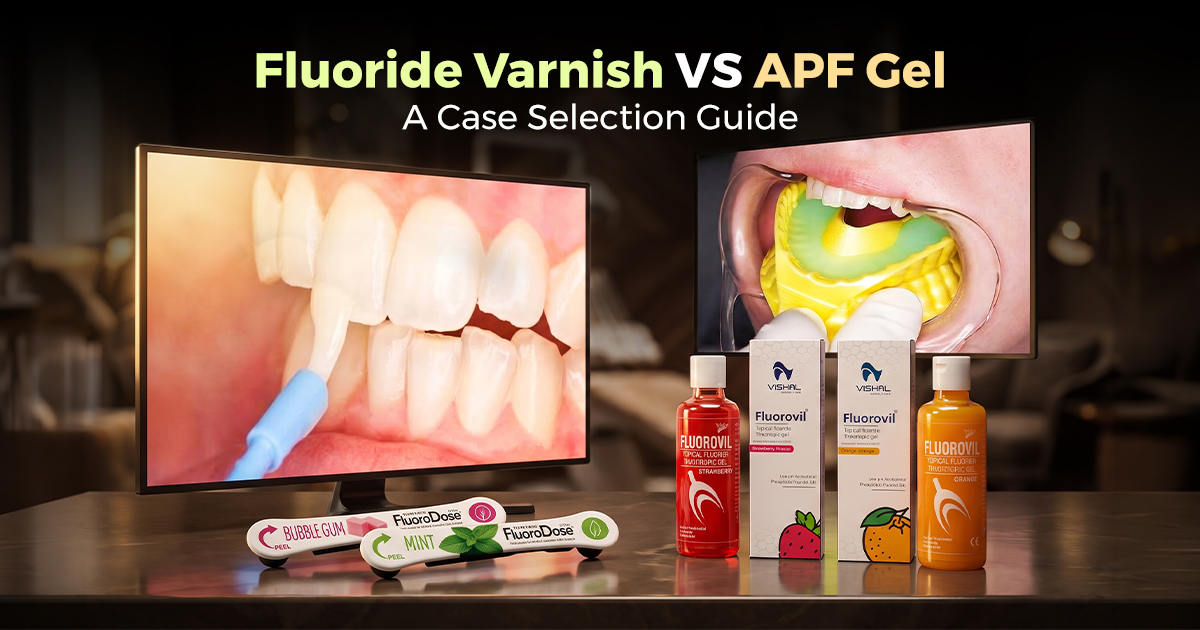
Fluoride Varnish vs. APF Gel: A Case Selection Guide
Choosing the Right Topical Fluoride
Fluoride varnish is the preferred agent for most patients, especially children, due to its prolonged contact time and lower ingestion risk. This guide contrasts its clinical performance with APF gel to refine your case selection for effective topical fluoride application.
Table of Contents
Fluoride Concentration and Mechanism Differences
The primary difference is that fluoride varnish uses a high concentration of sodium fluoride (22,600 ppm) in a resin base for prolonged contact, while APF gel uses a lower concentration of acidulated phosphate fluoride (12,300 ppm) requiring shorter, high-intensity exposure.
Varnish adheres to enamel for several hours, slowly releasing fluoride ions to form a calcium fluoride (CaF₂) reservoir that acts as a long-term source for remineralization. In contrast, APF gel's low pH of 3.5 etches the superficial enamel for about 4 minutes, rapidly forcing fluoride uptake but posing a risk to ceramic and composite restorations. This makes the choice of fluoride varnishes and gels highly dependent on existing dental work and patient age.
- Varnish: Contains 5% Sodium Fluoride (2.26% or 22,600 ppm fluoride ion) in a natural colophony resin base.
- APF Gel: Contains 1.23% Acidulated Phosphate Fluoride (1.23% or 12,300 ppm fluoride ion) in a thixotropic gel.
- Mechanism: Varnish provides slow, sustained fluoride release, whereas APF gel provides rapid, high-dose uptake via a temporary acidic etch.
- Remineralization Product: Both primarily form CaF₂, but varnish's sustained release allows for more stable fluorapatite formation over time.
| Parameter | Fluoride Varnish | APF Gel |
|---|---|---|
| Fluoride Concentration | 22,600 ppm premium | 12,300 ppm |
| pH Level | ~7.0 (Neutral) | 3.5 (Acidic) value |
| Required Contact Time | 4-6 hours (passive) | 4 minutes (active) |
| Risk to Restorations | None | High (etches ceramic/composite) |
| Ingestion Risk | Very Low best | Moderate to High |
Identify Ideal Candidates for Fluoride Varnish
Fluoride varnish is the superior choice for infants, young children, patients with special needs, and those with a pronounced gag reflex due to its rapid application and minimal ingestion risk. It is also the standard of care for high-caries-risk adults, especially for managing root caries and dentin hypersensitivity.
The sticky nature of the varnish ensures it remains on the tooth surface even in the presence of saliva, making it highly effective in uncooperative patients. A small unit-dose application (typically 0.25-0.5 mL) significantly reduces the total amount of fluoride used per treatment compared to APF gel, minimizing systemic toxicity risk from accidental swallowing. It is one of the safest professional fluoride products available.
- Pediatric Patients (<6 years): The gold standard due to safety from ingestion and ease of application.
- High-Caries-Risk Patients: Indicated for both coronal and root caries prevention due to prolonged fluoride release.
- Patients with Gag Reflex: Eliminates the need for bulky trays, improving patient comfort and compliance.
- Special Needs Patients: The quick, paint-on technique is ideal for patients with physical or cognitive limitations.
- Dentin Hypersensitivity: Effectively occludes dentinal tubules, providing immediate and lasting relief.
Varnish Selection Matrix
When is APF Gel the Appropriate Choice?
APF gel remains a viable option for cooperative older children, adolescents, and adults with good salivary control and no acid-sensitive restorations, particularly in high-volume public health or orthodontic settings.
The primary advantage of APF gel is its lower material cost per application and its proven efficacy in patients who can tolerate the 4-minute tray application without issue. It's especially useful for orthodontic patients, as the thixotropic gel can flow around brackets and wires more effectively than a painted-on varnish can be applied in some complex cases. However, its acidic nature is a significant contraindication for patients with composite or ceramic work.
- Cooperative Patients (>6 years): Suitable for teenagers and adults who can follow instructions to avoid swallowing.
- Orthodontic Patients: Gel in a custom or stock tray can provide comprehensive coverage around fixed appliances.
- Budget-Constrained Settings: Generally has a lower cost per application than unit-dose varnishes, making it practical for large-scale programs.
- Critical Contraindication: Do not use on patients with porcelain or composite restorations due to the risk of irreversible surface etching.
APF Gel
- Cost-effective for large-scale community programs.
- Excellent flow characteristics for coverage around orthodontic brackets.
- Long history of clinical effectiveness in cooperative patients.
- High risk of ingestion, contraindicating it for young children.
- Requires a full 4-minute application time with constant monitoring.
- Acidic pH damages the surface of ceramic and composite restorations.
Fluoride Varnish
- Extremely low ingestion risk, making it safe for infants and toddlers.
- Rapid 1-2 minute paint-on application increases clinic efficiency.
- Adheres to the tooth for hours, providing prolonged fluoride release.
- Safe for all restorative materials, including porcelain and composite.
- Higher cost per unit dose compared to bulk APF gel.
- Can leave a temporary yellow tint and sticky feeling on teeth.
Comparing Chairside Application and Comfort
Fluoride varnish application is significantly faster and more comfortable, typically taking only 1-2 minutes with no need for continuous suction. In contrast, APF gel requires a mandatory 4-minute tray placement with active saliva management, which can be challenging for many patients.
The varnish technique involves simply isolating and drying teeth quadrant-by-quadrant and painting on a thin layer, which sets on contact with saliva. Patients can leave immediately with simple post-operative instructions (e.g., avoid hard/hot foods for a few hours). APF gel application is more technique-sensitive, requiring properly sized trays, careful patient positioning to prevent swallowing, and consistent use of a saliva ejector for the full duration.
- Varnish Application Time: 1-2 minutes total.
- APF Gel Application Time: 4 minutes of tray placement, plus setup and cleanup.
- Patient Comfort (Varnish): High; no bulky trays, no unpleasant taste, fast procedure.
- Patient Comfort (APF Gel): Low to moderate; tray can trigger gag reflex, acidic taste, prolonged time with suction.
- Post-Op Instructions (Varnish): Soft diet for 4-6 hours, no brushing until the next morning.
- Post-Op Instructions (APF Gel): Do not eat, drink, or rinse for 30 minutes.
Step 1: Isolate & Dry
Use cotton rolls or gauze to isolate and dry one quadrant at a time. A completely dry surface is not essential, but removing excess saliva improves adhesion.
Step 2: Paint Thin Layer
Dip the provided microbrush into the unit-dose well and apply a thin, even coat to all tooth surfaces. The varnish sets on contact with moisture.
Step 3: Instruct Patient
Advise the patient to avoid hard, sticky, or hot foods for 4-6 hours and to refrain from brushing or flossing until the next morning to maximize contact time.
Frequently Asked Questions
For patients with high caries risk, topical fluoride application is recommended every 3 to 6 months. Fluoride varnish is often preferred for this frequent regimen due to its enhanced safety profile and prolonged therapeutic effect, which helps maintain a protective calcium fluoride layer on the enamel between appointments.
Yes, fluoride varnish is significantly more effective for treating dentin hypersensitivity. Its resin matrix allows it to physically occlude exposed dentinal tubules and form a lasting mechanical barrier, providing immediate and sustained relief. APF gel offers no specific tubule-blocking benefit and is not indicated for this purpose.
The most common patient complaint is a temporary feeling of a yellow, sticky film on the teeth. It is crucial to manage expectations by informing patients beforehand that this is normal. Assure them the varnish will wear away naturally after brushing the next day and that this feeling is a sign the treatment is working.
APF gel is 'acidulated' with 0.1 M phosphoric acid to achieve a low pH of approximately 3.5. This acidity slightly etches the enamel surface to promote rapid fluoride uptake. However, this same property can damage the surface glaze of porcelain veneers and composite restorations, causing irreversible dulling and increased staining over time.
It is clinically prudent to avoid APF gel in patients with GERD or severe acid reflux. The already acidic oral environment combined with the low pH of the gel can exacerbate enamel erosion and patient discomfort. A neutral sodium fluoride gel or a fluoride varnish is a much safer and more appropriate choice in these cases.
Written by
Dr. Yashasvi Sharma
Contributing Dental Clinician
Dr. Yashasvi Sharma is a contributing Dental professional at Dentalkart Blogs, where she distills chair-side clinical experience into evidence-based, practice-ready guides for Indian dentists. Her work bridges the gap between academic dentistry and everyday practice, translating global research into actionable insights tailored to the realities of Indian clinical settings.
Keep reading
Browse all →
Avoiding Common SSC Case Selection Errors
Avoiding Common SSC Case Selection ErrorsA Pediatric Clinical Guide SSCs are indicated for multi-surface carious primary molars, post-pulpotomy teeth, and high-
Choosing the Right Dental Rubber Dam Clamp
Choosing the Right Dental Rubber Dam ClampAn Isolation Selection Guide Selecting the correct dental dam clamps involves matching jaw design, bow configuration,

Bis-acryl vs. PMMA Temporary Materials
Bis-acryl vs. PMMA Temporary MaterialsA Case Selection Guide The choice between bis-acryl and PMMA provisional crown materials depends on the clinical case: bis