
Dr.Yukti
Dental Content Contributor
Selecting the Right Orthodontic Archwire
A Clinical Material Selection Guide
Selecting the right orthodontic archwire— whether NiTi, stainless steel, or beta-titanium (TMA) — involves matching material properties like superelasticity or stiffness to specific treatment stages. This critical choice directly impacts treatment efficiency, biomechanical control, and patient comfort in every orthodontic case.
Table of Contents
When to Use Nickel-Titanium (NiTi) Wires
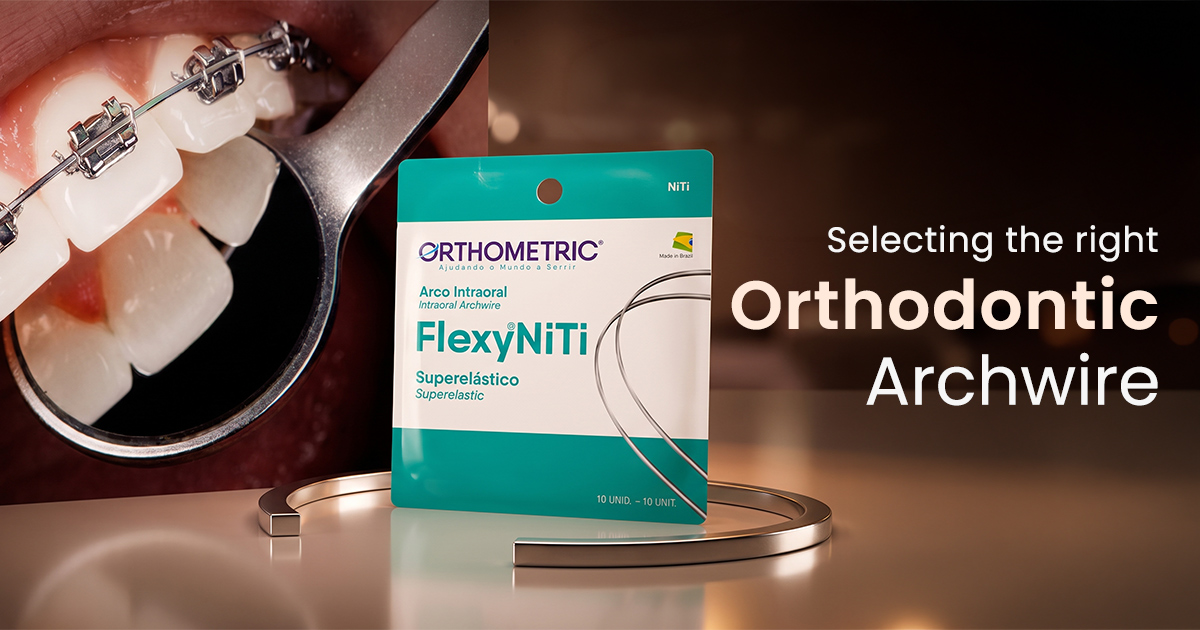
Nickel-Titanium (NiTi) archwires are primarily used during the initial alignment and leveling stages of orthodontic treatment due to their unique properties of superelasticity and shape memory. This superelasticity allows them to deliver light, continuous forces over a wide range of deactivation, even when severely deflected, making them the material of choice for correcting significant crowding.
The shape memory effect, activated by intraoral temperatures around 37°C, ensures the wire consistently attempts to return to its original archform, efficiently correcting rotations. These Nickel-Titanium (NiTi) archwires are ideal for engaging highly displaced teeth without causing patient discomfort or iatrogenic damage.
- Initial Alignment: Use small dimension (0.012" or 0.014") round Nickel-Titanium (NiTi) archwires to engage severely crowded teeth with minimal force.
- Low Hysteresis: NiTi wires have a low load-deflection rate, meaning the force they exert remains relatively constant as the tooth moves, providing sustained biological stimulus.
- Force Levels: They typically deliver forces in the range of 50-150 grams, which is optimal for initiating tooth movement in the early phases of treatment.
- Reduced Chair Time: Their wide range of action means fewer wire changes and adjustments are needed compared to more rigid materials.
Superelasticity
NiTi wires can undergo large deflections and return to their original shape, delivering light, continuous forces ideal for initial tooth movement.
Shape Memory
The wire is pre-programmed with an ideal archform that it seeks to regain at body temperature, guiding teeth into alignment.
Thermal Activation
Some NiTi wires are soft and easy to ligate at room temperature, becoming active and stiffer once warmed in the patient's mouth.
What Are the Clinical Uses for Stainless Steel Wires?
Stainless steel (SS) wires are the workhorse for mid-to-late stages of treatment, primarily used for space closure, torque control, and finishing where high stiffness and low friction are required. Unlike NiTi, SS wires have a high modulus of elasticity, providing the rigidity needed to maintain arch form and resist deformation from masticatory forces.
This allows for effective sliding mechanics and precise root positioning, as the wire does not deflect easily within the bracket slot. SS orthodontic wires are also highly formable, allowing for custom bends and loops to be placed chairside for fine-tuning the occlusion.
- Space Closure: Their stiffness provides excellent anchorage control and facilitates en-masse retraction using sliding mechanics.
- Torque Expression: Full-size rectangular SS wires (e.g., 0.019" x 0.025") fully engage the bracket slot for precise third-order root movement.
- Low Friction: The smooth surface of SS is ideal for sliding mechanics, reducing binding and resistance during space closure.
- Anchorage Bends: Can be easily bent to incorporate tip-back bends or toe-ins for anchorage preservation.
| Property | Stainless Steel (SS) | Nickel-Titanium (NiTi) |
|---|---|---|
| Stiffness | High best | Low |
| Springback | Low | Very High best |
| Formability | Excellent | Poor (Cannot be bent) |
| Friction | Low | High |
| Primary Use | Finishing, Space Closure | Alignment, Leveling |
What is the Role of Beta-Titanium (TMA) Wires?
Beta-Titanium (TMA) wires serve as a crucial intermediate option between NiTi and Stainless Steel, offering a unique combination of moderate stiffness, good formability, and excellent springback. They are ideal for the mid-to-late stages of treatment when control is needed but the rigidity of steel is excessive.
TMA's modulus of elasticity is roughly half that of stainless steel, delivering a more biologically compatible force level while still being formable. This makes it an excellent choice when you need to introduce detailed bends for individual tooth torque or vertical steps but still require more resilience than SS offers. For a full inventory of treatment options, explore our range of orthodontic products.
- Intermediate Force: Bridges the gap between NiTi and SS, useful for arch consolidation and early space closure.
- Finishing & Detailing: Can be bent into loops and customized archforms for final tooth positioning without fracturing.
- Good Springback: Offers twice the springback of stainless steel, meaning loops and bends remain active longer.
- Nickel-Free Option: TMA is a biocompatible alternative for patients with a documented nickel allergy.
Clinical Decision: When to Choose TMA
How Does Wire Cross-Section Affect Tooth Movement?
An archwire's cross-section—its shape (round, square, rectangular) and dimension—directly dictates the type and magnitude of force delivered to the tooth. This choice controls everything from simple tipping during initial alignment to complex bodily and torque movements in the finishing stages.
Round wires primarily exert tipping forces as they have clearance within the bracket slot, making them ideal for initial leveling. Rectangular wires, however, engage the full dimensions of the orthodontic brackets, allowing for three-dimensional control, including the critical buccolingual root torque. Remember that force increases exponentially with diameter; doubling a wire's diameter increases its stiffness by a factor of 16.
- Round Wires (e.g., 0.012", 0.014"): Used for initial alignment and leveling. They produce light tipping forces to unravel crowding.
- Square Wires (e.g., 0.016" x 0.016"): A transitional wire that begins to provide some torque control while maintaining flexibility for continued alignment.
- Rectangular Wires (e.g., 0.019" x 0.025"): Used for finishing. They fill the bracket slot (e.g., 0.022" slot) to provide maximum torque, tip, and rotational control for precise final positioning.
WIRE CROSS-SECTION AND FORCE CONTROL
Primarily produce tipping forces, making them ideal for initial alignment and derotation of crowded teeth.
Offer a transition to three-dimensional control by beginning to engage the slot for early torque expression.
Provide full torque and tip control for precise root positioning and finishing the case with ideal inclination.
Frequently Asked Questions
Superelastic NiTi wires exhibit their flexible, spring-like behavior at mouth temperature, delivering constant, light forces as they are unloaded. In contrast, shape memory NiTi wires (martensitic-active) are soft and malleable at room temperature for easy ligation, but upon warming in the mouth to their transition temperature of around 37°C, they stiffen and return to their original shape, activating the orthodontic force.
TMA is generally superior for loops used in space closure or for intrusions. While stainless steel is easily formed, it has low springback and deforms permanently under smaller deflections. TMA wires have nearly twice the springback of steel, meaning a TMA loop can be activated over a greater range and will deliver a more consistent force for a longer period before needing reactivation.
Ineffective movement with a NiTi wire often stems from binding or excessive friction, especially with severe crowding or poorly positioned brackets. Ensure there is no blockage in the bracket slot and consider using a smaller dimension wire (e.g., 0.012" NiTi) to reduce initial friction. Also, poor manufacturing can compromise the wire's superelastic properties, so always use high-quality orthodontic archwires from a trusted supplier.
A small-dimension, superelastic Nickel-Titanium (NiTi) archwire, typically a 0.012" or 0.014" round wire, is the standard of care for initial alignment. Its high flexibility and ability to deliver light, continuous forces allow for efficient and comfortable correction of severe crowding and rotations without overloading the periodontal ligament and causing patient discomfort.
Heat-treating, or stress-relieving, a stainless steel wire is done to increase its springiness after bending. Hold the bent portion of the wire over the blue cone of a flame from an alcohol torch for 3-5 seconds until it glows a faint straw or light brown color. Avoid overheating to a cherry red, as this will anneal the wire, making it too soft and negating the benefit of the procedure.
Written by
Dr.Yukti
Dental Content Contributor
Dr. Yukti Jain is a BDS-qualified dental professional and Product Specialist at Dentalkart with expertise in dental materials, equipment, and clinical innovations. Passionate about evidence-based dentistry, she creates insightful, research-driven content that simplifies complex topics and empowers dental professionals to make informed clinical and purchasing decisions.
Keep reading
Browse all →
Elastomeric Chains vs. NiTi Coil Springs: A Clinical Guide
Elastomeric Chains vs. NiTi Coil Springs: A Clinical GuideSpace Closure Selection An elastomeric power chain delivers a high initial force that decays rapidly,

Rapid Palatal Expansion Case Selection Criteria
Rapid Palatal Expansion Case Selection CriteriaAn Orthodontic Clinical Guide A rapid palatal expander (RPE) is indicated for skeletal maxillary transverse defic


A Clinician's Guide to Pediatric Space Maintainer Selection
A Clinician's Guide to Pediatric Space Maintainer SelectionCase Selection Simplified A pediatric space maintainer is a custom-made appliance designed to preserv