
Dr.Yukti
Dental Content Contributor
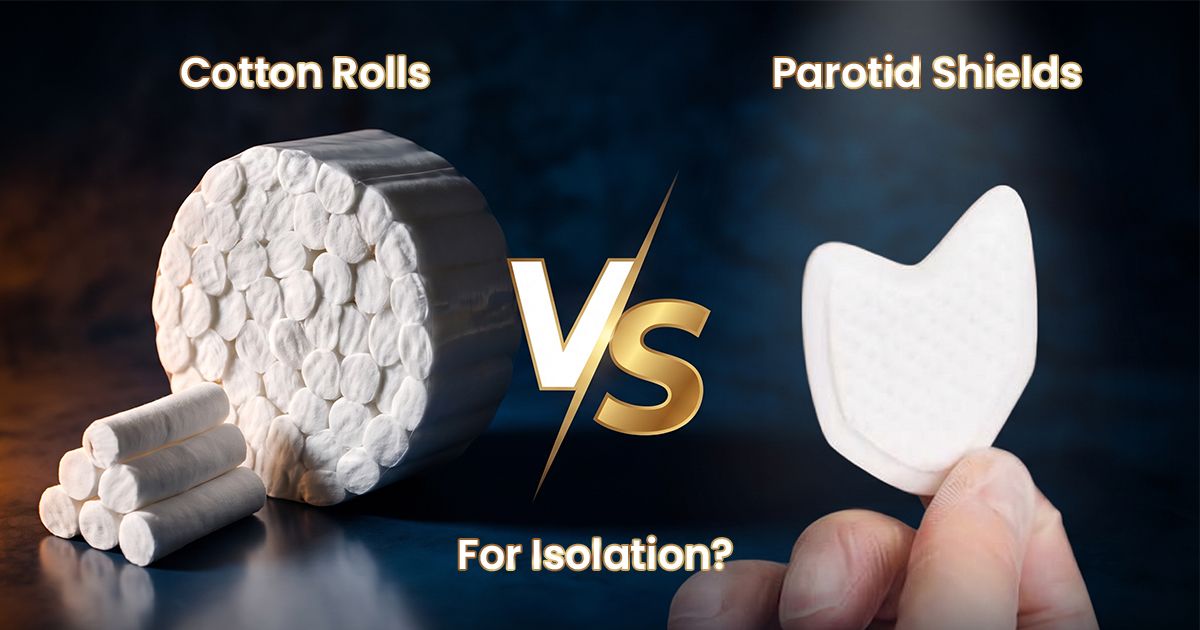
Cotton Rolls vs Parotid Shields for Isolation?
A Moisture Control Decision Guide
Effective dental isolation techniques depend on case selection: cotton rolls are sufficient for brief, low-risk procedures, while parotid shields are mandatory for moisture-sensitive aesthetic treatments. Choosing correctly is non-negotiable for achieving predictable bond strengths and long-term restorative success.
Table of Contents
What Are the Limitations of Cotton Roll Isolation?
The primary limitation of cotton rolls is their rapid saturation and inability to reliably block salivary flow from the parotid duct. Once a cotton roll absorbs its maximum capacity, typically within 5-7 minutes, it ceases to be an isolator and can become a source of contamination through wicking, actively pulling saliva back into the operative field. This makes them unsuitable for procedures requiring a consistently dry environment for longer durations.
Furthermore, their bulk does not provide effective cheek or tongue retraction, often requiring the clinician or assistant to manually manage soft tissues. This complicates four-handed dentistry and can obstruct the line of sight, particularly in the posterior maxillary region. Their tendency to adhere to dry mucosa also poses a risk of iatrogenic injury upon removal if not thoroughly wetted first.
- Rapid Saturation: Becomes fully saturated in minutes, requiring frequent replacement that disrupts workflow.
- Wicking Effect: A saturated roll can transfer moisture back to the tooth surface, compromising adhesive protocols.
- No Duct Blockage: Rests adjacent to, but does not physically block, Stensen's duct orifice.
- Poor Retraction: Offers minimal control over the tongue and buccal mucosa, increasing procedural difficulty.
- Mucosal Adherence: Can cause painful sloughing or ulceration if removed from dry tissue.
Risk of Bond Failure
Even momentary contamination of an etched enamel or dentin surface with saliva glycoproteins can reduce bond strength by over 50%. A saturated cotton roll is a common, and preventable, cause of this failure in adhesive dentistry.
Parotid Shields: Superior Moisture Control
Parotid shields, often called absorbent triangles, achieve superior moisture control by physically covering and blocking the orifice of Stensen's duct. This stops saliva at its primary source in the maxillary arch. Unlike cotton rolls, they are constructed with an absorbent cellulose core and a non-permeable polyethylene backing, which prevents saliva strike-through for up to 15 minutes, a significant increase in working time.
This design not only absorbs saliva but also holds its shape when wet, providing gentle but consistent cheek retraction. The shield's thin, anatomical shape conforms to the buccal vestibule without causing patient discomfort, making it a more effective and reliable component of modern dental isolation techniques. The result is a predictably dry field, which is critical for the success of sensitive adhesive procedures.
- Direct Duct Blockage: The shield is placed directly over the parotid papilla, physically preventing saliva expression.
- Extended Dry Time: Provides a dry field for 15-20 minutes, compared to 5-7 minutes for cotton rolls.
- No Strike-Through: A moisture-proof backing prevents absorbed saliva from contaminating the operative field.
- Effective Retraction: Stays in place and actively holds the cheek away from the working area.
HOW A PAROTID SHIELD WORKS
The shield is positioned directly over Stensen's duct orifice inside the cheek.
It physically blocks saliva flow while the inner core absorbs any output.
A non-permeable backing ensures the field remains dry for up to 15 minutes.
Which Procedures Demand Parotid Shields?
Parotid shields are mandated for any aesthetic or adhesive procedure where absolute moisture control is critical and the working time exceeds 10-15 minutes. The success of dental bonding agents is entirely dependent on a pristine, uncontaminated substrate, and the high flow rate from the parotid gland makes shields a non-negotiable tool for maxillary posterior work. This is especially true in India, where high-humidity environments can further challenge moisture control.
For multi-unit cases, such as cementing a quadrant of veneers or onlays, the time required for etching, priming, bonding, and light-curing each unit sequentially makes cotton rolls an unacceptable risk. Similarly, direct composite restorations that require careful layering and anatomical carving benefit immensely from the extended, uninterrupted working time that shields provide.
- Multi-Unit Veneer/Onlay Cementation: Ensures a dry field for the entire duration of a multi-step bonding protocol.
- Direct Composite Restorations (Class II, IV, V): Prevents contamination during incremental layering and final polishing.
- In-Office Vital Bleaching: Protects the parotid duct from chemical irritation and prevents saliva from diluting the bleaching agent.
- Pit and Fissure Sealants: Crucial for long-term sealant retention, especially in pediatric patients with active salivary flow.
Isolation Choice Matrix
Combine Shields With Other Isolation Methods
To achieve the highest level of moisture control short of a rubber dam, combine parotid shields with other isolation aids. The most effective technique involves placing the parotid shield first to manage the primary moisture source, then supplementing it with tools to control sublingual and submandibular secretions and retract soft tissues. This creates a multi-faceted defense against contamination from all salivary glands.
This combination approach transforms a challenging environment into a controlled one. For example, pairing a parotid shield with a lip and cheek retractor like the OptraGate provides unparalleled access and visibility for anterior aesthetic cases. For posterior work, placing the shield buccally and cotton rolls lingually with a saliva ejector offers comprehensive control for most restorative procedures.
- Shield + Saliva Ejector: The shield blocks the parotid duct while the ejector removes pooled fluid from the floor of the mouth.
- Shield + Lingual Cotton Rolls: Provides bilateral control, managing both buccal (parotid) and lingual (sublingual/submandibular) moisture.
- Shield + Lip Retractor: Ideal for anterior composite bonding or veneer cementation, offering maximum field visibility and isolation.
- Shield + Rubber Dam: For ultimate isolation, a shield can be placed under the dam to manage heavy salivary flow that might seep from the dam's edges.
Step 1: Dry the Mucosa
Gently dry the buccal mucosa with a 2x2 gauze. A dry surface ensures the shield adheres properly and comfortably for the patient.
Step 2: Place the Shield
With the tip pointing towards the back of the mouth, place the shield over the parotid papilla, opposite the maxillary second molar.
Step 3: Add Secondary Isolation
Position a saliva ejector in the floor of the mouth and place cotton rolls in the lingual and/or labial vestibule as needed.
Conclusion: Match the Tool to the Task
Ultimately, the choice between cotton rolls and parotid shields is a clinical judgment based on procedural duration and moisture sensitivity. While cotton rolls remain a staple for quick, simple tasks, upgrading to a parotid shield for any adhesive aesthetic procedure is a low-cost, high-impact decision that directly enhances bond strength and predictability. Mastering these dental isolation techniques is fundamental to elevating the quality of your restorative outcomes.
- Case Duration: Use cotton rolls for procedures under 10 minutes. For anything longer, especially adhesive work, use a parotid shield.
- Adhesive Procedures: Parotid shields are mandatory for multi-unit veneer cementation and complex direct composite layering to prevent bond failure.
- Blockage vs. Absorption: Remember that a shield physically blocks Stensen's duct, while a cotton roll only absorbs; this is the key functional difference.
- Combined Technique: For maximum control, place a parotid shield first, then supplement with lingual cotton rolls and a saliva ejector.
Frequently Asked Questions
The main difference is their mechanism of action. A cotton roll passively absorbs saliva until saturated, while a parotid shield actively blocks the orifice of Stensen's duct and absorbs its output at the source. The shield also has a waterproof backing to prevent absorbed saliva from contaminating the field.
First, dry the inside of the cheek with gauze. Identify the parotid papilla, which is typically located opposite the maxillary second molar. Place the absorbent triangle with the pointed corner facing toward the back of the throat, ensuring it completely covers the papilla. Gently press it against the cheek to ensure it adheres.
No, parotid shields are single-use disposable items. Attempting to reuse them, even on the same patient in a different appointment, presents a significant cross-contamination risk and violates standard infection control protocols. Always discard the shield after the procedure is complete.
Parotid shields are especially beneficial for patients with hypersalivation (ptyalism) or an overactive gag reflex that makes rubber dam placement difficult. They are also invaluable in pediatric dentistry and for anxious patients where procedural speed and efficiency are paramount for successful treatment.
No, a parotid shield cannot replace a rubber dam for procedures requiring absolute isolation, such as endodontic treatment. While it provides excellent moisture control from the parotid gland, it does not isolate the tooth from gingival crevicular fluid, blood, or sulcular moisture. It is a tool for relative isolation.
A standard parotid shield can provide effective moisture control for approximately 15 to 20 minutes, depending on the patient's salivary flow rate. This is significantly longer than a cotton roll, which often saturates in less than 7 minutes. Always monitor the shield and replace it if it becomes fully saturated during a long procedure.
Written by
Dr.Yukti
Dental Content Contributor
Dr. Yukti Jain is a BDS-qualified dental professional and Product Specialist at Dentalkart with expertise in dental materials, equipment, and clinical innovations. Passionate about evidence-based dentistry, she creates insightful, research-driven content that simplifies complex topics and empowers dental professionals to make informed clinical and purchasing decisions.
Keep reading
Browse all →
Mastering Dental Composite Case Selection in 2026
Mastering Dental Composite Case Selection in 2026Optimal Use for Aesthetic Restorations Effective composite case selection involves matching a material's specif
Ideal Clinical Cases for Dental Photo Contrastors
Ideal Clinical Cases for Dental Photo ContrastorsElevating Your Clinical Photography Dental photography contrastors are non-reflective, black intraoral tools th

Solving Common Sectional Matrix System Failures
Solving Common Sectional Matrix System FailuresMastering Perfect Class II Contacts Solving sectional matrix system failures requires correct matrix band and rin