
Dr.Yukti
Dental Content Contributor
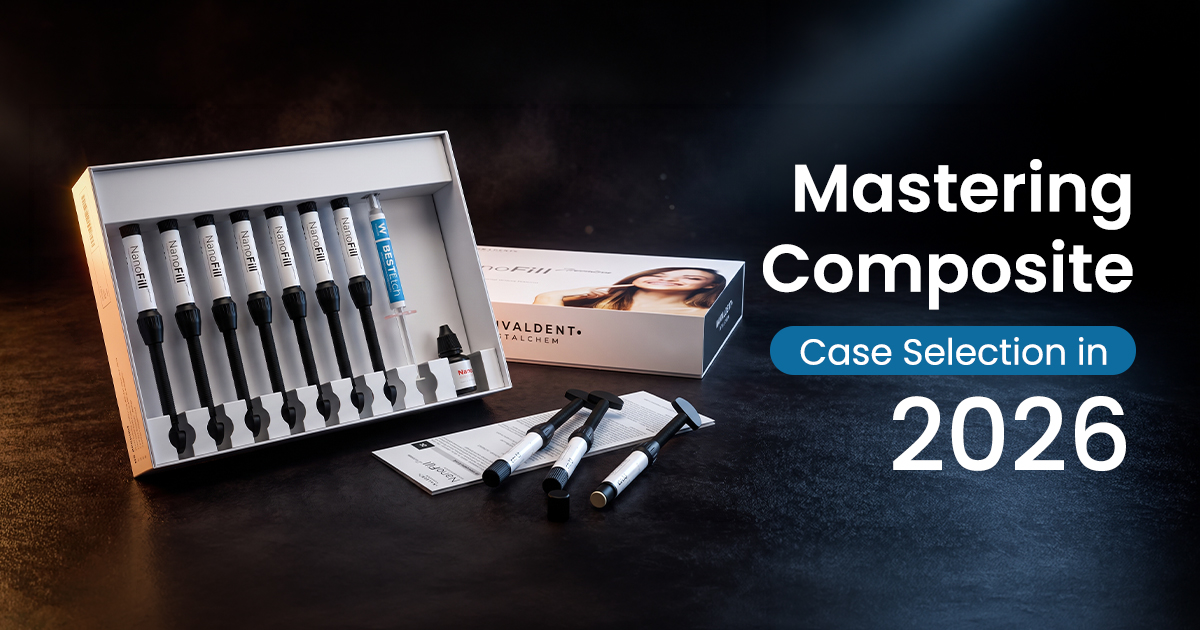
Mastering Dental Composite Case Selection in 2026
Optimal Use for Aesthetic Restorations
Effective composite case selection involves matching a material's specific physical and aesthetic properties to the clinical demands of the restoration. This process is critical for ensuring longevity, function, and patient satisfaction, preventing premature failures from polymerization shrinkage, wear, and fracture.
Table of Contents
- What are Primary Indications for Dental Composites?
- When to Advise Against Using Dental Composites
- How Cavity Size and Location Influence Selection
- Role of Specific Composite Types in Suitability
- Are There Patient-Specific Factors Affecting Choice?
- Conclusion: Case Selection is Key
- Frequently Asked Questions
What are Primary Indications for Dental Composites?
The primary indication for dental composites is any restoration where aesthetics and conservative tooth preparation are paramount. They are the material of choice for direct restorations in the aesthetic zone and for small-to-moderate-sized defects in posterior teeth where enamel is available for durable bonding.
This suitability stems from their ability to bond adhesively to tooth structure, which reinforces the remaining tooth and allows for preparations that remove only the carious tissue, preserving healthy enamel and dentin. A typical adhesive protocol achieves bond strengths of 20-30 MPa to enamel, providing a strong, predictable seal against microleakage when proper isolation is achieved.
- Anterior Restorations: Ideal for Class III, IV, and V restorations, direct composite veneers, and diastema closures due to excellent shade matching and polishability.
- Posterior Restorations: Suitable for small-to-moderate Class I and II restorations, particularly when the isthmus width is less than one-third of the intercuspal distance.
- Reparability: Existing composite restorations with localized defects like marginal staining or minor fractures can often be repaired intraorally, conserving the bulk of the restoration.
- Core Buildups: Used for building up tooth structure on vital teeth prior to crown placement, offering good compressive strength and immediate preparation capability.
Composite Suitability Checklist
The case demands superior aesthetics, such as in the anterior maxilla or mandible.
The lesion allows for a prep that preserves significant healthy tooth structure.
Sufficient enamel margins are present, especially at the gingival floor, to ensure a durable seal.
The operating field can be kept completely dry using a rubber dam or effective cotton roll isolation.
When to Advise Against Using Dental Composites
A dental composite should be advised against when the clinical situation prevents reliable adhesive bonding or when occlusal forces exceed the material's physical limits. These contraindications are crucial for preventing catastrophic failures and ensuring predictable long-term outcomes for the patient.
The most significant limiting factor is the inability to achieve absolute isolation from saliva, blood, or gingival crevicular fluid, which catastrophically reduces bond strength. Additionally, in patients with severe bruxism or clenching habits, the cyclic loading can lead to excessive wear and fracture, especially in large restorations that replace functional cusps.
- Poor Isolation: If the restorative margin is deeply subgingival or the patient cannot tolerate a rubber dam, the risk of moisture contamination is too high for a predictable bond.
- Heavy Occlusal Stress: Avoid using composites for direct cuspal coverage on molars in patients with heavy wear facets or diagnosed bruxism. An indirect restoration (inlay/onlay) is superior.
- Large Posterior Restorations: When a posterior cavity preparation extends beyond two-thirds of the intercuspal distance, the remaining tooth structure is too weak and polymerization shrinkage stress is too high.
- Poor Oral Hygiene: In patients with a high caries rate and poor plaque control, the margins of composite restorations are highly susceptible to secondary caries.
Subgingival Margins: A Critical Contraindication
Never place a direct composite restoration when the gingival margin is located deep in the sulcus and cannot be isolated. Even minimal contamination from crevicular fluid during the bonding steps will compromise the hybrid layer, leading to marginal leakage, post-operative sensitivity, and eventual restoration failure.
How Cavity Size and Location Influence Selection
Cavity size and location directly dictate the required physical properties of a composite, influencing the choice between different material classes. The primary factor is the balance between stress-bearing requirements and aesthetic demands, which varies significantly from anterior to posterior regions.
Location determines occlusal load, while size affects the polymerization shrinkage stress, governed by the configuration factor (C-factor). A deep, box-like Class I cavity has a high C-factor (approx. 5), leading to high internal stresses that can pull the material away from cavity walls. In contrast, an anterior Class IV restoration has a low C-factor (approx. 0.5), making it less susceptible to shrinkage effects.
- Small Anterior (Class III, V): Prioritize polishability and aesthetics. A nanofill or microfill composite is ideal for achieving a high-gloss, lifelike surface.
- Large Anterior (Class IV): Requires a balance of strength and aesthetics. A nanohybrid composite is often the best choice, providing both fracture resistance for the incisal edge and excellent polish.
- Small-to-Moderate Posterior (Class I, II): Focus on wear resistance and low shrinkage. A universal or nanohybrid posterior composite placed in 2 mm increments is standard.
- Deep Posterior (4mm+): Consider a bulk-fill composite for the base to reduce shrinkage stress and placement time, followed by a capping layer of a universal composite for superior wear resistance.
Composite Selection by Cavity
Role of Specific Composite Types in Suitability
Specific composite types are engineered with distinct filler technologies, making each suitable for different clinical applications. The choice is primarily based on filler particle size and loading, which determines the material's strength, wear resistance, polishability, and handling characteristics.
For instance, nanohybrid dental composites contain a blend of particle sizes, offering a versatile balance of strength for posterior use and high polish for anterior aesthetics. In contrast, flowable composites have lower filler loading (approx. 40-60% by weight), which reduces viscosity but also compromises physical properties, limiting their use to specific, low-stress applications.
- Nanohybrid Composites: The universal workhorse. Good for most anterior and posterior restorations due to balanced strength, wear resistance, and aesthetics.
- Nanofill Composites: Contain extremely small filler particles (20-75 nm). Offer the highest polishability and gloss retention, making them superior for aesthetic-critical anterior cases like direct veneers.
- Bulk-Fill Composites: Feature modified resin chemistry (e.g., new photoinitiators, stress modulators) allowing for placement in increments of 4-5 mm. Best for deep posterior restorations to save time and reduce shrinkage stress.
- Flowable Composites: Low viscosity allows them to adapt intimately to cavity preparations. Used as a liner in deep cavities, for small Class V restorations, or as a sealant.
| Composite Type | Primary Indication | Key Property |
|---|---|---|
| Nanohybrid | Universal (Anterior/Posterior) | Balanced Strength & Aesthetics best |
| Nanofill | High-Aesthetic Anterior | Superior Polishability |
| Bulk-Fill | Deep Posterior Base | Low Shrinkage Stress value |
| Flowable | Cavity Liner / Class V | High Adaptability |
Are There Patient-Specific Factors Affecting Choice?
Yes, patient-specific factors are equally as important as technical factors in composite case selection. A patient's habits, risk profile, and expectations can determine the success or failure of a composite restoration, regardless of how well it is placed.
Parafunctional habits like bruxism introduce extreme, non-axial forces that can cause rapid wear or bulk fracture of composite materials, making a more durable material like ceramic or gold a better choice. Similarly, a patient's aesthetic expectations must be carefully managed; achieving a perfect shade match can be challenging, and success depends on using high-quality materials and meticulous layering, followed by precise contouring with proper finishing and polishing kits.
- Parafunctional Habits: For patients with evidence of bruxism (e.g., significant wear facets, abfractions), composite is a high-risk choice for posterior restorations. An indirect onlay is recommended.
- Caries Risk Assessment: In patients with high cariogenic activity (high DMFT, poor diet), the marginal integrity of composites can be compromised, leading to secondary caries. Materials that release fluoride, like GI or RMGIC, may be better for interim restorations.
- Aesthetic Demands: Highly discerning patients may require complex multi-shade layering techniques to replicate natural tooth anatomy, influencing the selection of a composite system with a wide range of dentin, enamel, and translucent shades.
- Age and Dexterity: For paediatric or geriatric patients who may have difficulty maintaining excellent oral hygiene, the risk of marginal breakdown and staining increases over time.
Composite in High-Risk Patient
- Conservative and aesthetic.
- Can be repaired easily.
- High risk of premature wear/fracture.
- Susceptible to secondary caries at margins.
Indirect Onlay in High-Risk Patient
- Superior strength and wear resistance.
- Better marginal integrity long-term.
- Requires more tooth reduction.
- Higher cost and two-visit procedure.
Conclusion: Case Selection is Key
The ultimate success of a dental composite restoration depends more on correct case selection than on any specific brand or technique. Matching the material's properties to the biomechanical and aesthetic demands of the clinical situation is the most critical decision a dentist makes. Prioritizing proper isolation and respecting the material's limitations in high-stress areas will consistently yield better long-term clinical outcomes and higher patient satisfaction.
- Isolation is Non-Negotiable: If absolute moisture control cannot be guaranteed, a composite restoration is contraindicated. Re-evaluate the case for an alternative material.
- Mind the C-Factor: For high C-factor cavities like deep Class I preps, use an incremental layering technique with 2 mm layers or a low-stress bulk-fill base to prevent bond failure.
- Assess Occlusal Load: Avoid direct composite for cuspal coverage in patients with bruxism or heavy occlusal wear; an indirect restoration is the standard of care.
- Match Filler to Function: Use nanofill composites for high-polish anterior needs and nanohybrid or bulk-fill composites for stress-bearing posterior restorations.
Frequently Asked Questions
The main advantage of composite resin is its ability to bond adhesively to tooth structure, which allows for more conservative tooth preparations and reinforces the remaining tooth. Additionally, composites offer superior aesthetics, allowing restorations to be matched to the natural shade of the patient's teeth, a significant benefit over the metallic appearance of amalgam.
The longevity of posterior composite restorations varies widely based on proper case selection, placement technique, and patient factors. Well-placed composites in small-to-moderate-sized cavities can have an annual failure rate of 1-3%, suggesting a clinical lifespan of 7-15 years or more. However, in high-stress situations or in patients with poor hygiene, failure can occur much sooner.
For anterior teeth where aesthetics are the highest priority, a nanofill composite is generally considered the best choice. Its small particle size allows it to be polished to an extremely high, long-lasting gloss that mimics natural enamel. For larger Class IV restorations involving the incisal edge, a nanohybrid may be preferred for its added strength.
Moisture control is critical because the adhesive systems used for composites rely on creating a micromechanical bond with enamel and dentin, which is highly technique-sensitive. Contamination by saliva, blood, or crevicular fluid prevents the resin from properly infiltrating the etched tooth surface, leading to a weak or non-existent bond, marginal leakage, and post-operative sensitivity.
No, bulk-fill composites are not a universal solution for all posterior restorations. While they are excellent for filling deep cavities (4-5 mm increments) to save time and reduce shrinkage stress, their wear resistance and aesthetics are often inferior to conventional nanohybrid composites. It is best practice to use them as a dentin replacement and place a 2 mm capping layer of a universal composite for the final occlusal surface.
The most common reason for failure of posterior composite restorations is secondary caries, followed by bulk fracture. Both issues often stem from improper composite case selection, such as placing a composite in a patient with high caries risk or in a high-stress area that requires cuspal coverage. Inadequate isolation during placement is another major contributor to early failure due to marginal leakage.
Written by
Dr.Yukti
Dental Content Contributor
Dr. Yukti Jain is a BDS-qualified dental professional and Product Specialist at Dentalkart with expertise in dental materials, equipment, and clinical innovations. Passionate about evidence-based dentistry, she creates insightful, research-driven content that simplifies complex topics and empowers dental professionals to make informed clinical and purchasing decisions.
Keep reading
Browse all →
Ideal Clinical Cases for Dental Photo Contrastors
Ideal Clinical Cases for Dental Photo ContrastorsElevating Your Clinical Photography Dental photography contrastors are non-reflective, black intraoral tools th

Cotton Rolls vs Parotid Shields for Isolation?
Cotton Rolls vs Parotid Shields for Isolation?A Moisture Control Decision Guide Effective dental isolation techniques depend on case selection: cotton rolls are
Solving Common Sectional Matrix System Failures
Solving Common Sectional Matrix System FailuresMastering Perfect Class II Contacts Solving sectional matrix system failures requires correct matrix band and rin