The Endodontic Emergency Kit Checklist for Dental Clinics

Dr. Gurjeet
Contributing Dental Clinician
What Should Every Dental Clinic Keep in its Endodontic Emergency Kit?
An endodontic emergency kit should hold everything needed to diagnose, anaesthetise, isolate, access, debride and temporarily seal a tooth without leaving the chair: pulp testing aids, local anaesthetic armamentarium, rubber dam, access burs, small hand files, irrigant and side-vented needles, paper points, intracanal medicament, cotton pellets and a durable temporary restoration. Add a separate trauma module with splinting materials and a tooth storage medium.
What turns that list into a working kit is sizing it from your own emergency log, keeping it in one place, and restocking it the same day it is used.
What the Kit Has to Handle
Most endodontic emergencies fall into a handful of presentations, and each uses a different part of the kit.
Presentation | Typical chairside goal | Kit modules used |
Symptomatic irreversible pulpitis | Pain relief by pulpotomy or pulpectomy | Diagnosis, anaesthesia, isolation and access, debridement, interim seal |
Symptomatic apical periodontitis or acute apical abscess | Debridement, drainage where indicated | All core modules, plus incision and drainage items per clinic protocol |
Flare-up between appointments | Re-access, irrigate, re-dress | Isolation and access, debridement, interim seal |
Cracked or fractured tooth with pulp exposure | Diagnose, protect, plan | Diagnosis, anaesthesia, interim seal |
Dental trauma (avulsion, luxation, crown fracture) | Replant, reposition, splint, protect pulp | Trauma module, diagnosis, anaesthesia |

For irreversible pulpitis without systemic involvement, definitive pain relief comes from removing inflamed pulp, not from antibiotics. The American Association of Endodontists' 2017 guidance on antibiotic use states that antibiotics are not indicated for irreversible pulpitis, or for localised apical abscesses without systemic signs. The kit is designed around that principle: it equips you to treat the source at the chair. In my experience, a well-stocked kit is also the best antidote to the temptation of "antibiotics and come back next week" on a packed evening.
The Core Kit, Module by Module

Diagnosis
Mouth mirror, straight and periodontal probes, an instrument handle for percussion, refrigerant cold spray for sensibility testing, an electric pulp tester if your clinic uses one, and film or sensor holders for periapicals. Pulpitis pain is often poorly localised; a reproducible cold test and percussion response, compared with adjacent and contralateral teeth, is what pins it to one tooth before anything is cut. A working dental X-ray unit and sensor or film are assumed; the kit holds the positioning aids.
Anaesthesia
Aspirating syringe, needles in the lengths your team uses for infiltration and inferior alveolar nerve block, cartridges of your approved local anaesthetic agents, and topical anaesthetic. A "hot" mandibular molar with irreversible pulpitis is notoriously hard to anaesthetise, so keep the supplies for whatever supplementary techniques your dentists use, such as buccal infiltration or intraligamentary injection. Agent choice and dose remain the treating dentist's decision.
Isolation and access
Rubber dam sheets, frame, punch, clamp forceps, a small clamp selection covering molars, premolars and anteriors, and cotton rolls. Round and safe-ended tapered access burs. Clamps are the item most often missing from emergency kits, because they quietly migrate to the routine trays.
Canal debridement
Small hand files (ISO 08 to 25 is the core emergency range), an apex locator, sodium hypochlorite or your approved irrigant, irrigation syringes and closed-end side-vented needles. An emergency pulpectomy aims to remove pulp tissue and reduce the bacterial load, not to complete shaping, so the kit does not need a full rotary file system. If your dentists prefer rotary instrumentation in emergencies, keep one sequence and confirm the presets on the endomotor in the emergency operatory.
Dressing and interim seal
Paper points, sterile cotton pellets, an intracanal medicament (calcium hydroxide is the common choice) and a durable temporary restoration. A sound coronal seal between visits matters: a cotton pellet under an adequate thickness of temporary material, or a glass ionomer seal where the access cavity has lost marginal walls, reduces leakage and the risk of a flare-up.
Protection and records
Gloves, masks, protective eyewear for patient and operator, sterilisation pouches, emergency consent forms and a record sheet. Per-visit disposables can come from the operatory's general stock, but a spare set in the kit avoids delays when the emergency is seen in a different chair.
The Trauma Module
Trauma is time-critical and uses materials the endodontic modules do not. Keep it in a separate, clearly labelled box.
The International Association of Dental Traumatology (IADT) 2020 guidelines are the reference most of us follow. For an avulsed permanent tooth, prognosis falls sharply with extraoral dry time. When the tooth has been kept in a storage medium and the dry time is under 60 minutes, the periodontal ligament cells are regarded as viable but compromised; when the dry time exceeds 60 minutes, they are likely to be non-viable, whatever the tooth was stored in afterwards. The guidelines still advise replanting as soon as possible. Suitable storage media include Hank's balanced salt solution (HBSS), milk, saline and saliva. A small supply of HBSS or sterile saline in the kit means the tooth can be protected the moment it arrives.
For splinting, the IADT recommends a passive, flexible splint: stainless steel wire with a diameter of up to 0.4 mm (0.016 inch), or nylon monofilament, bonded with composite. Avulsed teeth are typically splinted for about two weeks. The module therefore needs that wire, etchant and bonding agent, a flowable or splinting composite, a wire cutter, and pulp-capping material for crown fractures with exposure.
Sizing the Kit From Your Emergency Log
A kit sized by guesswork is either overstocked with expiring material or empty on a busy day. Use your own records.
Worked example (hypothetical clinic):
Measure | Value |
Endodontic emergencies logged over 8 weeks | 44 |
Average per week | About 5 to 6 |
Highest number seen in one day | 3 |
Kit capacity target (busiest day + 1 buffer case) | 4 cases |
Irrigation needles per case (clinic protocol) | 2 |
Needles held in kit | 8 |
Rubber dam sheets held | 4 |

The kit only has to bridge until the same-day restock, so sizing it to the busiest observed day plus one case covers peaks without tying up stock. Larger multi-chair practices may hold two identical kits; the same calculation applies per kit.
Keeping It Usable
Four rules keep the kit alive:
One owner. A named team member checks and restocks it. Shared responsibility means nobody does it.
Same-day restock. The kit is replenished after every use, before the clinic closes.
Weekly check, monthly expiry audit. A weekly content check against the printed list, and a monthly sweep of expiry dates on anaesthetic cartridges, irrigant, medicament, bonding agents and storage media.
Practice runs. An occasional timed drill, from a simulated walk-in to the kit opened at the chair, shows where retrieval stalls.
Useful measures are kit completeness at each check, expired items found, items found missing during a real emergency, and time from the patient's arrival to the start of treatment.
Frequently Asked Questions
No. Medical emergency drugs and equipment (oxygen, adrenaline, glucose and similar) belong in a separate, clearly marked medical emergency kit with its own checks, as required by local regulations. Combining them slows retrieval of both and makes expiry tracking harder.
Trauma is uncommon in many general practices, so the module's contents often expire before use. Choose the smallest practical pack sizes, write expiry dates on the outside of the box, and include the trauma module in the monthly expiry audit rather than the weekly check.
Usually, if emergencies are seen in one designated operatory and the kit lives there. If any chair may receive a walk-in, keep identical kits or one central kit within a few seconds' reach, with the same contents and layout, so any assistant can work from either.
Written by
Dr. Gurjeet
Contributing Dental Clinician
Dr. Gurjeet is a practising dental clinician contributing to Dentalkart Blogs, sharing chair-side experience, treatment protocols, and equipment insights for the wider dental community.
Keep reading
Browse all →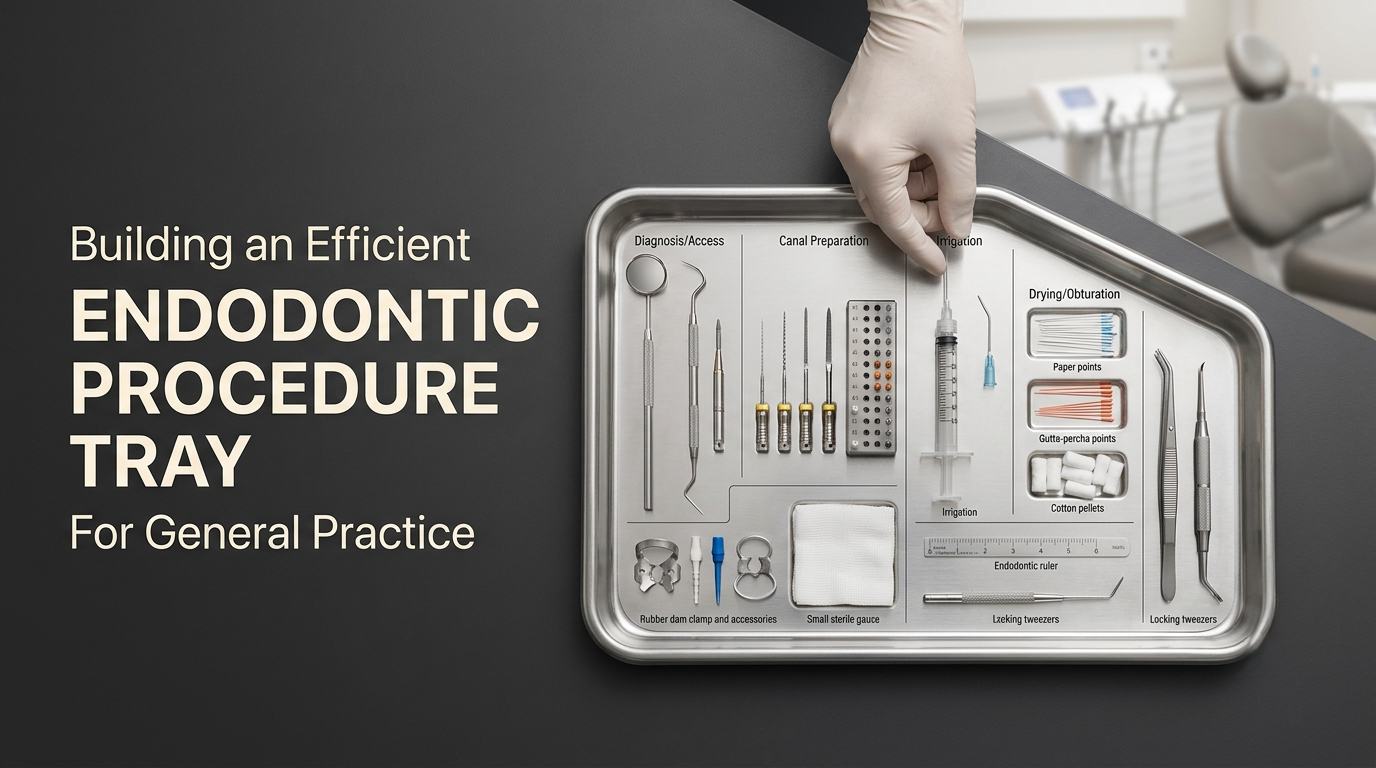
Endodontic Procedure Tray Setup for General Dental Practice
How Do You Build an Endodontic Procedure Tray for a General Dental Practice?Build the tray in three layers:A lean core tray used for every root canal treatment.
Bulk Buying Endodontic Supplies for Dental Clinics
What Should a Dental Clinic Consider Before Buying Endodontic Products in Bulk?Before buying endodontic products in bulk, check four things:How much your clinic
Dental Group Endodontic Purchasing Policy and Best Practices
How Can Dental Groups Create a Standard Endodontic Purchase Policy?A dental group or chain creates a standard endodontic purchase policy in five steps. First, a