
Dental Group Endodontic Purchasing Policy and Best Practices

Dr. Gurjeet
Contributing Dental Clinician
How Can Dental Groups Create a Standard Endodontic Purchase Policy?
A dental group or chain creates a standard endodontic purchase policy in five steps. First, audit 6 to 12 months of purchase data from every clinic. Second, agree clinical protocols with the treating dentists. Third, build a tiered approved list around compatible file, obturation and irrigation systems. Fourth, select vendors on service levels as well as price. Finally, pilot the policy in two clinics and review it every quarter.
The order matters. A list written by the purchase team and handed to dentists tends to be ignored at the chair. A list built from protocols the dentists agreed to usually holds.
Why Endodontic Supplies Need Their Own Policy
Endodontics depends on a chain of items that have to fit each other. A 25/.06 rotary file shapes a canal that a 25/.06 gutta-percha cone is designed to fill. The file's torque and speed settings must be available on the endomotor. The sealer must suit the obturation technique. When three clinics in one chain run three different file systems, every link in that chain multiplies: separate cone tapers, separate motor presets, separate training and separate safety stock.
The operational cost shows up in three places. Clinics make rushed local purchases when a paper point size runs out mid-case. Near-identical products appear on different invoices at different prices. And nobody has a reliable figure for what the group actually spends on endodontics. A purchase policy has to solve the clinical problem and the commercial problem together, which is why the clinical head and the operations manager should own it jointly.
Start With a Spend Audit, Not a Vendor Meeting
Pull 6 to 12 months of invoices from every clinic. Map each endodontic line item to its function: access, glide path, shaping, irrigation, medication, drying, obturation and temporisation. Groups that do this almost always find several products being bought for the same job at different prices.
Worked example (hypothetical figures): five clinics buy the same 6% taper gutta-percha box from different suppliers.
Clinic | Price per box (₹) | Boxes per month | Monthly spend (₹) |
A | 380 | 10 | 3,800 |
B | 420 | 14 | 5,880 |
C | 450 | 8 | 3,600 |
D | 400 | 12 | 4,800 |
E | 510 | 6 | 3,060 |
Group total | 50 | 21,140 |
Suppose pooling the group's 50 boxes a month secured a single price of ₹390 a box. That would save close to ₹20,000 a year on this one product. Run the same exercise across files, paper points, irrigants and sealers before you start negotiating.
Build the Approved List Around the Compatibility Chain
Sort every item into one of three tiers.
Tier | What belongs here | Rule |
Core | Glide path and shaping files for the group's standard system, matched gutta-percha and paper points, NaOCl and EDTA, irrigation needles, rubber dam kit, temporary filling material | One approved product across all clinics |
Preferred | Sealers, intracanal medicaments, hand files, retreatment files | Two approved options; the dentist chooses |
Dentist's choice | Bioceramic repair materials, retrieval kits, items for complex anatomy | Allowed with a written case reason |

Anchor the core tier on the shaping system. Cone taper, paper point sizing and motor settings all follow from that choice.
For example, if the group standardises on a 6% taper system and single-cone obturation, the gutta-percha points on the list must match it in both size and taper; a 2% ISO cone in a 6% preparation will not fill it properly with a single-cone technique. The rule is different for cold lateral compaction, where a .02 master cone with accessory cones is standard and perfectly appropriate in a tapered preparation. So the list has to be built around the obturation technique your dentists agree on, not only the file system. Our guide to choosing gutta-percha points for obturation covers taper matching in detail, and the heat-treated NiTi rotary file guide helps you decide which alloy belongs in the core tier.
Irrigation deserves the same discipline. Fix one sodium hypochlorite concentration, one EDTA product and one needle type in the written protocol. That way, a dental assistant moving between clinics prepares an identical tray. The clinician's guide to endodontic irrigating solutions summarises the role each solution plays. When shortlisting products for each tier, the Dentalkart endodontics range is a practical way to compare options side by side.
Avoid over-standardising. If every item is locked, dentists have no options for calcified canals, open apices or retreatments, and they will quietly buy their own.
Choose Vendors on Service Levels, Then Price
Score each shortlisted vendor on:
stock availability across every clinic location;
delivery lead time to each city;
substitution policy;
batch traceability and expiry dating;
returns and credit terms;
a named account manager.
A vendor should never substitute a file system or cone taper without written approval. Price still matters, but a file pack that is ₹200 cheaper and arrives two days late costs far more than ₹200 once a molar case has to be rescheduled.
Name a backup vendor for every core item. Relying on a single source is one of the commonest ways a standard policy fails.
Lead time also sets your reorder points. Worked example (hypothetical): a clinic uses 6 rotary file packs a week over 6 working days, which is 1 pack a day. The vendor's lead time is 4 days, and the clinic keeps a 2-day safety buffer.
So the reorder point is 6 packs: 4 days of use plus a 2-day buffer.

When stock falls to 6 packs, the order goes out. If the vendor's lead time stretches to 6 days, the reorder point rises to 8 packs, which ties up more cash. That is why lead time belongs on the vendor scorecard and not only on the price sheet.
Let Case Mix Set Stock Levels, Not the List
The approved list should be identical across the group. Quantities should not be. Molars usually have three or more canals, while most anterior teeth have one. A clinic with a heavy molar and retreatment load uses far more files, cones, paper points and irrigant per case than a clinic seeing mostly anterior and premolar work. Review each clinic's case mix, not just its case count.
High-volume clinics may justify larger pack sizes. Low-volume clinics often do better with smaller packs and fewer sizes. Irrigants, sealers and medicaments carry expiry dates, and a bulk discount disappears once stock has to be thrown away. Equipment follows the same logic: our piece on reducing an endomotor's true operational cost shows how maintenance shapes lifetime spend.
Exceptions, Pilots and Clinical Sign-Off
Write a one-page exception process:
The dentist submits the product, the indication and the reason an approved item will not work.
The clinical head decides within a fixed window, such as five working days.
Approved items are trialled, then either added to the list or retired at the next quarterly review.
Any change to the shaping or obturation system is a clinical decision for the clinical head or an endodontist, not a purchasing decision. Purchase staff should never substitute a file system, cone size or material because another option is cheaper or in stock. Follow the manufacturer's instructions for compatibility, single-use status and reprocessing for every instrument on the list.
Pilot the policy in two clinics for one quarter, ideally one high-volume and one low-volume clinic. Train the dental assistants on the new trays, fix what the pilot exposes, then roll out in stages.

Measuring Whether the Policy Works
Track a small set of measures on the same quarterly cycle:
Compliance: the share of endodontic spend that goes on approved items. If a group spends ₹4,00,000 in a quarter and ₹3,40,000 of it is on approved items, compliance is 85%.
Stockouts and emergency purchases per clinic per month.
Appointments delayed by a missing item.
Expired or wasted stock as a share of purchases.
Vendor fill rate and lead time against the agreed terms.
Feedback from dentists and dental assistants on the list.
Falling compliance usually points to a problem with the list, not a lack of discipline: a missing size, a disliked product or a vendor that keeps running short. Fix the list before you enforce it.
Frequently Asked Questions
Treat it as an exception, not a new standard. Allow a defined transition period on the familiar system while the dentist trains on the group's core system, and stock matched cones for both systems during that window. Adding a second core system for one dentist doubles your stock and training requirements.
Yes, once the list is genuinely standard. Being able to move stock between clinics is one of the biggest benefits of a common list. A clinic short on 25/.06 cones can borrow from a neighbouring branch instead of placing an emergency order. Record every transfer so each clinic's usage data stays accurate.
Not if part of the pack expires before it is used. Compare the cost per case actually treated, not the cost per millilitre purchased. Before approving a larger pack, check its labelled shelf life against each clinic's monthly consumption.
Written by
Dr. Gurjeet
Contributing Dental Clinician
Dr. Gurjeet is a practising dental clinician contributing to Dentalkart Blogs, sharing chair-side experience, treatment protocols, and equipment insights for the wider dental community.
Keep reading
Browse all →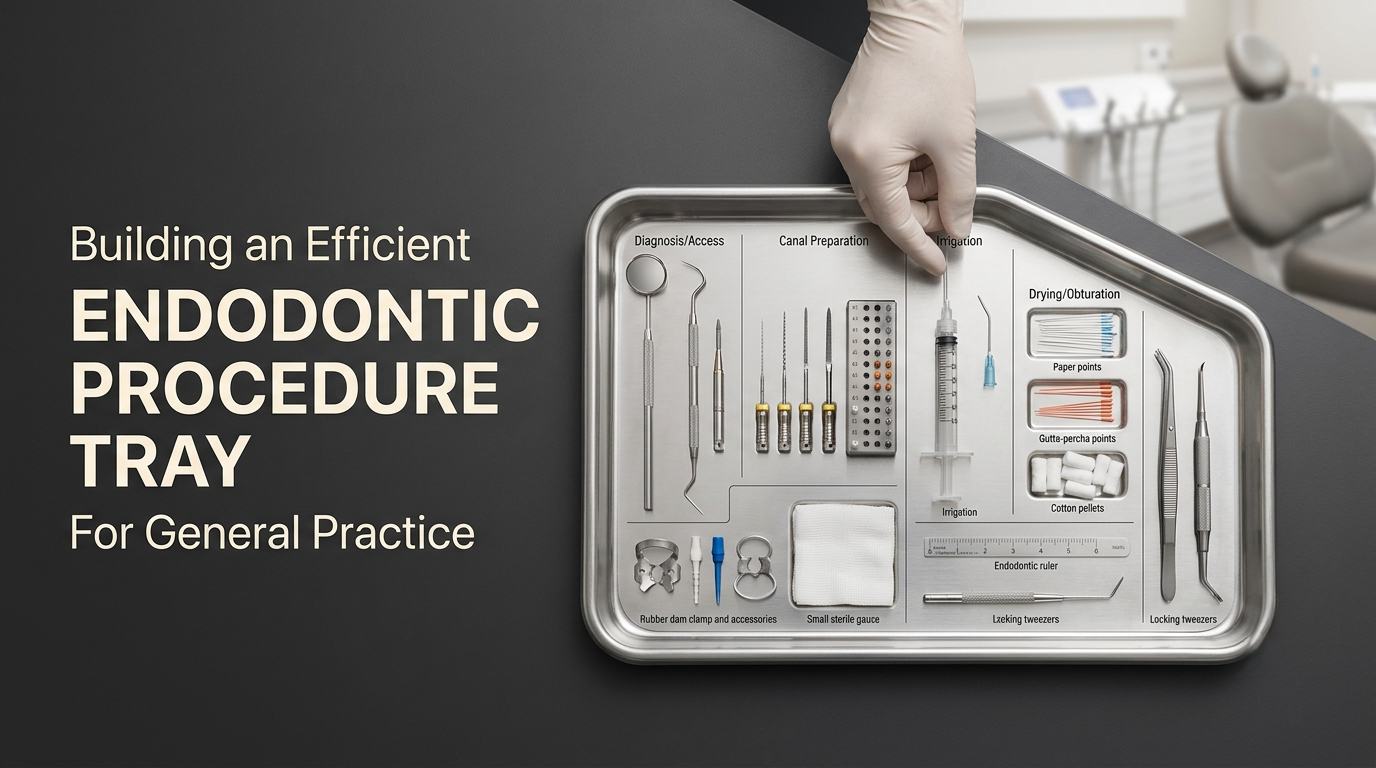
Endodontic Procedure Tray Setup for General Dental Practice
How Do You Build an Endodontic Procedure Tray for a General Dental Practice?Build the tray in three layers:A lean core tray used for every root canal treatment.

Bulk Buying Endodontic Supplies for Dental Clinics
What Should a Dental Clinic Consider Before Buying Endodontic Products in Bulk?Before buying endodontic products in bulk, check four things:How much your clinic
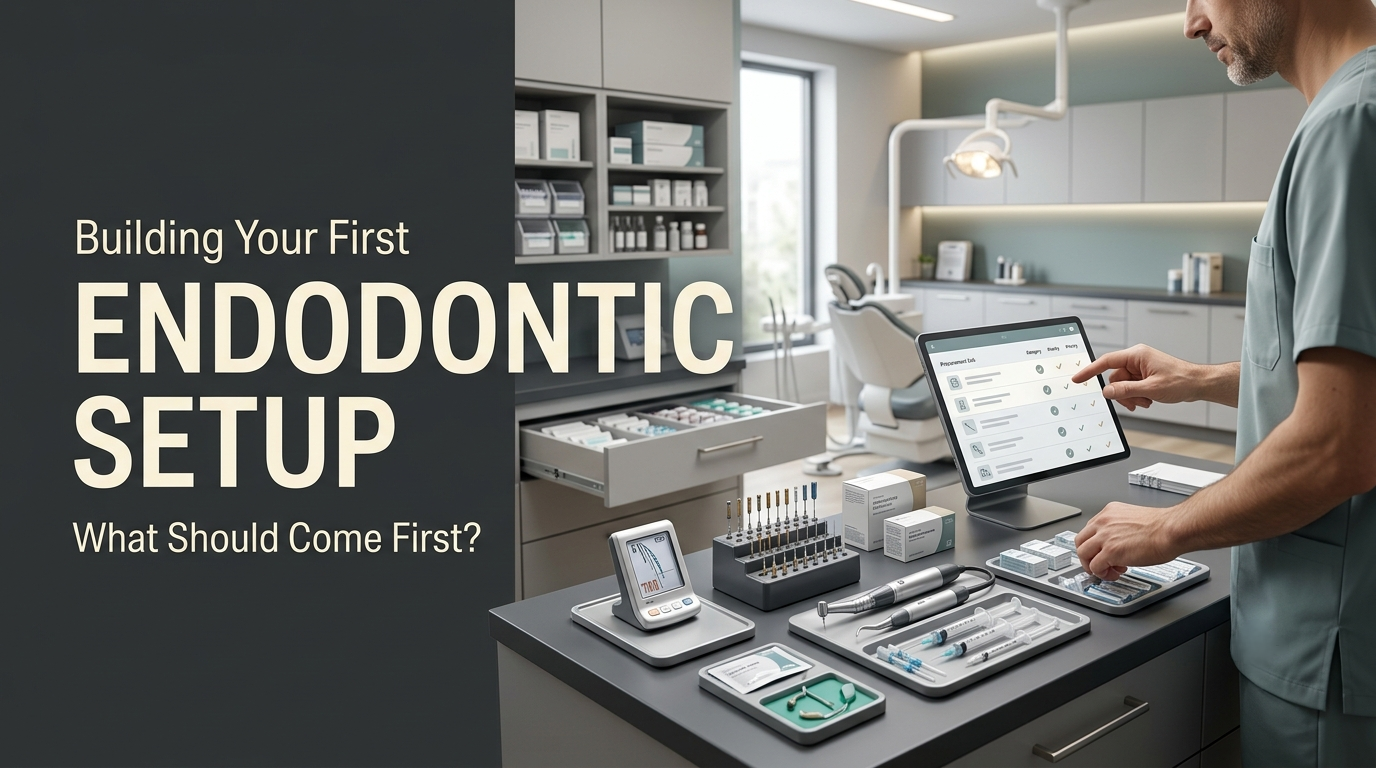
New Dental Clinic Endodontic Procurement Checklist and Guide
How Should a New Dental Clinic Build Its First Endodontic Procurement List?Build it in this order. Have the treating dentists choose one instrumentation and obt