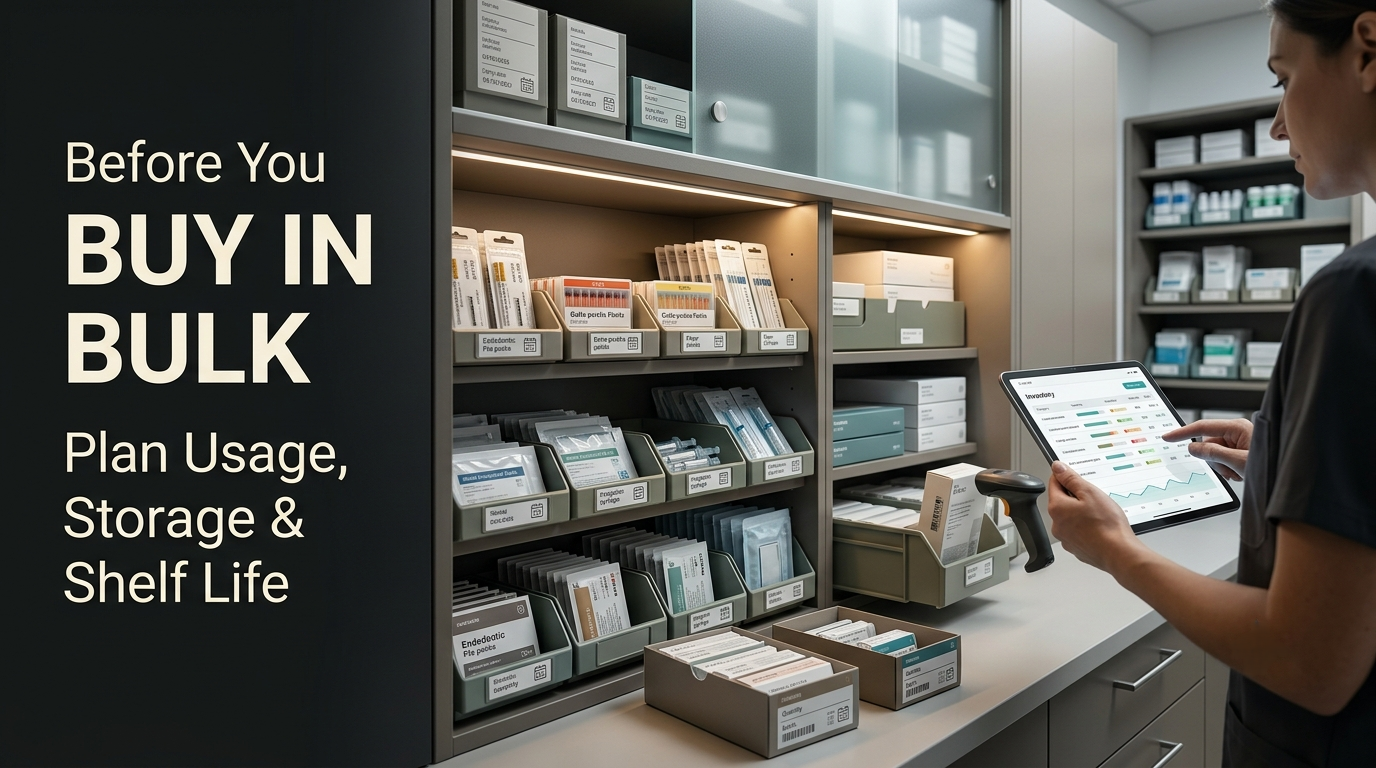
Bulk Buying Endodontic Supplies for Dental Clinics

Dr. Gurjeet
Contributing Dental Clinician
What Should a Dental Clinic Consider Before Buying Endodontic Products in Bulk?
Before buying endodontic products in bulk, check four things:
How much your clinic uses each month, taken from records rather than memory.
The expiry date on the batch that will actually arrive.
Whether you have the right storage conditions and space.
The cost per unit actually used, not the cost per unit bought.
Bulk buying pays only for fast-moving items your clinic will finish well before they expire, and only when the discount is still worth having after likely waste. Rotary files and paper points in your standard sizes usually qualify. Gutta-percha can qualify in your most-used sizes if you have cool storage and will use it within a few months. Sealers, slow-moving sizes and retreatment solvents usually do not.
The invoice shows the saving on day one. The shelf shows the real result months later. Everything below is about closing the gap between those two numbers.
Cost per Unit Used: The Only Number That Matters
The bulk price is what you pay. The number that decides the deal is what each unit costs once waste is counted:
Divide what you paid by the number of units you actually use before expiry.
Worked example (hypothetical figures): a clinic uses one tube of root canal sealer a month and normally pays ₹1,200 a tube. A supplier offers 12 tubes at 20% off: ₹960 a tube, or ₹11,520 in total. The batch that arrives has 9 months of shelf life left.
The clinic uses 9 tubes before expiry. The other 3 expire unopened.
So each tube actually used costs ₹1,280.
That is ₹80 more per tube than the normal price, so the 20% discount has turned into a premium.

Now apply the same 20% discount to rotary files. The clinic uses 4 packs a month, and sterile file packs typically carry a long expiry. Buying 12 packs gives 3 months of stock, every pack gets used well within its date, and the clinic keeps the full 20% saving. Same discount, opposite outcome. The difference is long expiry and steady use, not the absence of an expiry date: always check the date on the batch.
Which Endodontic Items Suit Bulk Buying?
The pattern is consistent. The more often an item is used, and the less time and storage conditions affect it, the safer it is to buy in bulk.
Item | Bulk-buying suitability | Why |
Rotary files (standard sizes, single-use) | High | Used every case; long expiry on sterile packs; check the batch date |
Paper points (standard sizes) | High | Used every case; stable if kept dry and sealed |
Irrigation needles and syringes | High | Fast-moving; long-dated |
Rubber dam sheets | Moderate to high | Fast-moving, but latex ages with heat and light; needs cool, dry storage |
Gutta-percha (standard sizes) | Moderate | Fast-moving, but ages and turns brittle with heat and time; buy only a few months ahead |
Sodium hypochlorite | Moderate to low | Degrades with heat and light; large volumes lose strength before use |
Sealers | Low | Slower-moving; finite shelf life; expensive per tube |
Slow-moving file and cone sizes | Low | Likely to expire before use |
Retreatment solvents and specialist items | Low | Used occasionally |

Gutta-percha deserves a specific note. Cones that have aged or been stored warm lose flexibility, which matters during compaction. Our guide to choosing gutta-percha points explains why taper and condition affect the fit.
Shelf Life: Ask About the Batch, Not the Product
The shelf life printed on a product listing tells you little. What matters is how many months remain on the batch that will actually be delivered. Ask the supplier before ordering, and check again when the stock arrives.
A practical ceiling is to plan to use up a bulk purchase within about three-quarters of its remaining shelf life. The other quarter is a buffer for slow months, a dentist on leave or a change in case mix. That gives a simple rule: order no more than three-quarters of what you would use before the batch expires.

Two examples:
A sealer used once a month, with 12 months remaining: no more than 9 tubes.
An irrigant used at 5 bottles a month, with 10 months remaining: cap the order at 37 bottles.
If a supplier's minimum order is above this ceiling, decline the deal. Do not stretch the rule to fit it.
Storage Conditions Can Erase the Discount
Read the storage instructions on the label before deciding where bulk stock will live. Many endodontic materials are labelled for storage below a stated temperature and away from direct light. A store room that heats up in May, or a cabinet next to the autoclave, can shorten a product's useful life well before the printed expiry date.
Hypochlorite is the most common casualty. It breaks down faster when warm or exposed to light, so a drum bought to last six months may be weaker than its labelled concentration by the time it reaches the canal. The clinician's guide to endodontic irrigating solutions covers why concentration matters for debridement. If you do not have a cool, dark, dry space with room for the volume, buy smaller quantities.
How Case Mix and Volume Change the Answer
Consumption follows anatomy. A molar typically has three or more canals, so each molar case uses more files, paper points, cones and irrigant than a single-canal anterior tooth. Retreatments use more again.
Worked example (hypothetical): two clinics each complete 20 RCTs a month. Using the same assumptions as the rest of this series, a molar or retreatment uses about 15 paper points and a single-canal tooth about 4, and paper points come in boxes of 200.
Clinic A: 14 molar and retreatment cases, 6 single-canal teeth.
Clinic B: 6 molar and retreatment cases, 14 single-canal teeth.
Points per month | Boxes per month | |
Clinic A | 234 | About 1.2 |
Clinic B | 146 | About 0.7 |
Clinic A uses up bulk stock about 60% faster, so the same bulk pack carries less expiry risk for it.
At the other end of the scale is a general practice doing four or five RCTs a month. A bulk pack that a specialist practice clears in weeks could sit on that clinic's shelf for most of a year.
Cash Flow and System Lock-In
Money tied up in bulk stock cannot be spent on anything else. If a clinic holds ₹60,000 of inventory meant to last six months, that ₹60,000 is not available when a handpiece breaks or a payment is delayed. For a smaller clinic, a modest discount rarely justifies holding six months of slow-moving stock.
Bulk buying also commits you to a system. Suppose a dentist is thinking of switching, for example to a heat-treated NiTi file system for curved canals. A shelf full of the old files creates pressure to keep using them. Clinical choice should never follow the discount, so confirm with the treating dentist that the system is staying before committing to a large order.
Receiving and Rotating Bulk Stock
When a delivery arrives:
Check the expiry date on every box against what the supplier promised.
Label each box clearly with its expiry date.
Place new stock behind existing stock.
Rotate on a first-expiry, first-out (FEFO) basis rather than first-in, first-out. A later delivery can carry an earlier expiry date, so the date, not the delivery order, decides what gets used first.
Once a month, compare the units remaining against the maximum-quantity rule above. If a bulk item is running behind schedule, stop reordering it. Use it in cases where it fits, or move it to a sister clinic if you have one.
Once you know which items genuinely qualify for bulk buying, the Dentalkart endodontics range can be browsed by product type.
Frequently Asked Questions
Expired materials must come out of clinical stock completely and never be used on patients. Some clinics move expired non-sterile items into a clearly labelled training box for practice on typodonts or extracted teeth. Keep that box physically separate so nothing drifts back into the operatory.
Single-size packs in your most-used sizes usually waste less. With assorted packs, the extreme sizes tend to go unused while the middle sizes run out. Check your usage records by size before ordering, and bulk-buy only the sizes you use every week.
Yes, provided every clinic uses the same products and stock can be moved between clinics. Pooling lets each clinic draw stock at its own pace while the group clears the order before expiry. Without a shared approved product list, pooled orders tend to leave stock stranded at clinics that use a different system.
Written by
Dr. Gurjeet
Contributing Dental Clinician
Dr. Gurjeet is a practising dental clinician contributing to Dentalkart Blogs, sharing chair-side experience, treatment protocols, and equipment insights for the wider dental community.
Keep reading
Browse all →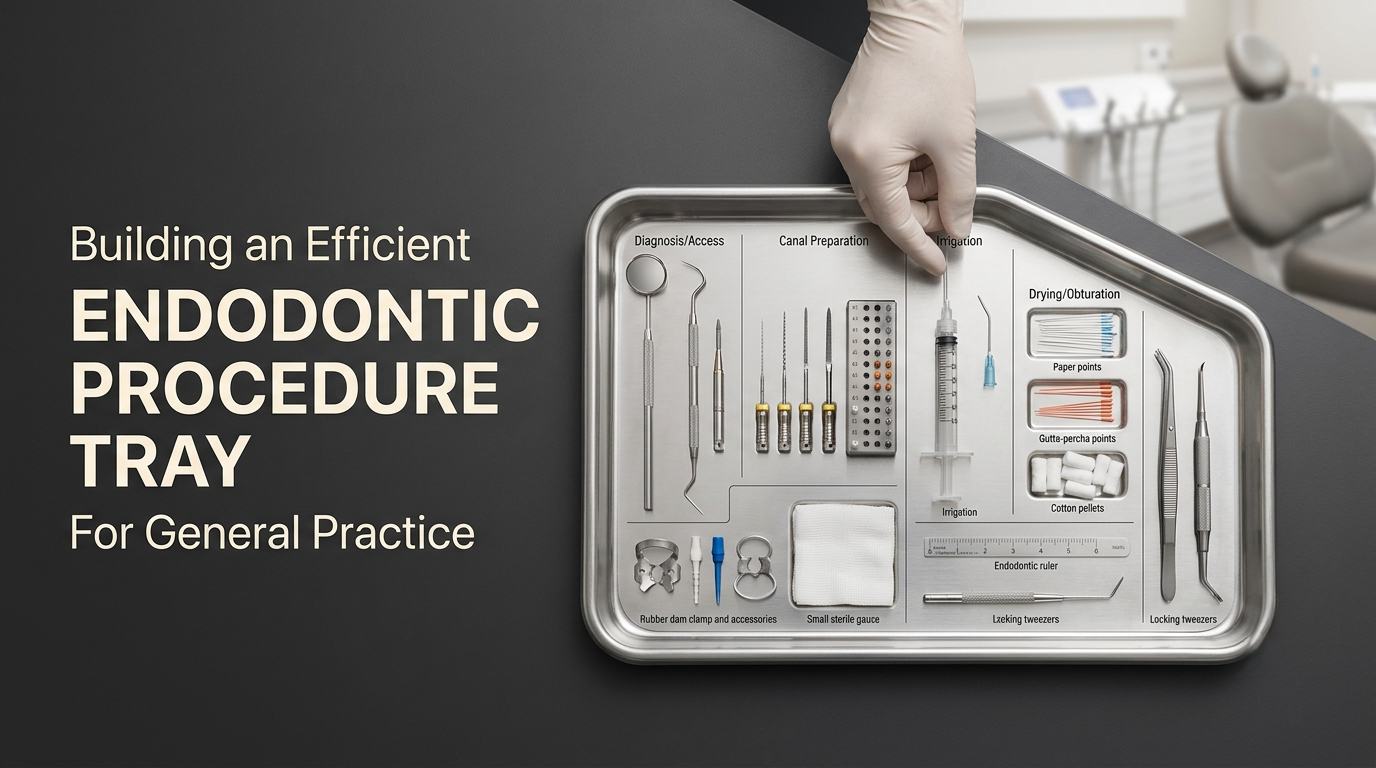
Endodontic Procedure Tray Setup for General Dental Practice
How Do You Build an Endodontic Procedure Tray for a General Dental Practice?Build the tray in three layers:A lean core tray used for every root canal treatment.

Dental Group Endodontic Purchasing Policy and Best Practices
How Can Dental Groups Create a Standard Endodontic Purchase Policy?A dental group or chain creates a standard endodontic purchase policy in five steps. First, a
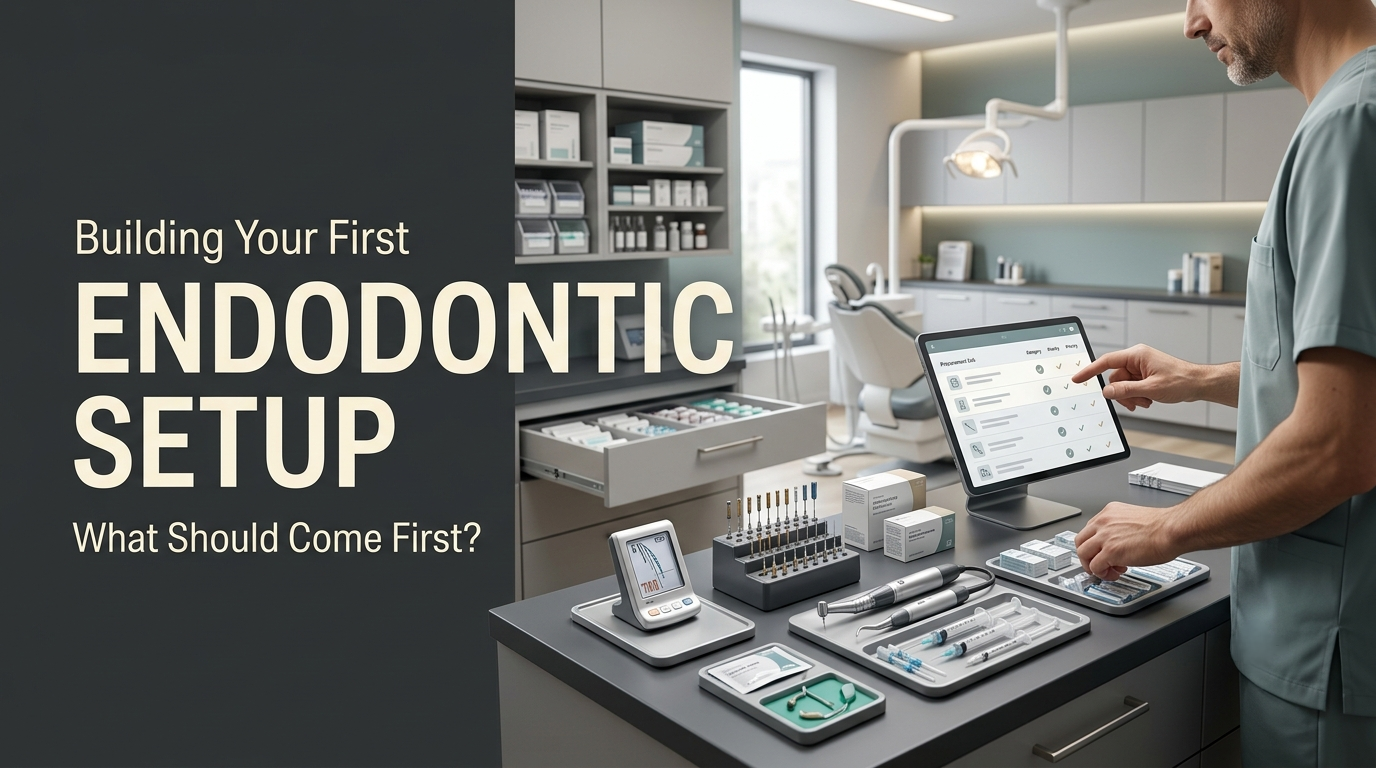
New Dental Clinic Endodontic Procurement Checklist and Guide
How Should a New Dental Clinic Build Its First Endodontic Procurement List?Build it in this order. Have the treating dentists choose one instrumentation and obt