
Dr. Prerna Sahrawat
Contributing Dental Clinician
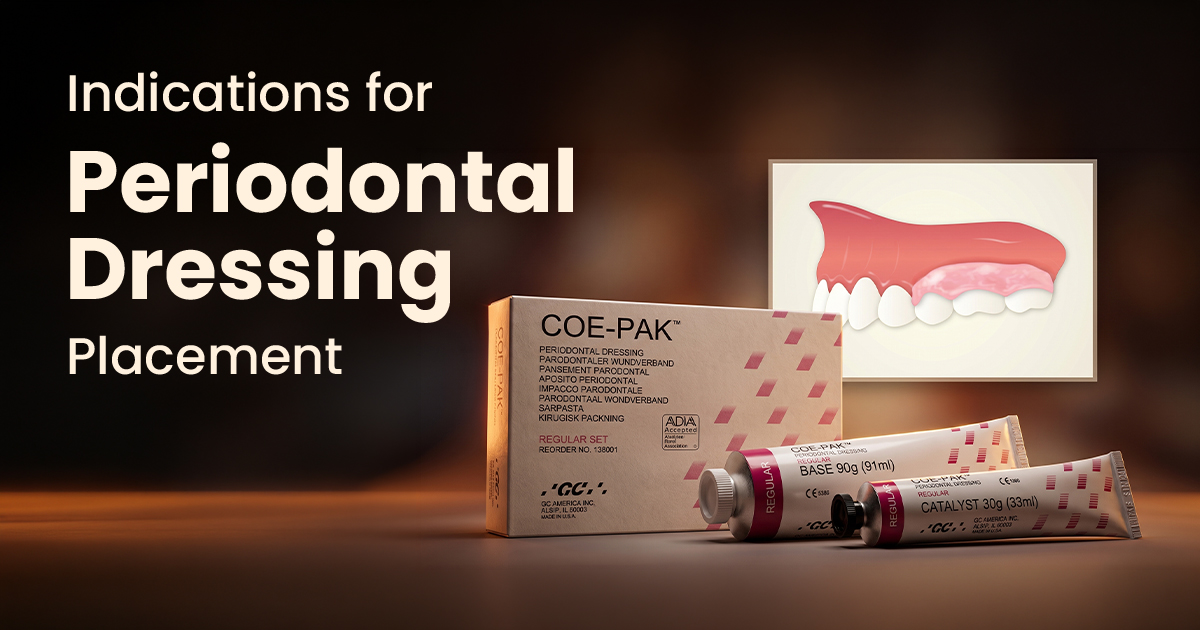
Indications for Periodontal Dressing Placement
A Clinical Case Selection Guide
A periodontal dressing material is a protective pack placed over a surgical site to shield the wound, enhance patient comfort, and stabilize tissues during initial healing. This guide focuses on evidence-based case selection, clarifying when a dressing is critical versus when it may be safely omitted.
Table of Contents
Primary Functions of a Periodontal Dressing
The primary function of a periodontal dressing is to act as a physical barrier, protecting the surgical wound from mechanical trauma and contamination during the critical initial healing phase. By shielding the underlying clot and delicate tissues from the forces of mastication and tongue movement, it provides an environment conducive to undisturbed repair. This mechanical protection is particularly vital for the first 7-10 days post-surgery, when the wound has minimal tensile strength.
Beyond protection, dressings aid in adapting flaps or grafts securely against the underlying bone, minimizing the potential for dead space and hematoma formation. While they do not possess any inherent wound healing properties, their ability to improve patient comfort by covering exposed connective tissue and reducing pain is a significant clinical benefit. Properly placed, they also help in controlling minor post-operative oozing by providing gentle pressure.
- Wound Protection: Shields the site from food impaction, tongue movement, and other mechanical irritants.
- Clot Stabilization: Protects the initial blood clot, which is essential for organized healing and regeneration.
- Tissue Adaptation: Helps to hold flaps and grafts in their intended position against the bone.
- Patient Comfort: Covers exposed, sensitive tissues, significantly reducing post-operative pain and sensitivity.
- Hemostasis: Provides gentle pressure to control minor capillary bleeding or oozing after surgery.
CORE ROLES OF A PERIODONTAL DRESSING
Acts as a physical bandage against mechanical trauma and food debris.
Maintains the initial blood clot, which is crucial for successful tissue healing.
Reduces post-operative pain by covering sensitive, exposed wound surfaces.
Surgical Procedures Warranting a Dressing
A dressing is strongly indicated for procedures where tissue stability is paramount and large areas of connective tissue are exposed. The classic example is a free gingival graft (FGG), where the dressing is critical for immobilizing the graft, preventing its displacement, and protecting it during the initial revascularization period. Without a stable dressing, the graft's survival is significantly compromised.
Similarly, extensive gingivectomy or gingivoplasty procedures that leave a broad, raw connective tissue surface benefit greatly from a dressing. It acts as a palliative covering, drastically reducing post-operative pain and sensitivity for the patient. For certain flap procedures, especially apically positioned flaps without perfect primary closure, a dressing can help maintain the new flap position and protect the exposed periosteum or bone. All these procedures benefit from the protection offered by quality periodontic products.
- Free Gingival Grafts (FGG): Essential for graft immobilization, adaptation, and survival.
- Laterally Positioned Flaps: Helps stabilize the flap in its new position over the recipient site.
- Extensive Gingivectomy/Gingivoplasty: Primarily for patient comfort, covering the large raw wound surface.
- Apically Positioned Flaps: Used when primary closure is not achieved to protect exposed bone or periosteum.
Dressing Application Decision Matrix
Safely Omitting a Periodontal Dressing
A periodontal dressing can be safely omitted in any procedure where precise primary closure of the flaps is achieved and the wound margins are stable. Modern suturing techniques and materials often provide sufficient wound stability, making a dressing redundant. In these cases, omitting the dressing can improve post-operative oral hygiene, as patients can clean adjacent areas more effectively.
Procedures such as flap for osseous resective surgery, crown lengthening, and exploratory flaps that conclude with well-approximated wound edges do not require a dressing. The sutures alone are adequate to maintain flap position. Furthermore, dressings can sometimes act as a plaque-retentive surface if not perfectly adapted, potentially hindering rather than helping the healing process. The key determinant is the stability of the closed wound immediately after suturing.
- Flaps with Primary Closure: Includes most osseous surgeries and pocket reduction procedures where flap edges are tightly sutured.
- Crown Lengthening: When flap margins are stable and sutured coronally or at the new bone crest.
- Gingival Curettage: This minimally invasive procedure does not create an open wound requiring a dressing.
- Small Biopsy Sites: Punch or small excisional biopsy sites that are sutured or achieve hemostasis quickly.
Pre-Omission Safety Checklist
The flap edges must be well-approximated with no gaps.
Tissues should be stable and securely adapted to the underlying bone.
There should be no active bleeding or significant oozing from the wound margins.
The patient must be able to follow post-operative instructions for gentle oral hygiene.
Non-Eugenol or Light-Cured: Which to Choose?
The choice between a non-eugenol paste and a light-cured resin dressing depends on handling preferences, the surgical site, and esthetic demands. Non-eugenol zinc oxide dressings (e.g., Coe-Pak) are two-paste systems that set via a chemical reaction, remaining pliable for several minutes, which allows for detailed adaptation around teeth and into interproximal spaces. They are ideal for posterior regions and large surgical sites.
In contrast, light-cured dressings (e.g., Barricaid) are single-component materials delivered via syringe and cured on demand with a standard curing light (typically for 20-40 seconds). They offer superior esthetics due to their translucent pink color, making them the preferred choice for the anterior maxilla. While they are more rigid and less forgiving during placement, their smooth surface is more comfortable for the patient and less plaque-retentive. Selecting the right periodontal dressing material is key to a successful outcome.
- Handling: Non-eugenol pastes offer a longer working time for contouring; light-cured resins provide command-set control.
- Esthetics: Light-cured dressings are tooth-colored or translucent pink, ideal for anterior zones.
- Rigidity: Light-cured dressings set to a hard, rigid state, while non-eugenol pastes remain slightly flexible.
- Placement: Syringe-based delivery of light-cured materials can be faster for smaller sites.
| Feature | Non-Eugenol (e.g., Coe-Pak) | Light-Cured (e.g., Barricaid) |
|---|---|---|
| Setting Mechanism | Chemical reaction (2-paste) | Photopolymerization (Command set) |
| Handling | Pliable, long working time | Syringeable, less adaptable once placed |
| Esthetics | Opaque, pink/white | Translucent pink, superior best |
| Rigidity | Firm but slightly flexible | Hard and very rigid |
| Ideal Location | Posterior regions, large sites | Anterior regions, single-tooth sites |
| Removal | Breaks off in pieces | Often removed as a single unit |
Conclusion: Judicious Dressing Placement
The decision to place a periodontal dressing should be driven by surgical necessity rather than routine protocol. Its primary value lies in protecting vulnerable sites like free gingival grafts and managing patient comfort after extensive tissue removal. In cases of stable primary closure, omitting the dressing often promotes better hygiene and equivalent healing. Therefore, evaluate each case individually based on wound stability and the extent of exposed tissue. This selective approach aligns with modern, minimally invasive periodontal principles.
- Graft Protection: Always apply a dressing over free gingival and connective tissue grafts to ensure complete immobilization, which is critical for survival.
- Primary Closure: Safely omit dressings when precise primary closure is achieved, as modern sutures provide adequate stability and facilitate better patient hygiene.
- Esthetic Zones: Choose a light-cured dressing for anterior surgical sites to provide superior esthetics and patient comfort during the 7-10 day healing period.
- Patient Comfort: For extensive gingivectomies, a non-eugenol dressing is invaluable for covering the large raw surface and minimizing post-operative pain.
Frequently Asked Questions
The main purpose of a periodontal dressing material is to act as a protective barrier over a surgical wound. It shields the area from mechanical irritation from food and the tongue, helps stabilize the blood clot, aids in adapting tissues like flaps or grafts, and significantly improves patient comfort by covering sensitive, exposed areas.
A periodontal dressing should typically remain in place for 7 to 10 days. This duration allows for initial wound healing and epithelialization. At the follow-up appointment, the dressing is removed, and the site is gently cleansed and evaluated. Leaving it longer can increase plaque accumulation and tissue inflammation.
No, a periodontal dressing is not necessary or indicated for a routine, uncomplicated tooth extraction. A stable blood clot forming within the socket is the natural and preferred dressing. A dressing is only considered in periodontics for soft tissue flap or graft surgeries, not for standard exodontia sockets.
The primary difference is the presence of eugenol, an essential oil that can cause tissue irritation, allergic reactions, and a burning sensation for some patients. Eugenol-based dressings are now largely obsolete. Non-eugenol dressings, typically zinc oxide-based, are the current standard of care as they are biocompatible and cause minimal tissue irritation.
Patients should not eat normally. They should be instructed to follow a soft diet and chew on the opposite side of the mouth to avoid dislodging the dressing. Hard, crunchy, or sticky foods must be avoided, as they can fracture the dressing and traumatize the underlying surgical site, compromising healing.
Written by
Dr. Prerna Sahrawat
Contributing Dental Clinician
Dr. Prerna Sahrawat is a dentist with over 4 years of experience in clinical dentistry and dental content writing. She is passionate about simplifying complex dental concepts into practical, evidence-based content that helps dentists make informed clinical and purchasing decisions while staying updated with the latest advancements in dentistry.
Keep reading
Browse all →
Indications for Periodontal Fiber Splinting
Indications for Periodontal Fiber SplintingA Clinical Case Selection Guide Periodontal splinting is indicated for stabilizing teeth with increasing mobility (Mi
Preventing Burnished Calculus with Gracey Curettes
Preventing Burnished Calculus with Gracey CurettesA Subgingival Scaling Protocol Burnished calculus is a residual deposit smoothed by an incorrectly used curett
Socket Preservation Grafting: A Case-Based Clinical Analysis
Socket Preservation Grafting: A Case-Based Clinical AnalysisSelecting Materials for Ridge Integrity Socket preservation — also called alveolar ridge preservatio
