
Dr.Yukti
Dental Content Contributor
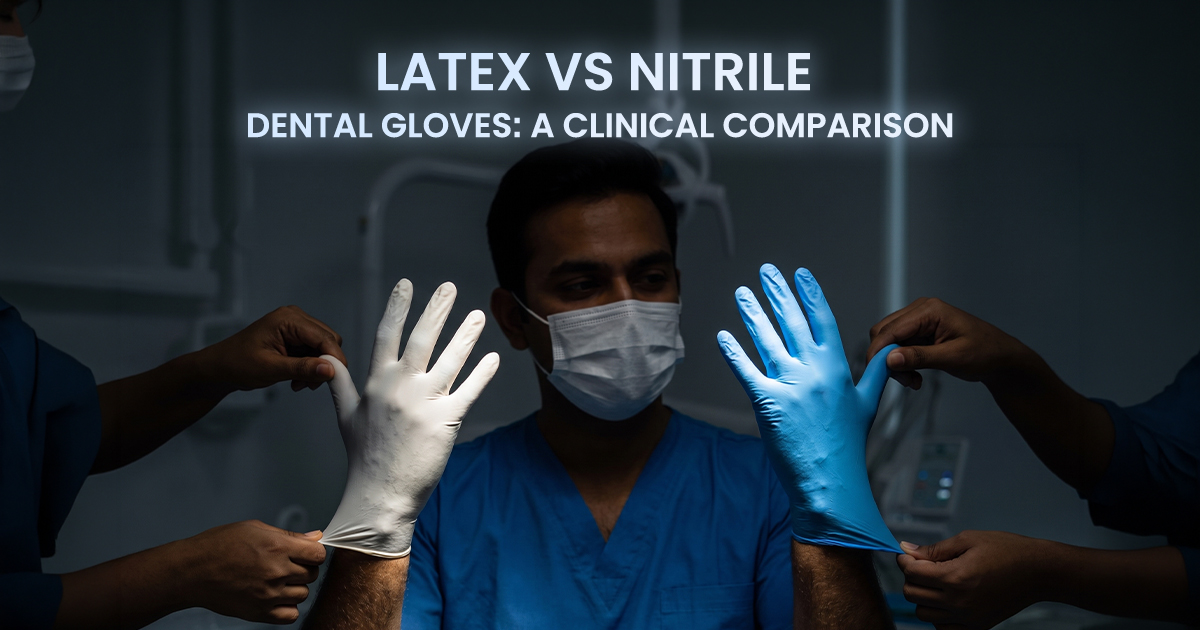
Latex vs Nitrile Dental Gloves: A Clinical Comparison
Your Clinical Selection Guide
The choice between latex and nitrile dental examination gloves balances latex's superior tactile sensitivity against nitrile's higher puncture resistance and hypoallergenic properties. This decision directly impacts procedural precision, infection control, and the long-term health of both clinicians and patients.
Table of Contents
Glove Material and Tactile Sensitivity
Latex gloves offer superior tactile sensitivity compared to nitrile gloves due to their higher elasticity and lower modulus, allowing them to conform more closely to the hand. This “second skin” feel is critical for procedures requiring fine motor control and the ability to discern subtle surface textures, such as detecting subgingival calculus or faint carious lesions.
The natural rubber in latex provides excellent tensile strength and elongation, meaning it stretches without losing its form-fitting shape. This property ensures that the clinician's proprioceptive feedback is minimally impeded. While modern nitrile formulations have improved, they remain slightly stiffer, which can marginally reduce the feedback needed for delicate tasks like placing retraction cords or evaluating crown margins.
- Endodontics: Latex allows for better feel of the apical constriction when negotiating canals with hand files.
- Periodontics: Enhanced sensitivity is crucial for differentiating between calculus deposits and root surface irregularities during scaling and root planing.
- Restorative Dentistry: Precisely detecting marginal overhangs or flash on composite restorations is easier with the tactile feedback of latex.
- Diagnostics: Palpating for lymphadenopathy or subtle tissue changes during an oral cancer screening requires maximum tactile acuity.
Latex Gloves
- Superior elasticity and fit
- Excellent tactile sensitivity
- High comfort for long procedures
- Significant allergy risk (Type I & IV)
Nitrile Gloves
- Good tactile sensitivity (improving with new tech)
- Hypoallergenic (no latex proteins)
- Slightly less elastic and flexible than latex
- Can feel stiffer during initial wear
Clinical Risk of Latex Allergies
The primary clinical risk of latex is a Type I hypersensitivity reaction, an IgE-mediated allergy to natural rubber proteins that can manifest as urticaria, rhinitis, asthma, or life-threatening anaphylaxis. A less severe Type IV (delayed) hypersensitivity, a T-cell mediated reaction to processing chemicals, can also occur, causing contact dermatitis.
Clinicians and staff with daily exposure are at elevated risk of developing sensitization over time. For patients, those with a history of spina bifida, multiple surgeries, or allergies to foods like bananas, avocados, or kiwis (latex-fruit syndrome) are at higher risk. Maintaining a completely latex-free environment is the only definitive way to prevent reactions in sensitized individuals, protecting both the dental team and patients from potential medical emergencies.
- Clinician Risk: Cumulative exposure increases the risk of occupational asthma and contact dermatitis, potentially ending a clinical career.
- Patient Risk: An undisclosed allergy can lead to a severe intraoperative or postoperative systemic reaction.
- Cross-Contamination: Airborne latex particles from powdered gloves (now less common) can trigger reactions even without direct contact.
- Medicolegal Implications: Failure to take an adequate allergy history and use appropriate gloves carries significant medicolegal liability.
Anaphylaxis Risk
A Type I latex allergy can escalate to anaphylactic shock within minutes of exposure. Ensure your clinic is equipped with an emergency kit containing epinephrine and that all staff are trained in its administration.
Glove Puncture and Tear Resistance
Nitrile gloves offer significantly better puncture resistance than latex gloves, making them the safer choice for procedures involving sharp instruments, burs, or potential contact with bone fragments. The synthetic acrylonitrile-butadiene copolymer structure of nitrile is inherently more durable and resistant to mechanical stress and tearing.
This enhanced protection is critical during surgical procedures like extractions, implant placement, or periodontal surgery. Furthermore, nitrile has low “memory”; when punctured, it tears, making breaches more obvious and visible to the clinician. Latex, by contrast, is highly elastic and can be punctured by a fine needle or probe and reseal, potentially masking a breach in the infection control barrier. This makes nitrile a more reliable material for high-risk applications.
- Surgical Procedures: Nitrile's durability protects against suture needles, scalpels, and sharp edges of bone during extractions or alveoloplasty.
- Instrument Handling: Reduces risk of sharps injuries when handling and cleaning contaminated instruments.
- Chemical Resistance: Nitrile is more resistant to breakdown from oils, solvents, and many disinfectants used chairside.
- Visible Breach: A tear in a nitrile glove is more likely to propagate, immediately alerting the user to the need for a change.
| Property | Latex | Nitrile |
|---|---|---|
| Puncture Resistance | Good | Excellent best |
| Tensile Strength | Excellent | Very Good |
| Elasticity / Elongation | Excellent best | Very Good |
| Chemical Resistance | Fair | Excellent |
| Allergy Potential | High (Type I & IV) | Very Low (Type IV only) value |
Cost vs Performance: A Practical Comparison
While nitrile gloves often have a higher per-box cost than latex, a comprehensive value analysis must account for performance, safety, and failure rates. The superior durability of nitrile means fewer in-procedure tears and punctures, potentially reducing the total number of gloves used and minimizing the risk of costly sharps injuries.
For a high-volume Indian practice, the added cost of nitrile can be justified as an investment in safety and risk management. It eliminates the potential for treating allergic reactions in patients or staff and simplifies inventory by allowing for a single, universally safe glove type. When sourcing dental disposables, balancing the budget against clinical risk is key. For non-invasive procedures on non-allergic patients, latex may be a cost-effective choice, but nitrile remains the superior all-around option for safety and versatility.
- Failure Rate: Factoring in the cost of glove changes due to rips shows nitrile can be more economical in demanding procedures.
- Safety Overhead: The cost of managing a single allergic reaction or sharps injury far exceeds the marginal price difference in gloves.
- Versatility: Stocking only nitrile simplifies ordering and eliminates the risk of accidental latex exposure.
- Patient Perception: Using high-quality, hypoallergenic materials can enhance patient confidence in your clinic's infection control standards.
Glove Selection Matrix
Frequently Asked Questions
Nitrile gloves are the best choice for handling PVS (polyvinyl siloxane) impression materials. The sulfur-containing compounds used in the vulcanization of latex gloves can inhibit the setting reaction of PVS, leading to a distorted or incomplete impression. Using nitrile eliminates this risk of chemical interaction, ensuring predictable and accurate results.
The main difference is in protection and fit. Nitrile gloves offer excellent puncture and chemical resistance with a snug, comfortable fit. Vinyl (PVC) gloves are less elastic, offer a looser fit, and provide minimal protection against punctures or chemicals. Vinyl is a low-cost option suitable only for very low-risk, short-duration tasks like examinations, not for most clinical procedures.
Nitrile gloves tear during donning usually due to improper sizing or technique. If the glove is too small, it will be overstretched, causing it to fail. Ensure you are using the correct size for your hand. Additionally, pull the glove on from the cuff, not by pinching the palm or fingers, to distribute the force evenly and prevent localized stress that can initiate a tear.
The color of dental examination gloves is primarily for branding and contrast, not a direct indicator of quality. However, black nitrile gloves can offer a distinct clinical advantage by providing high contrast against oral tissues, tooth structure, and dental materials like composites or cements. This can help improve visibility and reduce eye strain during intricate restorative procedures.
Gloves should be changed whenever a tear or puncture is suspected, or after touching a non-sterile surface. For long procedures, it is good practice to change gloves approximately every 60-90 minutes. Over time, mechanical stress and exposure to saliva can create microscopic perforations (glove degradation) that compromise the barrier, even without a visible tear.
Written by
Dr.Yukti
Dental Content Contributor
Dr. Yukti Jain is a BDS-qualified dental professional and Product Specialist at Dentalkart with expertise in dental materials, equipment, and clinical innovations. Passionate about evidence-based dentistry, she creates insightful, research-driven content that simplifies complex topics and empowers dental professionals to make informed clinical and purchasing decisions.
Keep reading
Browse all →
When to Use Absorbable Gelatin Sponges?
When to Use Absorbable Gelatin Sponges?Clinical Hemostasis Case Selection An absorbable dental hemostatic sponge is a sterile, porcine-derived gelatin foam used

Correcting Common Pit & Fissure Sealant Application Errors
Correcting Common Pit & Fissure Sealant Application ErrorsAn Evidence-Based Guide Successful pit and fissure sealant application is technique-sensitive, and
Dental RVG Sensor Quality Assurance Protocol
Dental RVG Sensor Quality Assurance ProtocolA Clinical Calibration Guide A dental RVG (radiovisiography) sensor quality assurance protocol is a set of routine t