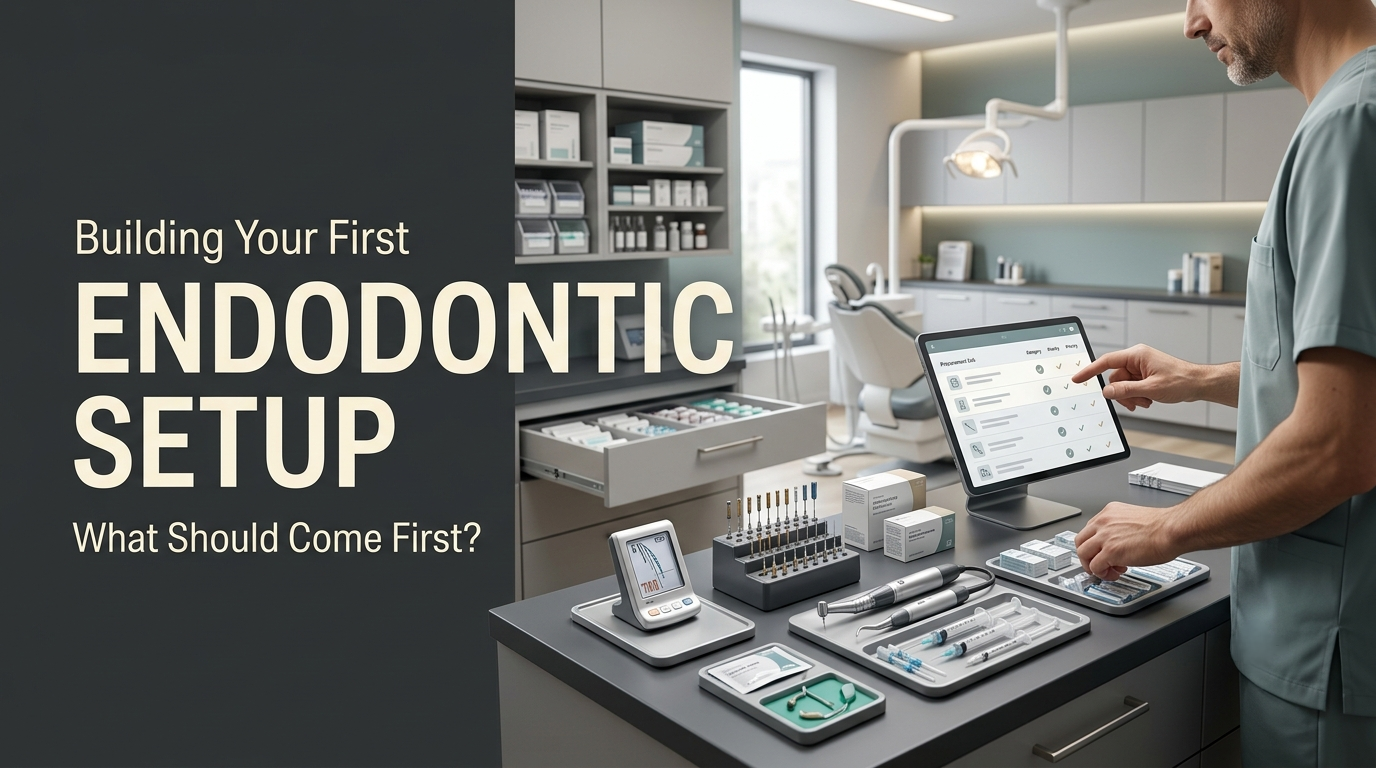
New Dental Clinic Endodontic Procurement Checklist and Guide

Dr. Gurjeet
Contributing Dental Clinician
How Should a New Dental Clinic Build Its First Endodontic Procurement List?
Build it in this order. Have the treating dentists choose one instrumentation and obturation system. Buy the Phase 1 equipment that system needs (endomotor, apex locator, radiography, sterilisation). Stock consumables for roughly the first six weeks of forecast root canals plus a modest buffer. Defer ultrasonics, warm obturation and magnification until real case volume justifies them.
A new clinic has no usage history, so every quantity is a forecast. Build the list to be corrected after about three months, not to be right on day one. When I set up my own first operatory, the items I over-bought were the ones a sales representative convinced me I "would definitely need"; the items I ran out of were the boring ones.
Choose the System Before You Open a Catalogue
The most expensive procurement mistake in endodontics is buying items that do not work together. Files, motor and obturation form a chain:
File system and motor. Rotary files run at manufacturer-specified speed and torque; reciprocating files need a motor with the matching reciprocation programme. Confirm the endomotor carries presets for the system your dentists will actually use.
Files and obturation. Master cones should match the final shaping file's tip size and taper, so the file system decides which gutta-percha points and paper points you stock.
Technique and sealer. Single-cone, cold lateral and warm vertical techniques need different sealers and equipment.
Let the dentists who will treat the patients make these choices based on their training. Procurement then works backwards from that decision. One system on opening day is enough; a second doubles the size range without adding clinical capability.
Three Phases, Not One Big Order
Group | Phase 1: before opening | Phase 2: when demand shows | Phase 3: as the practice matures |
Equipment | Endomotor, apex locator, X-ray unit and sensor or film, autoclave | Ultrasonic unit with endo tips, warm obturation unit | Magnification (loupes or microscope), CBCT access |
Instruments | Hand instruments, endo ruler, spreaders or pluggers for the chosen technique, rubber dam kit | Retreatment instruments, extra instrument kits for parallel cases | Specialist instruments for microsurgery |
Consumables | Files, irrigant and side-vented needles, paper points, gutta-percha, sealer, rubber dam sheets, burs, temporary restoration, local anaesthetic | Larger packs of proven fast movers | Bulk agreements on stable lines |
Sterilisation and safety | Pouches, indicators, PPE, sharps and waste containers | Extra cassettes and trays | Tracking systems |
Records | Consent and treatment record formats | Inventory and cost tracking | Outcome audits |

Phase 1 is everything needed to complete an RCT safely, from diagnosis to coronal seal. Nothing more.
Worked Example: Sizing the Opening Order
Hypothetical clinic forecast; replace with your own assumptions.
Item | Value |
Forecast RCTs, month 1 | 8 |
Forecast RCTs, month 2 | 12 |
Forecast RCTs, month 3 | 16 |
Opening order covers | Month 1 plus half of month 2: 14 cases |
Buffer (25%, because there is no history) | 4 cases |
Opening order sized for | 18 cases |

At an assumed consumable cost of ₹1,300 per case (hypothetical), the opening consumable spend comes to about ₹23,400. Buying a year's supply up front, at a forecast of around 180 cases, would tie up roughly ₹2,34,000 in stock before a single case had confirmed the forecast, the case mix, or even that the dentists are happy with the chosen system.
Translate the 18-case figure into packs item by item. Using the same assumptions as the rest of this series, an average case uses about 11 paper points (fewer for anteriors, about 15 for a molar), so 18 cases need about 200, one pack of 200 in your most-used sizes. Single-use file sequences need one per case, so 18 sequences, split across the sizes the system uses. Round up to pack size for fast movers; round down, or buy smaller packs, for anything with a short shelf life once opened.
Reorder from the second week using actual consumption, not the forecast. By the end of month 3 you will have real numbers to build proper reorder points.
When Phase 2 Equipment Earns Its Place
Deferred equipment should come in when it changes outcomes or efficiency for a measurable number of cases, not when a catalogue makes it look essential. A simple cost-per-case test helps.
Hypothetical example: a warm obturation unit costing ₹60,000, used over 5 years (60 months).
Warm obturation cases per month | Total cases over 5 years | Equipment cost per case |
10 | 600 | ₹100 |
30 | 1,800 | About ₹33 |

At low volume the unit adds ₹100 to every case it is used on; at three times the volume, a third of that. The same logic applies to an ultrasonic unit, whose case strengthens as retreatments, calcified canals and separated instruments become part of your caseload. Magnification follows when complexity, not just volume, rises.
Write the trigger down in advance, for example "add a warm obturation unit when the dentists' technique and monthly case volume support it", so the decision is made against a rule rather than a sales visit.
Do Not Forget the Non-Endo Prerequisites
Several Phase 1 items sit outside the endo catalogue but stop treatment just as surely if missing:
Radiography and AERB licensing. In India, a dental X-ray facility needs a licence for operation from the Atomic Energy Regulatory Board (AERB), obtained through its eLORA portal, before the X-ray unit is used on patients. The process requires type-approved equipment, a designated Radiological Safety Officer, quality assurance tests on the installed unit and a compliant room layout. Build the lead time for all of this into your opening plan.
Sterilisation capacity. A validated autoclave with enough cycle capacity for your instrument turnover, plus pouches and indicators.
Biomedical waste. Segregation containers and an agreement with an authorised common biomedical waste treatment facility, as required under the Bio-Medical Waste Management Rules, 2016.
Disposables and interim materials. PPE and disposables, and a durable temporary restoration such as a glass ionomer for teeth with compromised walls between visits.
An emergency kit. A small, labelled endodontic emergency kit from day one, separate from the medical emergency kit.
Compare Suppliers on More Than Price
For equipment, compare warranty length, the location of the nearest authorised service centre, availability of a loaner unit during repair, and spare-part lead times. A motor that is 10% cheaper but takes three weeks to repair from a city 500 km away can cost more in lost appointments than the discount saved. For consumables, compare delivery lead time to your pin code, minimum order values and the availability of smaller pack sizes, which matter more in the first quarter than unit price.
Reviewing the List at Three Months
Compare forecast with actual: number of RCTs, case mix (anterior, premolar, molar, retreatment), consumption per case, stockouts and emergency orders, expired or untouched stock, and spend against budget. Use that data to set proper reorder points and to calculate a real consumable cost per case for fee setting. Anything that has not moved in three months should not be reordered until a case needs it.
Frequently Asked Questions
It can be. Combined units save counter space, allow real-time apex monitoring during rotation and turn two purchases into one. The trade-off is that a fault in one function can take both out of service. If the budget allows, a standalone apex locator as backup protects the schedule; if not, confirm service turnaround before choosing a combined unit.
Hand instrumentation alone is clinically valid, but it lengthens chair time per canal, which matters once case volume grows. Most new clinics are better served by starting with the rotary or reciprocating system the dentists already use confidently, because chair time is usually scarcer than consumable budget.
For some items, possibly, if it comes with a written warranty, documented service history and authorised service access. Avoid refurbished units where calibration matters and verification is difficult. For radiographic equipment, confirm before purchase that the model is type-approved and that the unit can be licensed by AERB at your premises.
Written by
Dr. Gurjeet
Contributing Dental Clinician
Dr. Gurjeet is a practising dental clinician contributing to Dentalkart Blogs, sharing chair-side experience, treatment protocols, and equipment insights for the wider dental community.
Keep reading
Browse all →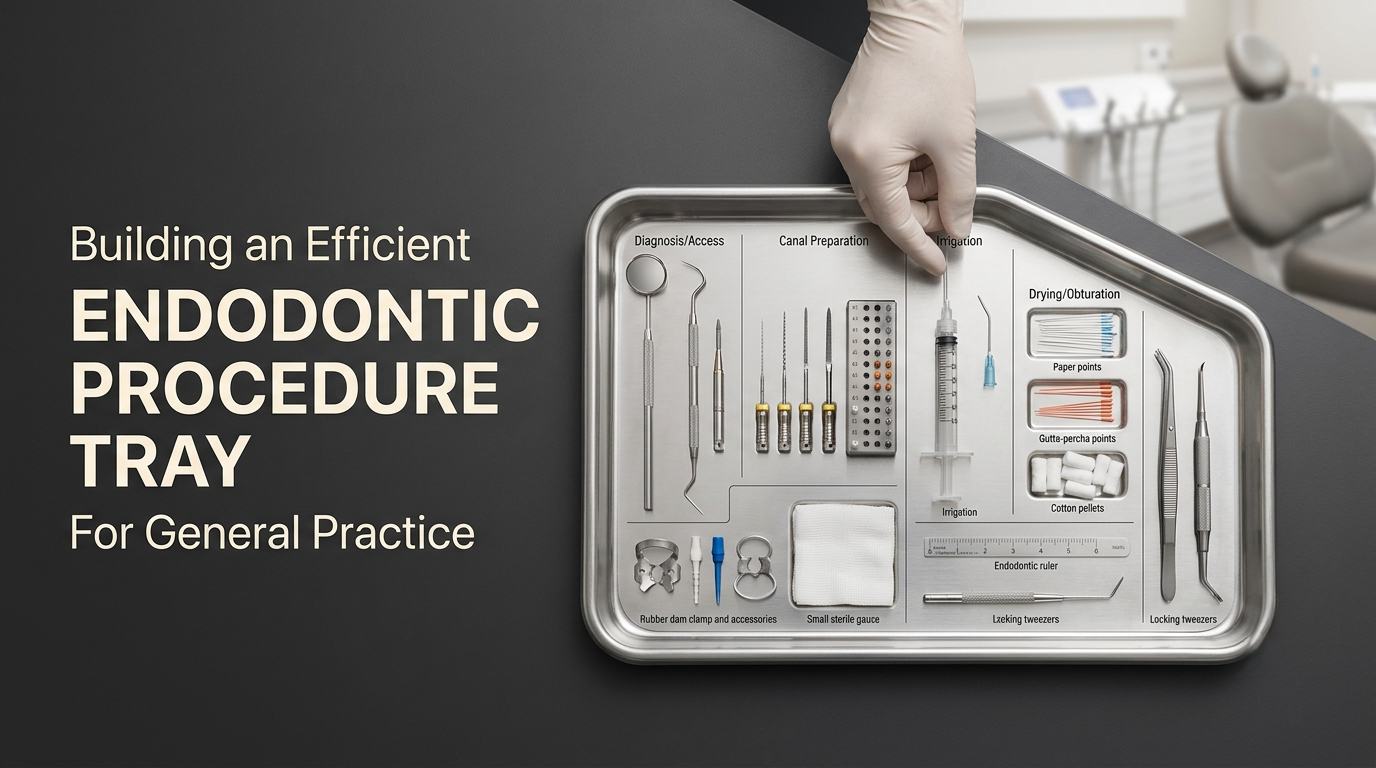
Endodontic Procedure Tray Setup for General Dental Practice
How Do You Build an Endodontic Procedure Tray for a General Dental Practice?Build the tray in three layers:A lean core tray used for every root canal treatment.
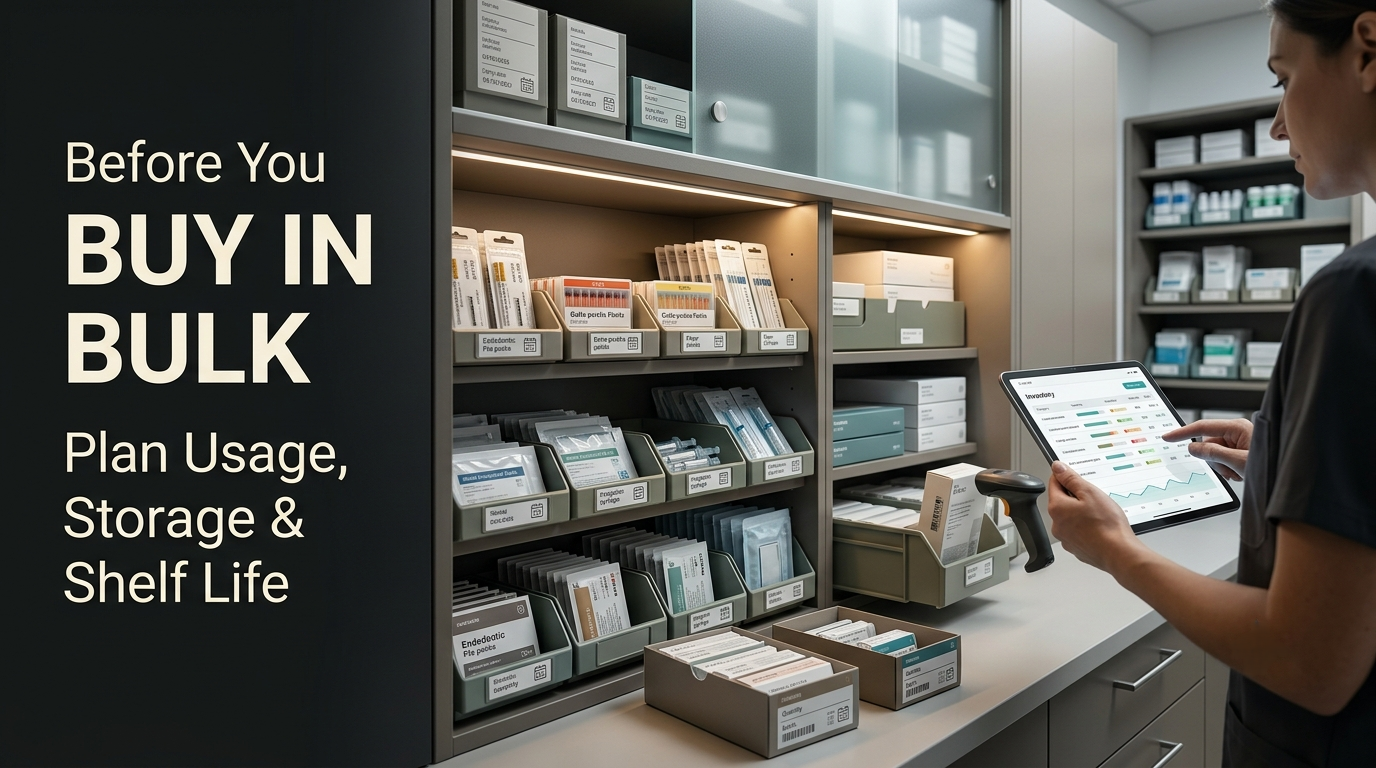
Bulk Buying Endodontic Supplies for Dental Clinics
What Should a Dental Clinic Consider Before Buying Endodontic Products in Bulk?Before buying endodontic products in bulk, check four things:How much your clinic
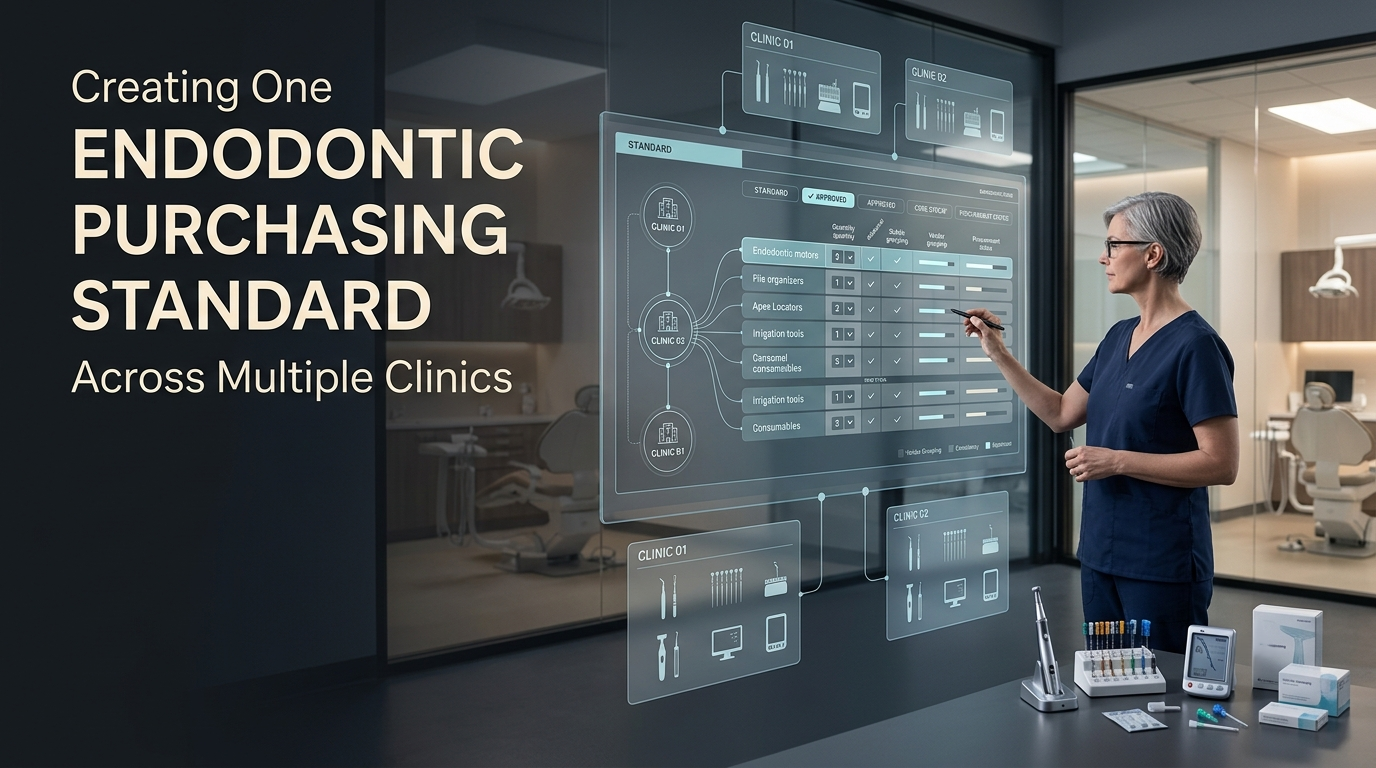
Dental Group Endodontic Purchasing Policy and Best Practices
How Can Dental Groups Create a Standard Endodontic Purchase Policy?A dental group or chain creates a standard endodontic purchase policy in five steps. First, a