
Dr. Prerna Sahrawat
Contributing Dental Clinician
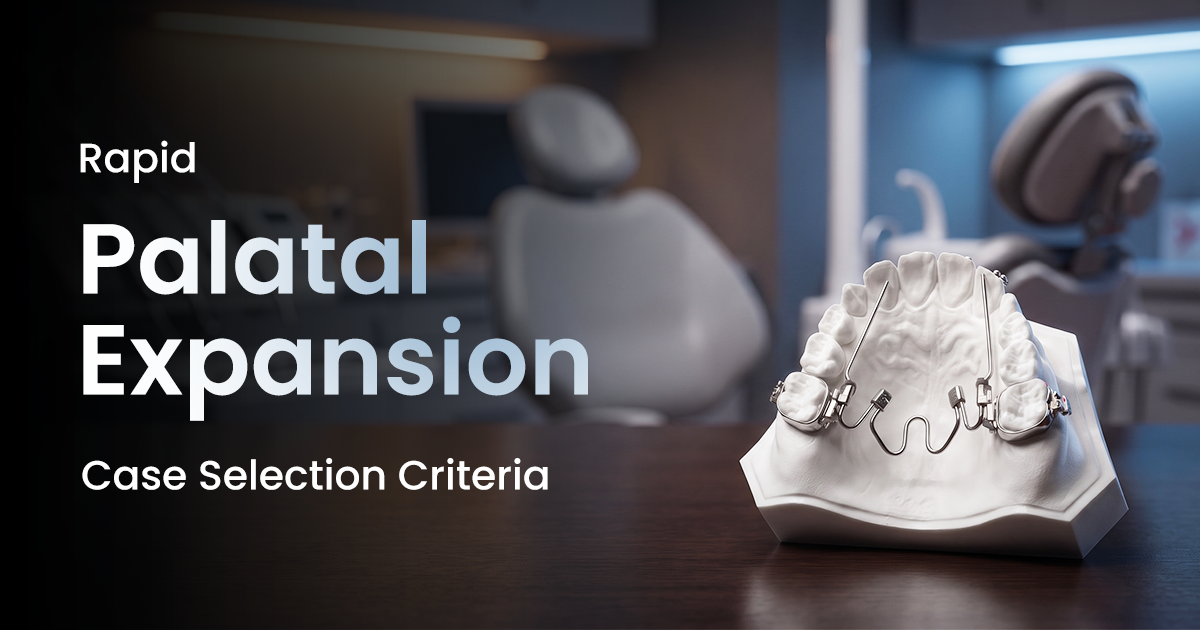
Rapid Palatal Expansion Case Selection Criteria
An Orthodontic Clinical Guide
A rapid palatal expander (RPE) is indicated for skeletal maxillary transverse deficiency, identified by posterior crossbites and severe crowding, before midpalatal suture fusion. RPE success depends critically on timing and patient factors, making precise case selection essential for predictable outcomes.
Table of Contents
Key Diagnostic Indicators for RPE Treatment
RPE therapy's primary diagnostic indicator is skeletal maxillary transverse deficiency, not just a dental crossbite. Clinically, this presents as a bilateral or unilateral posterior crossbite, a narrow V-shaped maxillary arch, and significant dental crowding (>4-5 mm) unresolvable by simple proclination. A CBCT scan, though not routine, offers the most definitive assessment of midpalatal suture morphology and patency, crucial for adolescents.
Proper diagnosis differentiates skeletal from dental crossbites. Skeletal discrepancies (high-arched palate) demand orthopedic correction. Dental crossbites (tooth tipping) are often managed with standard orthodontic brackets. A functional mandibular shift upon closure to maximum intercuspation strongly indicates underlying maxillary constriction.
- Bilateral Posterior Crossbite: Most definitive clinical sign of true maxillary skeletal deficiency.
- High, V-Shaped Palatal Vault: Indicates constricted growth and lack of transverse development.
- Significant Maxillary Crowding: Arch length deficiency of ≥5 mm often indicates narrow basal bone.
- Absence of Buccal Overjet: Posterior teeth occlude edge-to-edge or in crossbite, signaling width mismatch.
- Functional Mandibular Shift: Mandibular deviation to one side upon closing for comfortable bite.
RPE Indication Checklist
Verify unilateral/bilateral crossbite and functional shift.
Evaluate for narrow, V-shaped maxillary arch and dental crowding.
Assess skeletal age (CVM stage) for midpalatal suture pliability.
Confirm patient/parent understanding of activation protocol and oral hygiene.
Patient Age: The Decisive Factor for Expansion
Patient age is paramount for RPE success; treatment must precede midpalatal suture fusion, which prevents orthopedic movement. The ideal window is during the pre-pubertal/pubertal growth spurt (ages 8-14), when the suture is patent and cartilaginous. Orthopedic expansion (~0.5 mm/day) is achievable with minimal dental side effects during this phase.
With maturation, the midpalatal suture interdigitates and fuses, rendering conventional RPE ineffective. In late adolescents/adults (post-16F, post-18M), resistance is too great, causing dental tipping, buccal bone fenestration, and pain, not skeletal expansion. For these patients, Surgically Assisted Rapid Palatal Expansion (SARPE) is necessary.
- Pre-Pubertal (Ages 7-10): Optimal window. Suture is wide and straight, offering minimal resistance.
- Pubertal (Ages 11-14): Excellent window. Suture is still patent, responsive to orthopedic forces.
- Late Adolescence (Ages 15-18): Variable success. Suture becomes tortuous; success depends on individual maturation. MARPE (Miniscrew-Assisted RPE) may be considered.
- Adulthood (Ages 18+): Contraindicated. Suture typically fused; SARPE necessary for skeletal expansion.
MIDPALATAL SUTURE MATURATION STAGES
Suture is straight and open, ideal for purely orthopedic expansion with minimal force.
Suture becomes wavy and interdigitated, requiring higher forces yet still responsive to RPE.
Suture parts begin to fuse or are obliterated, necessitating surgical intervention.
Select the Correct RPE Appliance Design
Choosing the appropriate rapid palatal expander depends on patient dentition, age, and desired clinical outcome. Primary categories are tooth-borne (e.g., Hyrax), tooth-tissue-borne (e.g., Haas), and a bonded option for younger patients. Each design has specific indications influencing case selection and management.
The Hyrax appliance is tooth-borne, facilitating hygiene but concentrating forces on anchor teeth, potentially causing buccal tipping. The Haas appliance uses an acrylic pad contacting the palatal vault, distributing forces for more bodily movement. The bonded RPE covers posterior occlusal surfaces with acrylic, acting as a bite block to disocclude arches; useful in mixed dentition or high-angle cases. These appliances are part of broader orthodontic products for early intervention.
- Hyrax Type: Best for patients with good periodontal support and high hygiene priority.
- Haas Type: Indicated for maximum skeletal expansion with minimal dental tipping. Requires meticulous hygiene to prevent tissue inflammation.
- Bonded Type: Ideal for mixed dentition to prevent posterior tooth extrusion and for high-angle cases. Occlusal coverage minimizes interferences during expansion.
- MARPE (Miniscrew-Assisted): For borderline late-adolescent or young adult cases where conventional RPE may fail.
| Appliance Type | Primary Indication | Hygiene Level |
|---|---|---|
| Hyrax (Tooth-Borne) | Permanent dentition, good hygiene | Good value |
| Haas (Tooth-Tissue-Borne) | Maximum skeletal effect needed | Fair (risk of inflammation) |
| Bonded (Tooth-Borne) | Mixed dentition, vertical control | Good value |
| MARPE (Bone-Borne) | Skeletally mature patients | Excellent best |
Primary Contraindications for Rapid Palatal Expansion
Primary RPE contraindication is skeletal maturity, where the midpalatal suture is fused and won't separate with orthopedic forces. Attempting RPE then causes severe pain, periodontal damage, buccal tipping of anchor molars, and minimal skeletal change. This occurs in patients past the pubertal growth spurt, confirmed by CVM staging or hand-wrist radiographs.
Other significant contraindications involve clinical factors compromising dentition stability. Patients with a steep mandibular plane angle or anterior open bite tendency are poor candidates, as RPE can cause downward and backward mandibular rotation, worsening vertical dimension. Post-expansion comprehensive treatment with fixed appliances (e.g., heat-activated NiTi archwires) is hindered if initial vertical control is lost.
- Skeletal Maturity: Confirmed midpalatal suture fusion.
- Anterior Open Bite: RPE may extrude posterior teeth, worsening open bite.
- Steep Mandibular Plane Angle: Expansion can cause undesirable clockwise mandibular rotation.
- Non-Compliant Patient: Activation protocol and hygiene demand significant patient/parent cooperation.
- Active Periodontal Disease: Orthopedic forces can exacerbate existing periodontal breakdown near anchor teeth.
Clinical Red Flag: High Mandibular Plane Angle
Proceed with extreme caution for patients with a high FMA or SN-MP angle. RPE's bite-opening effect averages 1-2 degrees; while insignificant in low-angle patients, it severely compromises facial aesthetics and functional occlusion in high-angle cases.
Conclusion: RPE Case Selection
Successful rapid palatal expansion therapy hinges on one primary factor: intervening before the midpalatal suture loses plasticity. Appliance design and activation are secondary to skeletal age, the fundamental biological constraint. Thus, the most critical clinical decision is accurately assessing patient developmental stage to confirm viability for orthopedic, not surgical, correction.
- Timing is Everything: Ideal RPE window is pubertal growth spurt (CVM 2-3); beyond stage 4, success is unpredictable.
- Diagnosis is Key: Differentiate true skeletal deficiency (bilateral crossbite, V-shaped arch) from dental malocclusion before RPE.
- Vertical Control: For high mandibular plane angle patients, bonded RPE is preferred to prevent >1-2 degrees undesirable bite opening.
- Activation Protocol: Standard activation: one quarter-turn (0.25 mm) twice daily until desired expansion.
Frequently Asked Questions
The primary difference is activation rate and biological response. RPE is turned 0.5-1.0 mm/day, applying heavy orthopedic forces to split the midpalatal suture. SME uses ~1 mm/week, applying lighter forces for combined skeletal and dental movement with fewer side effects.
The most reliable clinical sign of successful suture opening is a midline diastema between maxillary central incisors, appearing within 1-2 weeks of activation. While an occlusal radiograph can visually confirm the radiolucent split at the suture line, the diastema remains the key chairside indicator.
The standard activation is one quarter-turn (0.25 mm) morning and evening, totaling 0.5 mm/day for 2-4 weeks until desired expansion. After active expansion, the appliance remains a passive retainer for 3-6 months minimum, allowing bone fill and suture stabilization.
No, adults cannot undergo conventional RPE due to fused midpalatal sutures. Attempting it causes extreme pain and dental tipping. For adults needing skeletal expansion, Surgically Assisted Rapid Palatal Expansion (SARPE) is necessary, where an oral surgeon performs osteotomies for sutural separation before expander activation.
A bonded RPE is generally best for mixed dentition patients. Its acrylic occlusal coverage prevents posterior tooth eruption during expansion, aiding vertical dimension control. It also provides excellent stability by incorporating multiple teeth and is easily retained even on partially erupted permanent molars.
Written by
Dr. Prerna Sahrawat
Contributing Dental Clinician
Dr. Prerna Sahrawat is a dentist with over 4 years of experience in clinical dentistry and dental content writing. She is passionate about simplifying complex dental concepts into practical, evidence-based content that helps dentists make informed clinical and purchasing decisions while staying updated with the latest advancements in dentistry.
Keep reading
Browse all →
A Clinician's Guide to Pediatric Space Maintainer Selection
A Clinician's Guide to Pediatric Space Maintainer SelectionCase Selection Simplified A pediatric space maintainer is a custom-made appliance designed to preserv

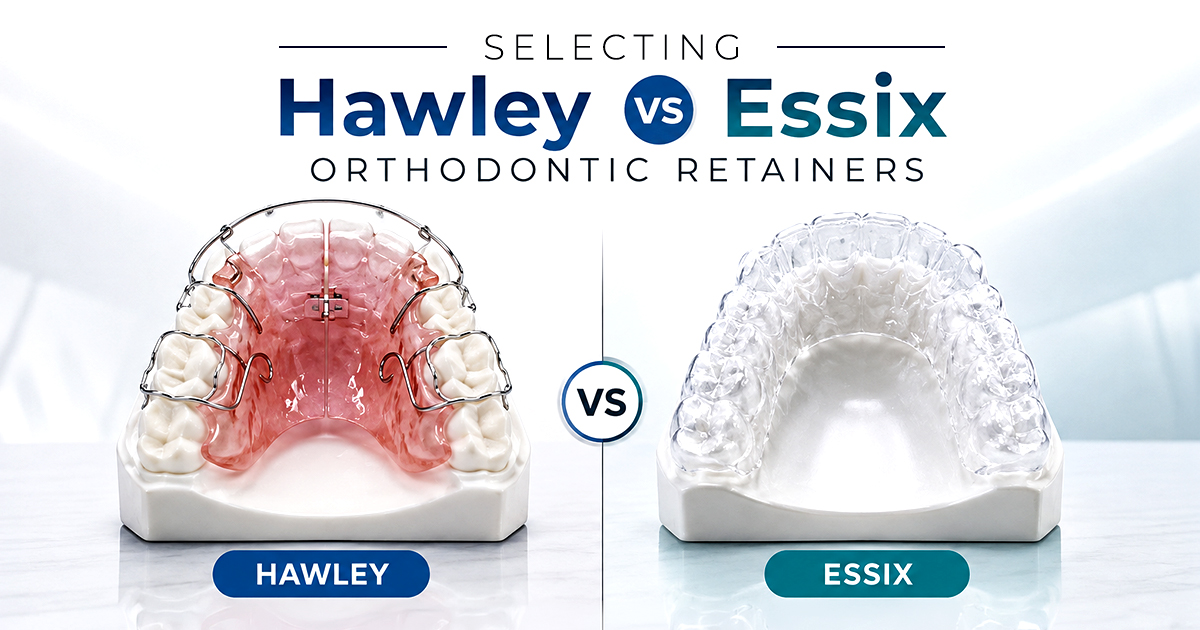
Selecting Hawley vs. Essix Orthodontic Retainers
Selecting Hawley vs Essix Orthodontic RetainersA Clinical Decision Guide The clinical selection of orthodontic retainers hinges on whether the case requires occ

Selecting the Right Orthodontic Archwire
Selecting the Right Orthodontic ArchwireA Clinical Material Selection Guide Selecting the right orthodontic archwire— whether NiTi, stainless steel, or beta-tit