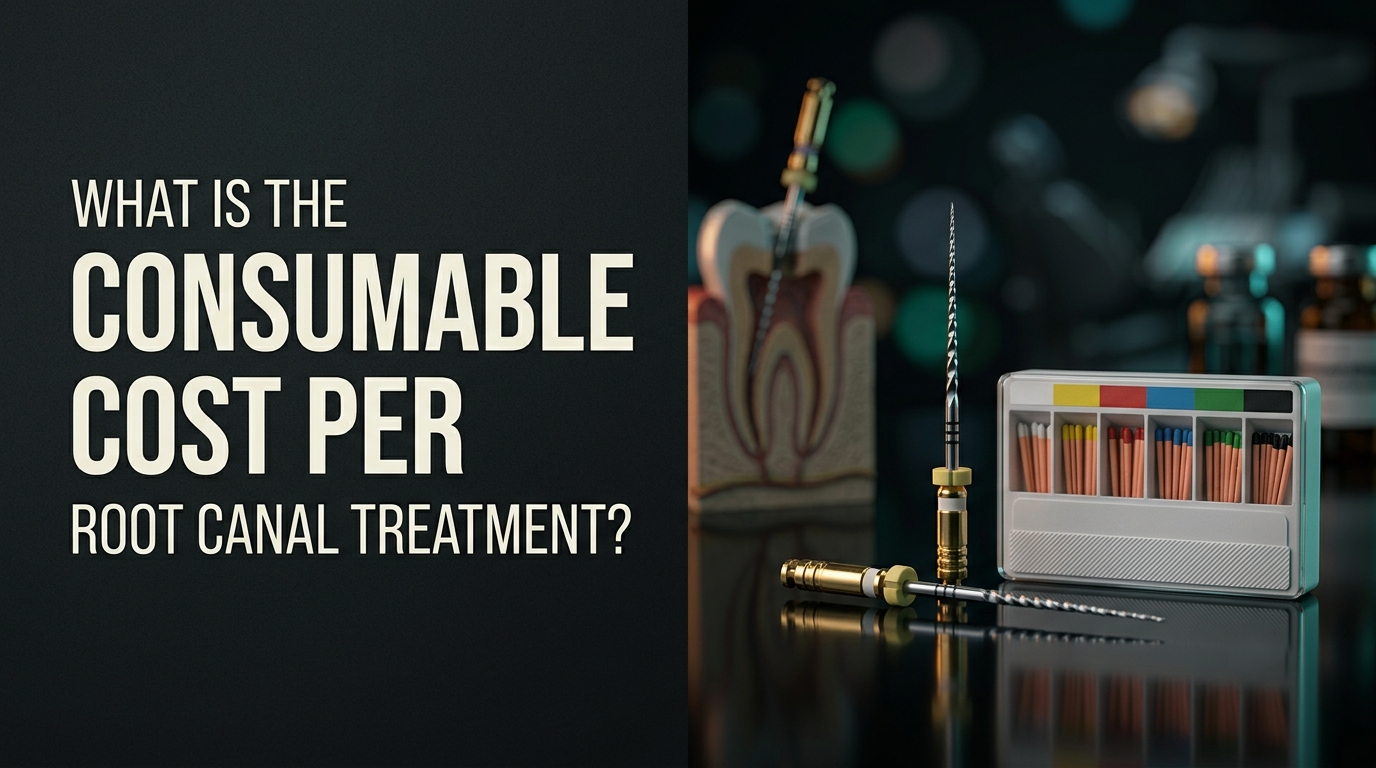
Root Canal Consumable Cost Per Case: A Clinic Guide

Dr. Gurjeet
Contributing Dental Clinician
What Is the Consumable Cost Per Root Canal Treatment and How Can a Clinic Budget It?
The consumable cost of a root canal is the total of every material used up in one case: files, irrigants, needles, paper points, gutta-percha, sealer, rubber dam, temporary filling, anaesthetic and per-visit disposables. Work it out by pricing each item per unit and adding up what a case uses, separately for anterior, premolar, molar and retreatment cases. Add a wastage allowance, then scale it to your monthly case mix to set the budget.
It excludes staff time, rent and equipment, which belong in a separate cost layer. Clinics that never do this sum usually find out through their margins: a busy endo list earning less than expected, because molars and retreatments were being charged like incisors.
Price Every Item Per Unit, Not Per Pack
Pack price is what you pay. Unit price is what a case actually consumes. The conversion is simple, but it has to be done for every item, including the small ones nobody lists.
Divide the pack price by the number of usable units in it.
A box of 200 paper points at ₹300 costs ₹1.50 per point. A 60-portion sealer tube at ₹1,500 costs ₹25 per portion. A rubber dam pack of 36 sheets at ₹540 costs ₹15 per sheet. Always use the GST-inclusive price you actually paid after discount, not the list price.
"Usable units" matters for liquids and pastes. Sealer that sets on the mixing pad, and hypochlorite left in an opened bottle beyond its stability window, are paid for but never used. That is what the wastage allowance covers.
For instruments, the manufacturer's instructions for use (IFU) decide the denominator, not the budget. Many rotary files are labelled single-use, so their full price falls on one case. Where an instrument is validated for reprocessing, divide by the number of uses your protocol and the IFU permit, never by how long the file happens to survive.
Worked Example: Anterior vs Molar RCT
All prices and quantities below are hypothetical, chosen to illustrate the method. Replace them with your own invoices and recorded usage. This example assumes single-use rotary files; see the reprocessing section below for the alternative.
Item | Anterior case (₹) | Molar case (₹) |
Files (rotary and hand) | 560 | 1,120 |
Irrigation (hypochlorite and needles) | 18 | 38 |
Obturation (paper points, gutta-percha, sealer) | 40 | 122 |
Rubber dam, temporary filling and per-visit disposables | 155 | 155 |
Subtotal | 773 | 1,435 |
With 10% wastage allowance | ≈ 850 | ≈ 1,578 |
Local anaesthetic, EDTA (or your chelator) and intracanal medicament are left out of this table to keep it short. Each adds only a small amount per case, but include them in your own version.

Two things stand out. A molar costs nearly twice as much as an anterior case. More importantly, files make up most of the molar figure: roughly three-quarters of it, with rotary files alone about 70%. Paper points, gutta-percha and sealer together come to under a tenth. A cheaper paper point saves you rupees. Standardising on one file system, negotiating its pack price and avoiding opened-but-unused sequences moves the number.
Canal anatomy drives cost for the same reason. A maxillary central usually has one canal; mandibular molars typically have three, and maxillary first molars frequently four. Every extra canal adds files, irrigant, needles, points and cones. Curved or calcified canals, and retreatments needing gutta-percha removal and solvent, push the figure higher again.
What Changes If Your Files Are Reprocessed
The "files dominate" conclusion depends on the single-use assumption. Many clinics use file systems whose IFU permits reprocessing for a limited number of uses. If your protocol, within the IFU, uses each rotary sequence on three cases (a hypothetical figure), rotary file cost per molar falls from ₹1,000 to about ₹333. The molar subtotal drops from about ₹1,435 to about ₹770, and files fall from roughly three-quarters of the cost to under 60%.
Even with reprocessing, files remain the largest single item. Reprocessing also brings its own costs (cleaning, autoclave cycles, pouches and inspection time), so add those to your equipment layer. And it is only an option where the manufacturer validates it: a file labelled single-use is discarded after one patient, whatever the budget says.
Turning Per-Case Cost Into a Monthly Budget
Once each case type has a cost, the monthly budget follows from your case mix. Here is a hypothetical clinic doing 38 RCTs a month, with assumed costs of ₹1,000 for premolars and ₹2,200 for retreatments:
Case type | Cases/month | Cost per case (₹) | Monthly cost (₹) |
Anterior | 8 | 850 | 6,800 |
Premolar | 12 | 1,000 | 12,000 |
Molar | 15 | 1,578 | 23,670 |
Retreatment | 3 | 2,200 | 6,600 |
Total | 38 | 49,070 |

That works out to about ₹1,300 per case on average. A clinic budgeting a flat ₹1,000 per case would fall short by about ₹11,000 a month, close to a quarter of actual spend. Almost all of that gap sits in the molar and retreatment rows.
Case mix is not stable. A month with more referred molars or retreatments shifts the budget even when the total case count is unchanged, so build the figure from your last three to six months of records rather than a single month.
Where the Number Is Usually Wrong
Most costing errors are omissions rather than bad arithmetic. The common ones:
Counting one visit when the case takes two or three. Per-visit disposables, rubber dam and temporary filling repeat at every appointment.
Using list price instead of the price actually paid. Include GST and freight, and subtract discounts.
Leaving out anaesthetic, EDTA and intracanal medicament. Small per case, significant across a month.
Ignoring opened-but-unused material. A file sequence opened and not used, or sealer mixed and discarded, is still a cost.
Treating single-use files as reusable on paper. The IFU sets the number of uses, not the spreadsheet.
Forgetting retreatment extras. Solvent, gutta-percha removal files and extra irrigant.
Costing from one month only. A single heavy or light month skews the average.

What Cost Data Should Not Decide
Per-case costing tells you what a case consumes. It does not tell you what a case needs. File system, taper, sealer chemistry, irrigation protocol and whether any instrument is reprocessed are clinical decisions for the treating dentist, governed by infection-control requirements and the IFU. The useful cost levers are commercial: standardising systems, buying pack sizes that match your usage, reducing opened-but-unused material and comparing equivalent products on price. Browsing the endodontics range by product type, from paper points to rotary files, makes like-for-like price comparison quicker once the clinical choice is fixed.
Measuring Whether the Budget Holds
Review monthly against four numbers: actual material spend versus budget, cost per case by case type, wastage as a percentage of spend, and emergency purchases caused by missing items. If actual spend on molar cases runs consistently above the calculated figure, your per-case quantities are wrong, not the budget. Re-measure usage for a fortnight and update the table.
Frequently Asked Questions
Healthcare services provided by clinical establishments in India are generally exempt from GST, so most dental clinics cannot claim input tax credit on consumables. The GST you pay is therefore a real cost and belongs in every unit price. Confirm your clinic's position with your chartered accountant.
Keep it as a separate layer so consumable trends stay visible, but do calculate it. As a hypothetical example, an endomotor costing ₹45,000 and used for five years at 38 cases a month adds only about ₹20 per case before servicing. Add autoclave pouches and sterilisation cycle costs for reprocessed instruments to the same layer.
There is no standard figure; the 10% above is illustrative. Start with a provisional allowance, then replace it with your actual write-offs (expired, damaged and opened-but-unused items) as a percentage of monthly spend after two or three months of tracking.
Written by
Dr. Gurjeet
Contributing Dental Clinician
Dr. Gurjeet is a practising dental clinician contributing to Dentalkart Blogs, sharing chair-side experience, treatment protocols, and equipment insights for the wider dental community.
Keep reading
Browse all →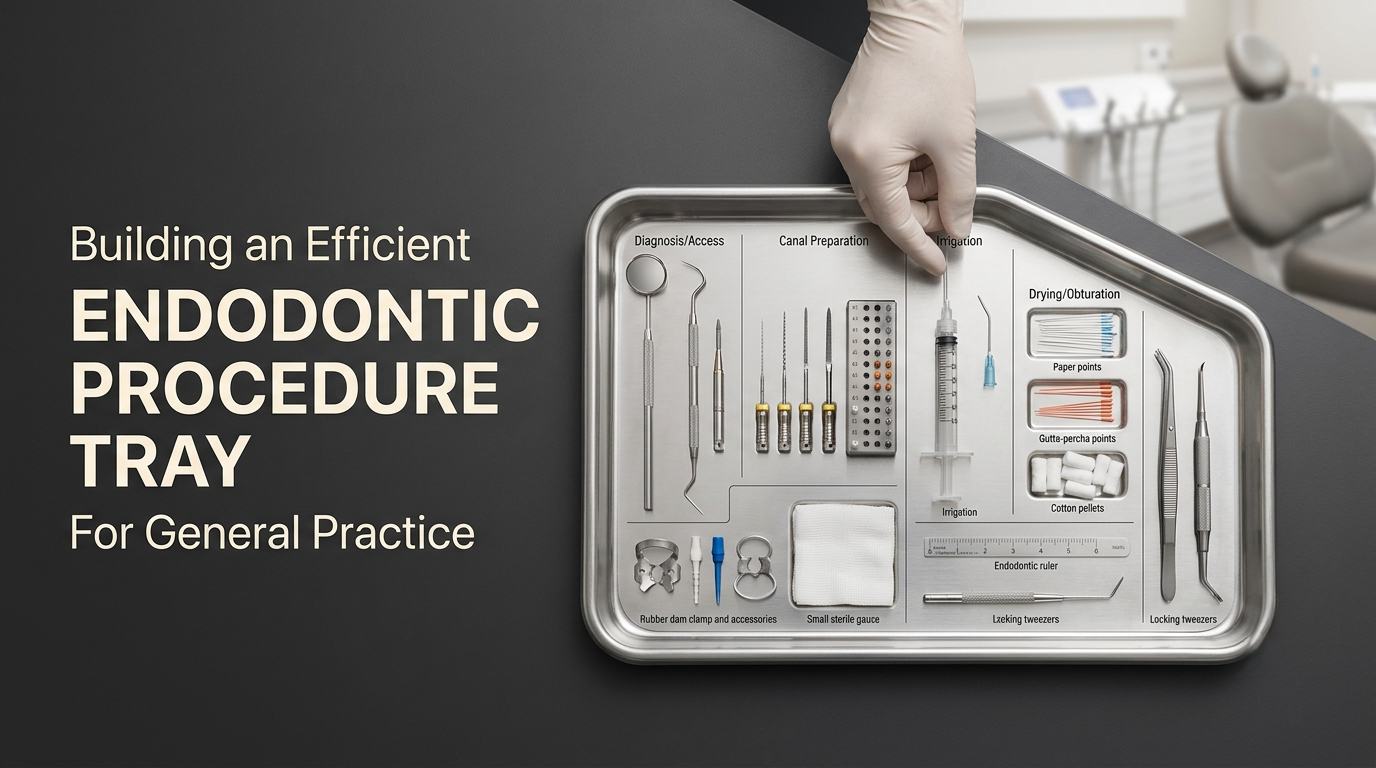
Endodontic Procedure Tray Setup for General Dental Practice
How Do You Build an Endodontic Procedure Tray for a General Dental Practice?Build the tray in three layers:A lean core tray used for every root canal treatment.
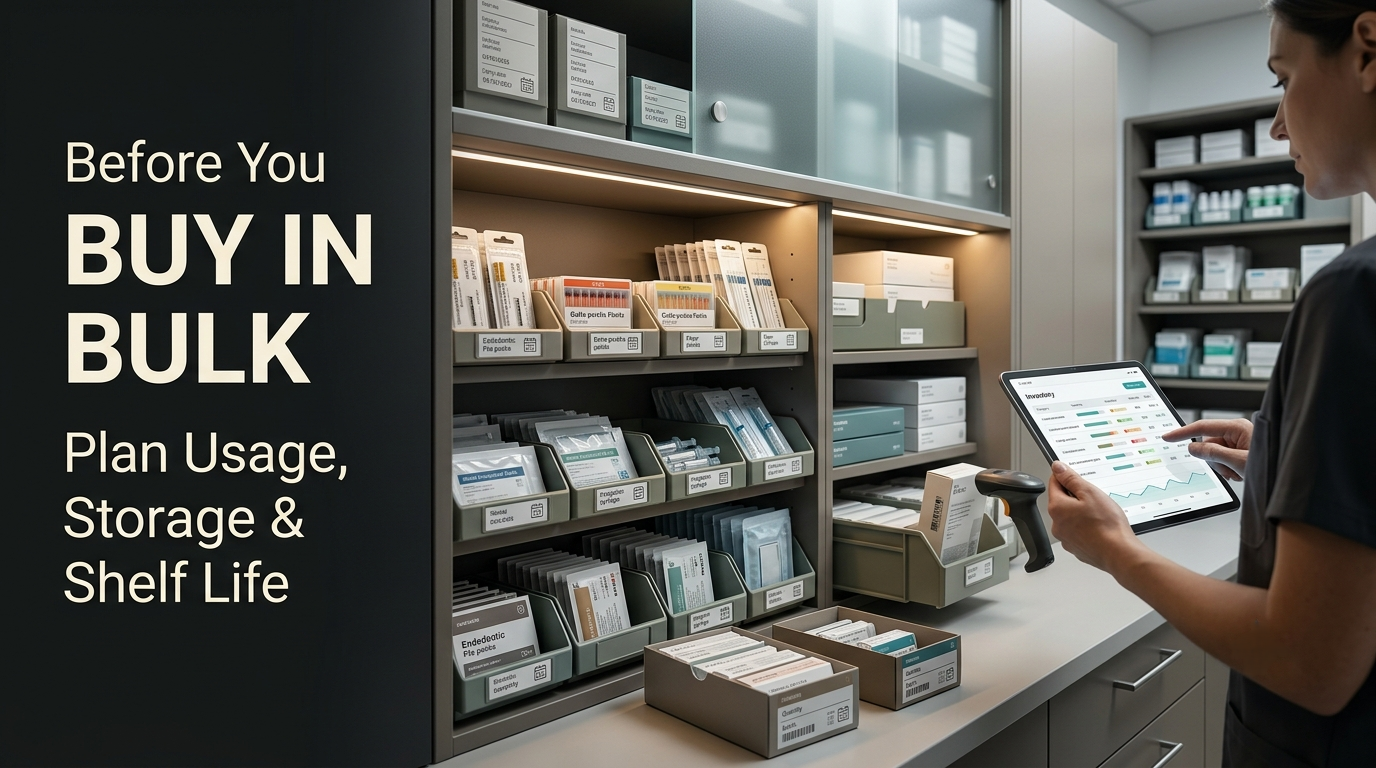
Bulk Buying Endodontic Supplies for Dental Clinics
What Should a Dental Clinic Consider Before Buying Endodontic Products in Bulk?Before buying endodontic products in bulk, check four things:How much your clinic
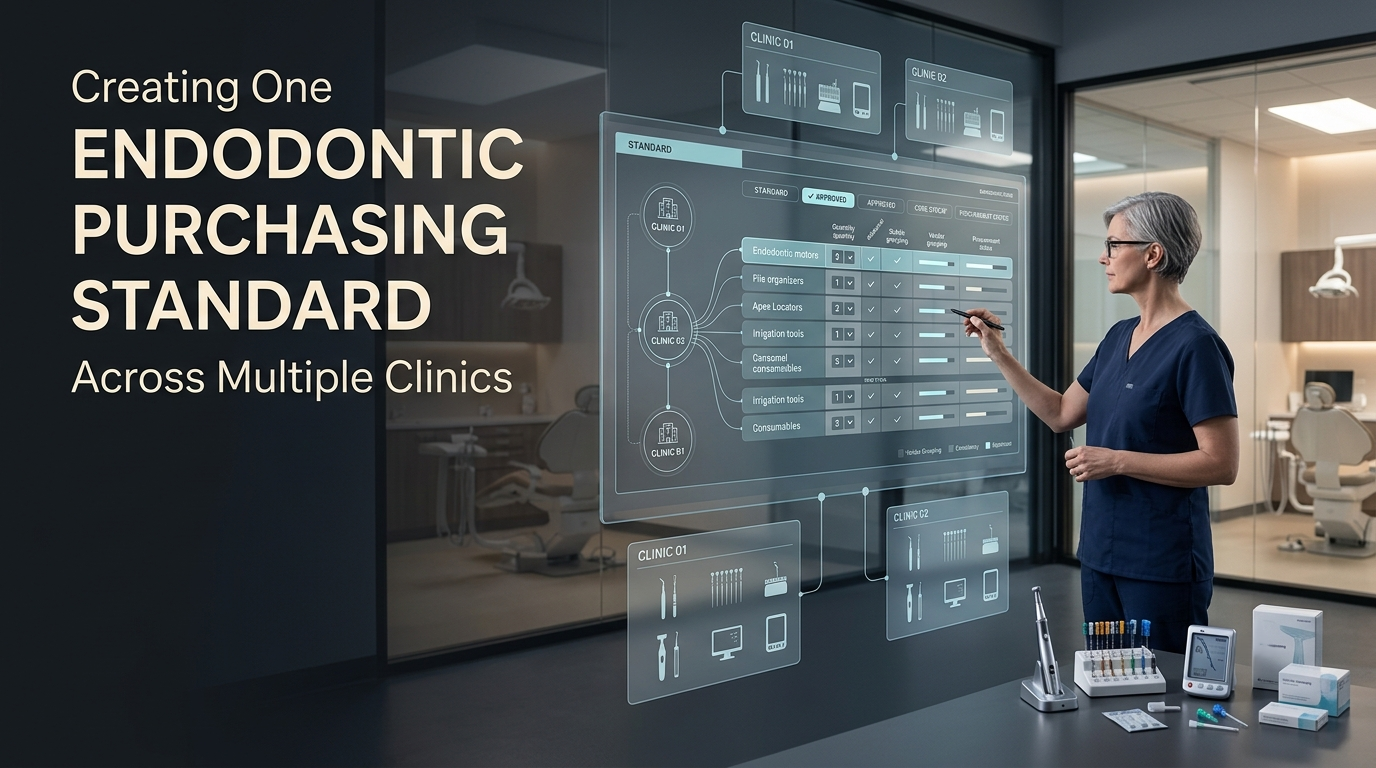
Dental Group Endodontic Purchasing Policy and Best Practices
How Can Dental Groups Create a Standard Endodontic Purchase Policy?A dental group or chain creates a standard endodontic purchase policy in five steps. First, a