
Dr. Prerna Sahrawat
Contributing Dental Clinician
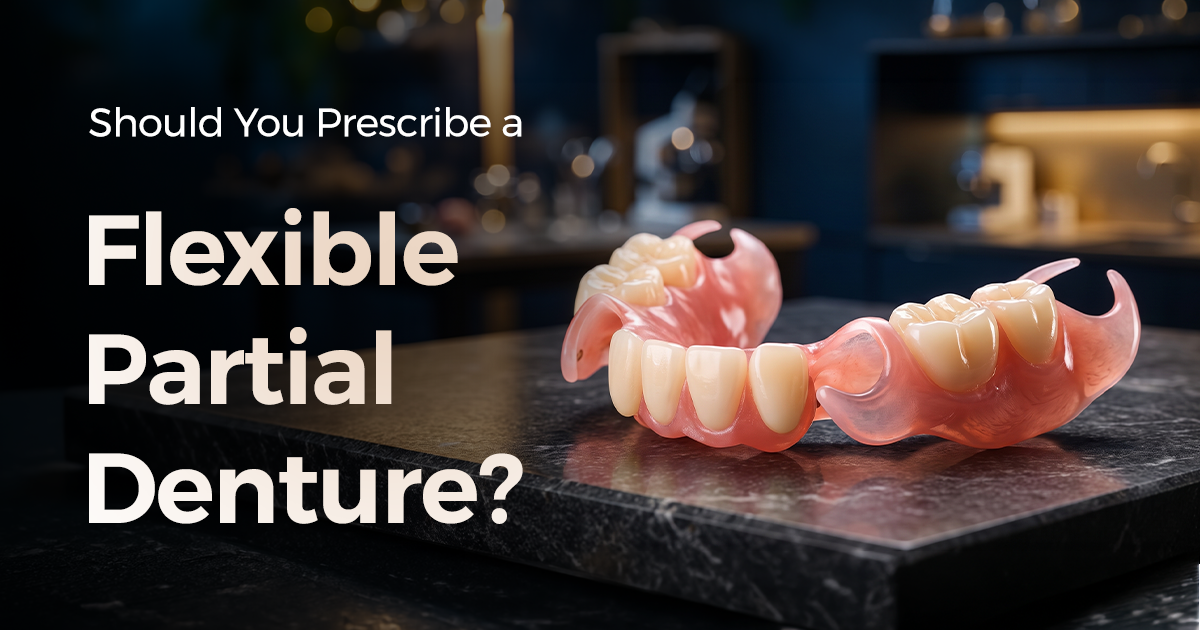
Should You Prescribe a Flexible Partial Denture?
A Clinical Case Selection Guide
Flexible partial dentures are metal-free removable prostheses ideal for patients with acrylic allergies or superior aesthetics for small edentulous spans. Understanding precise indications versus traditional RPDs is critical for stability and patient satisfaction.
Table of Contents
Ideal Clinical Scenarios for Flexible Partials
Flexible partials suit small, unilateral edentulous spaces (Kennedy Class III) or interim aesthetic prostheses. They are ideal for patients allergic to cobalt-chromium or nickel alloys in traditional cast frameworks.
Thermoplastic resin flexibility allows clasps to engage deeper undercuts (up to 0.75 mm) without deformation, offering excellent, metal-free retention. This suits anterior tooth replacement for aesthetics, or as a temporary post-extraction solution. Explore denture base materials.
- Single Tooth Replacement: Ideal for single posterior/anterior tooth replacement when FPDs are contraindicated.
- Metal Allergies: Primary choice for documented nickel or cobalt sensitivity.
- Interim Prostheses: Space maintainer or temporary aesthetic during implant healing.
- Limited Mouth Opening: Flexibility aids insertion for trismus or microstomia patients.
- History of Denture Fracture: Benefits patients frequently fracturing conventional acrylic dentures (higher impact strength).
When to Choose a Flexible Partial
Why Cast Metal RPDs Still Reign for Stability
Traditional cast metal RPDs are clinically superior for long/unbounded edentulous spans (Kennedy Class I/II) requiring absolute rigidity and occlusal support. Their function extends beyond simple tooth replacement.
Cobalt-chromium frameworks provide rigid major connectors and positive occlusal rests, directing axial forces down abutment teeth. This prevents tissue-ward movement and preserves the alveolar ridge, unlike flexible materials which flex. Rigidity is essential for cross-arch stabilization, distributing forces across the arch, not concentrating them on the edentulous ridge.
- Distal Extension: Essential for Kennedy Class I/II, requiring positive abutment support to prevent mucosal compression/bone loss.
- Long Spans: Spans over two teeth need cast framework rigidity for support/stability.
- Need for Rests: Occlusal, cingulum, or incisal rests preclude flexible partials.
- Periodontally Compromised Abutments: Rigid major connectors can stabilize teeth with minor mobility.
- Future Additions: Easier, more predictable to add denture teeth sets to cast metal framework than flexible base.
| Clinical Factor | Flexible Partial Denture | Cast Metal RPD |
|---|---|---|
| Support | Mucosal (Tissue) Borne | Tooth & Mucosal Borne best |
| Rigidity | Low (Flexible) | High (Rigid) best |
| Ridge Resorption | Higher risk in distal extensions | Minimized by occlusal rests |
| Aesthetics | Excellent (Tooth/tissue colored clasps) best | Good (Metal clasps may be visible) |
| Tooth Preparation | Minimal to none | Requires rest seats and guide planes |
Assess These Contraindications Before Prescribing
Flexible partials are strongly contraindicated with minimal vertical clearance, deep vertical overlap (deep bite), and periodontally compromised abutments. They are unsuitable for immediate dentures anticipating significant, unpredictable ridge resorption.
Flexible base strength requires bulk (minimum 1.5 mm), impractical with limited interocclusal space. Tissue-supported design places excessive load on the edentulous ridge, accelerating bone resorption, especially in distal extensions. Poor for patients with resorbed or knife-edge ridges unable to withstand functional loading.
- Minimal Vertical Space: Insufficient room (<4-5 mm) between opposing arch and edentulous ridge.
- Poor Abutment Support: Severely tilted, mobile, or short clinical crowns lack adequate retention/support.
- Bilateral Free-End Saddles: Kennedy Class I requires rigid support; flexible RPDs cannot provide it.
- Need for Relining: Flexible materials are difficult to reline predictably. Use acrylic for cases expecting significant tissue changes, compatible with standard relining materials.
- High Functional Loads: Bruxism or strong musculature causes excessive denture flexure, leading to ridge trauma/instability.
Critical Contraindication: Distal Extensions
Never prescribe flexible partials for Kennedy Class I or II cases. Lack of rigid rests/connectors inevitably leads to excessive distal ridge pressure, accelerated bone resorption, and damage to remaining dentition.
Tooth Preparation: Flexible vs. Cast RPD Requirements
Flexible partial denture prep is minimal to none, a key advantage in preserving tooth structure. Cast RPDs, conversely, mandate precise preparations: rest seats, guide planes, and surveyed retentive undercuts for correct function.
Flexible RPDs retain purely by engaging gingival undercuts with flexible clasps, eliminating occlusal/cingulum/incisal rest seats. Cast RPDs rely on rests for vertical support and guide planes for a stable insertion path. Preparations must be cut into enamel or existing restorations for axial force transmission. Guide planes are parallel abutment tooth surfaces, typically 2-3 mm occluso-gingival height. Find prosthodontic products on DentalKart.
- Rest Seats: Mandatory for cast RPDs (e.g., spoon-shaped on posterior teeth) for vertical stops; none for flexible RPDs.
- Guide Planes: Parallel surfaces on abutment teeth proximal areas essential for cast RPDs; not required for flexible RPDs.
- Retentive Undercuts: Cast RPDs need 0.25 mm undercut at surveyed height; flexible RPDs engage deeper (up to 0.75 mm) gingival undercuts.
- Enameloplasty: Significant tooth reduction for rests/guide planes is exclusive to cast RPDs.
Flexible Partial
- Preserves tooth structure; no preparation needed.
- Less chair time for preparation.
- Lacks positive vertical stops, leading to tissue settling.
Cast Metal RPD
- Rest seats direct occlusal forces axially, protecting the ridge.
- Guide planes provide stability and a defined path of insertion.
- Requires irreversible removal of healthy tooth structure.
Conclusion: A Tool for Specific Scenarios
The crucial decision is matching prosthesis to biomechanical needs, not just patient aesthetics. Flexible partials offer a valuable, minimally invasive option for small, bounded edentulous spans and metal allergy patients. However, their use in long-span or distal extension cases risks iatrogenic damage. Prioritize biomechanical support/stability; a cast metal RPD remains the gold standard for complex removable prosthodontic cases.
- Ideal Use Case: Reserve flexible partials for short, tooth-supported spans (Kennedy Class III) or interim aesthetic prostheses.
- Red Flag: Avoid flexible partials for Kennedy Class I or II (distal extension) cases due to lack of rigid support and high risk of accelerated ridge resorption.
- Tooth Preparation: If positive rest seats cannot be prepared on abutment teeth, cast RPD is contraindicated; a flexible partial may be an option if other factors align.
- Vertical Clearance: Ensure minimum 4-5 mm interocclusal space to accommodate required flexible denture base bulk for strength.
Frequently Asked Questions
Primary disadvantage is lack of rigidity and occlusal rests, making them entirely tissue-supported. This can accelerate alveolar ridge resorption, especially under functional load in distal extension cases, making them less stable/supportive than cast metal RPDs.
Relining/repairing flexible dentures is harder than with conventional acrylic. Thermoplastic materials don't chemically bond to standard reline resins. Specialized lab techniques exist, but bonds are often weak/unpredictable, making chairside adjustments/relines nearly impossible, compromising long-term fit.
Cast metal RPDs offer greater longevity due to rigid design, protecting abutment teeth/ridge. Flexible dentures may lose retention as clasps fatigue/stretch. Nylon-based materials' color stability is inferior to acrylic, often showing staining/discoloration within 3-5 years.
Patients report higher initial comfort with flexible partials due to lighter weight, no metallic taste, and soft clasps. However, this comfort is misleading. In poorly selected distal extension cases, lack of support leads to tissue soreness, instability, and accelerated long-term bone loss.
Common materials: thermoplastic nylons (e.g., Valplast) and polyolefins (e.g., Lucitone FRS). Nylon-based materials offer excellent flexibility/aesthetics but absorb moisture/stain. Polyolefins are generally more moisture/stain resistant and slightly more rigid, balancing properties better for some clinical situations.
Written by
Dr. Prerna Sahrawat
Contributing Dental Clinician
Dr. Prerna Sahrawat is a dentist with over 4 years of experience in clinical dentistry and dental content writing. She is passionate about simplifying complex dental concepts into practical, evidence-based content that helps dentists make informed clinical and purchasing decisions while staying updated with the latest advancements in dentistry.
Keep reading
Browse all →Optimizing Your Dental Lab Vibrator Technique
Optimizing Your Dental Lab Vibrator TechniqueA Guide to Bubble-Free Casts A dental vibrator machine uses controlled vibrations to remove trapped air from gypsum

When Should You Use a Dental Vacuum Former?
When Should You Use a Dental Vacuum Former?A Guide to Clinical Applications A dental vacuum former is best used for fabricating single-arch appliances like blea
Which Luting Cement for Zirconia Crowns?
Which Luting Cement for Zirconia Crowns?A Clinical Decision Guide The ideal luting cement for zirconia crowns is typically a self-adhesive resin cement, prized