
Dr. Bhavishya Arora
Chief Dental Editor
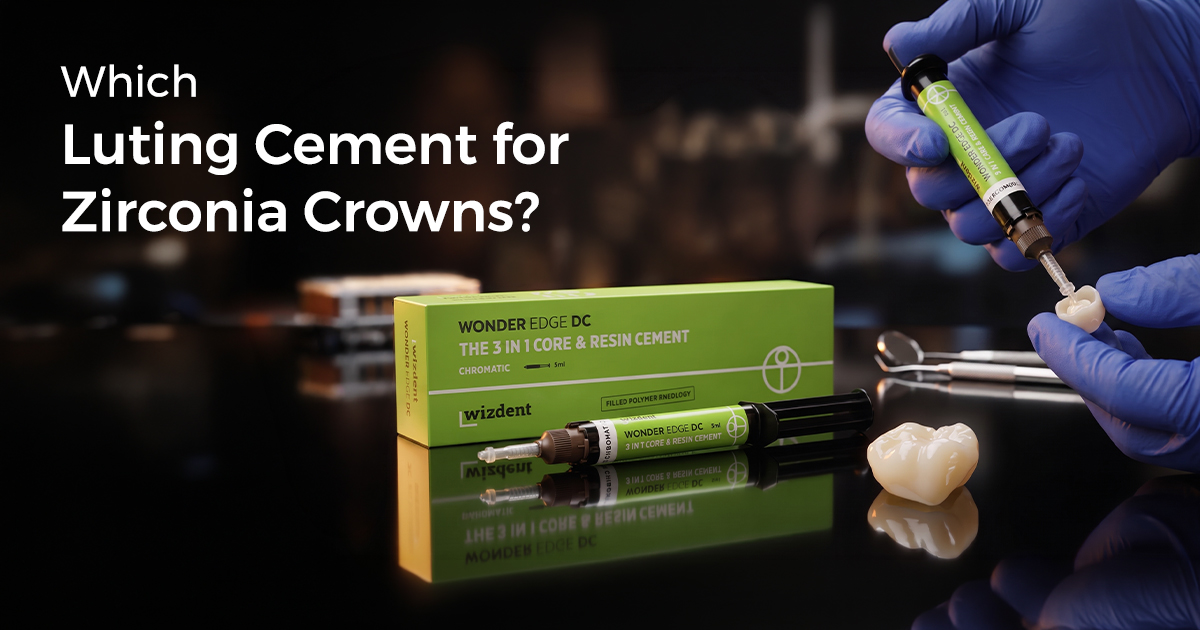
Which Luting Cement for Zirconia Crowns?
A Clinical Decision Guide
The ideal luting cement for zirconia crowns is typically a self-adhesive resin cement, prized for its simple protocol and dual-cure capabilities. However, its lower bond strength compared to adhesive resin cements makes proper case selection based on preparation geometry absolutely critical for long-term clinical success.
Table of Contents
Self-Adhesive Resin Cement: Ideal Use Cases
Self-adhesive luting cement is the preferred choice for zirconia crowns with adequate resistance and retention form, specifically preparations with at least 4 mm of axial wall height and a total occlusal convergence of 6-10 degrees. This cement class contains acidic phosphate monomers (like 10-MDP) that chemically bond to zirconia oxides and tooth structure simultaneously, eliminating the need for separate etching and bonding steps. This simplified, single-step protocol significantly reduces chairside time and minimizes technique sensitivity, a major advantage for busy practices using modern resin cements.
- Retentive Preparations: Walls are parallel or have a taper of less than 12 degrees, providing sufficient frictional resistance.
- Adequate Tooth Structure: At least 4 mm of vertical wall height is available for macromechanical retention.
- Supragingival Margins: Margins are easily isolated from saliva and sulcular fluid, ensuring a clean, dry field for bonding.
- Posterior Restorations: Ideal for single posterior crowns and 3-unit bridges where occlusal forces are primarily compressive.
Self-Adhesive Cement Selection Matrix
What Are the Contraindications for Self-Adhesive Cements?
The primary contraindication for self-adhesive resin cements is any clinical situation lacking sufficient mechanical retention from the tooth preparation. Because these cements have lower bond strength (typically 5-15 MPa) compared to multi-step adhesive systems, they rely heavily on the macromechanical retention provided by the prep geometry achieved with quality crown preparation kits. Using them on short, over-tapered, or non-retentive preps is a leading cause of debonding.
- Low Bond Strength Requirements: Not suitable for resin-bonded bridges (Maryland bridges) or veneers that depend entirely on a strong enamel bond.
- Poor Moisture Control: Cannot be used in fields with unavoidable contamination from blood or sulcular fluid.
- Sclerotic Dentin: The mild acidity may be less effective at conditioning and bonding to highly sclerotic, non-vital dentin.
- Non-Retentive Preps: Any preparation with a clinical crown height less than 3 mm or a taper exceeding 20 degrees.
Risk of Debonding
Using self-adhesive cements on non-retentive preparations transfers the entire functional load to the chemical bond alone, which is insufficient. This almost guarantees clinical failure within 1-2 years, often presenting as a debonded crown with no cement remaining on the tooth.
Zirconia vs. Lithium Disilicate: Cementation Protocols
Yes, the choice of luting cement is fundamentally different for zirconia versus lithium disilicate (e.g., E-max) due to their distinct surface properties and composition. Zirconia is a non-etchable polycrystalline ceramic, so bonding relies on air-particle abrasion (sandblasting) followed by a chemical bond via 10-MDP-containing primers or cements. In contrast, lithium disilicate is a glass-ceramic that must be etched with hydrofluoric (HF) acid to create micromechanical retention, followed by a silane coupling agent. Using the wrong protocol for the material is a guaranteed bond failure. Always have the right prosthodontic products on hand for the case.
For a full framework covering every cement class beyond zirconia, see our clinician's guide to luting cements.
- Zirconia (e.g., Katana, BruxZir): Clean with Ivoclean or similar, then use an MDP-containing self-adhesive or adhesive resin cement. Do NOT use HF acid.
- Lithium Disilicate (e.g., E-max): Etch intaglio surface with ~5% HF acid for 20 seconds, apply silane, then use an adhesive resin cement.
- Feldspathic Porcelain: Requires HF etching and silanization, similar to lithium disilicate, and must be bonded with an adhesive system.
- Metal/PFM: Best luted with self-adhesive resin cements or RMGI after sandblasting the metal substructure.
| Protocol Step | Monolithic Zirconia | Lithium Disilicate (E-max) |
|---|---|---|
| Surface Treatment | Air-abrade (50μ Al₂O₃ at ~2 bar) | Etch (5% HF acid, 20s) |
| Primer/Coupling Agent | MDP-containing primer (often in cement) | Silane coupling agent |
| Primary Cement | Self-Adhesive Resin Cement best | Adhesive Resin Cement |
| Bond Mechanism | Chemical (MDP-ZrO₂) | Micromechanical + Chemical |
Cementing on Short or Non-Retentive Preps
For short clinical crowns (less than 4 mm occluso-gingival height) or over-tapered preparations, an adhesive resin cement with a separate bonding agent is mandatory for predictable outcomes. This multi-step protocol significantly increases bond strength to both enamel and dentin, compensating for the lack of mechanical retention. The process involves etching the tooth, applying a universal bonding agent, and then using a dual-cure adhesive resin cement for zirconia. This creates a robust micromechanical and chemical bond that can withstand functional forces far better than a self-adhesive cement in these compromised situations.
- Increase Surface Area: Add auxiliary retention features like grooves, boxes, or pins during the preparation phase.
- Select the Right System: Use a total-etch or selective-enamel-etch technique with a compatible adhesive resin cement.
- Intaglio Surface Prep: Ensure the zirconia crown's internal surface is properly air-abraded (sandblasted) by the lab to optimize it for bonding.
- Strict Isolation: Use a rubber dam for absolute moisture control, as adhesive protocols are highly technique-sensitive.
Step 1: Tooth Preparation
Etch enamel for 30 seconds and dentin for 15 seconds with 37% phosphoric acid. Rinse thoroughly and gently air-dry, leaving dentin visibly moist.
Step 2: Bonding Agent
Apply a universal bonding agent to the entire preparation surface per manufacturer directions. Air-thin to evaporate the solvent and light-cure for 10-20 seconds.
Step 3: Crown Seating
Load the air-abraded and primed zirconia crown with dual-cure adhesive resin cement and seat with firm, consistent pressure. Tack cure for 2-3 seconds.
Step 4: Final Cure
Remove excess cement with a scaler and floss, then light-cure all margins for at least 40 seconds per surface to ensure complete polymerization.
Frequently Asked Questions
10-MDP (Methacryloyloxydecyl dihydrogen phosphate) is an acidic functional monomer that is the key ingredient for chemically bonding to zirconia. It forms a strong, stable, and water-resistant ionic bond with the zirconium oxide on the crown's surface, creating a durable link between the resin cement and the restoration. Cements without 10-MDP or a similar phosphate monomer will not reliably bond to zirconia.
The main difference is the number of clinical steps and resulting bond strength. Self-adhesive cements combine etch, prime, and bond functions into a single paste for a simple, quick protocol ideal for retentive preps. Adhesive resin cements require separate etching and application of a bonding agent to the tooth, a more technique-sensitive process that achieves significantly higher bond strengths (20-35 MPa), making them necessary for non-retentive cases.
When a zirconia crown debonds with the cement fully retained inside it, this indicates a failure of the bond to the tooth structure. Common causes include saliva or blood contamination during cementation, inadequate drying of the preparation, or using a self-adhesive cement on a non-retentive prep that couldn't provide the necessary mechanical support. Revisiting your isolation protocol and prep design is crucial to prevent recurrence.
While conventional GIC can be used for zirconia crowns on extremely retentive preparations, it is generally not recommended due to its low strength and high solubility. A resin-modified glass ionomer (RMGI) is a better alternative if moisture control is challenging, as it offers better strength and fluoride release. However, for most cases, a self-adhesive or adhesive resin cement for zirconia provides superior longevity and marginal integrity.
The intaglio surface must be decontaminated after try-in to remove salivary phosphates that block bonding sites. The gold standard is air-particle abrasion (sandblasting) with 50-micron aluminum oxide at a low pressure of around 2 bar (30 psi). If you don't have a sandblaster, using a dedicated cleaning solution like Ivoclean for 20 seconds is an effective alternative. Simply wiping with alcohol is insufficient to remove the phosphate layer.
Written by
Dr. Bhavishya Arora
BDS, MDSChief Dental Editor
A contributing clinician at Dentalkart Blogs, Dr. Bhavishya is a compassionate, detail-driven dentist known for thoughtful patient care, clear communication, and a calm chair-side manner that puts patients at ease. Beyond the clinic, she leads product content and category initiatives at Dentalkart India's largest dental marketplace where she bridges clinical understanding with commercial insight to help dentists make better-informed product choices.
Keep reading
Browse all →
Mastering Direct Chairside Denture Relining: A Clinical
Mastering Direct Chairside Denture Relining: A Clinical ProtocolImprove Fit, Function, and Comfort Direct chairside relining readapts a denture's intaglio surfa

Digital Dental Shade Matching for Predictable Aesthetic
Digital Dental Shade Matching for Predictable Aesthetic RestorationsPrecision Beyond the Eye A dental spectrophotometer is a device that objectively measures to
A Clinical Guide to Preventing Dental Fiber Post Debonding
A Clinical Guide to Preventing Dental Fiber Post DebondingTroubleshooting Clinical Failures Fiber post debonding is the most common failure in post and core res
