How to Standardize Endodontic Consumables Across Operatories

Dr. Gurjeet
Contributing Dental Clinician
Why and How to Standardize Endodontic Consumables Across Operatories
To standardise endodontic consumables, audit what every chair uses, have the treating dentists agree on one core list built around a single compatible file system, set up an identical labelled endo kit in every operatory, and give each chair a par level based on its own case volume, topped up daily from a central store. Complex cases draw from one shared, pre-approved add-on kit.
The goal is simple: any root canal can start in any operatory, and no assistant has to leave the chair to look for a 25/.06 paper point.
Why Operatories Drift Apart
Chairs rarely start out different. They drift. One associate prefers a reciprocating system, a visiting endodontist leaves behind a box of their preferred sealer, a supplier substitution arrives and gets shelved in whichever operatory had space. Within a year, a three-chair clinic can be stocking three file systems, each with its own matching gutta-percha and paper point tapers.
The cost shows up in three places. Treatment stalls when the obturation materials in one operatory do not match the files used to shape the canal. Stock multiplies because every system needs its own size range. And slow-moving tapers sit in a drawer until they expire.
Compatibility Is the Backbone of the Core List
Standardising endodontics is not about choosing one brand of everything. It is about choosing one coherent system chain, because the items depend on each other:
Motor to file. Rotary files run at manufacturer-specified speed and torque; reciprocating files need a motor with the matching reciprocation programme. If every chair's endomotor carries the presets for the approved system, any file in the kit works in any operatory.
File to obturation. The master cone should match the final shaping file's tip size and taper. Standardise the file system and you have standardised the gutta-percha points and paper points you need, in the same tapers.
Sealer to technique. Cold lateral, single-cone and warm vertical techniques have different sealer and heat-carrier requirements. One agreed default technique keeps the obturation drawer consistent.
Get the chain right and most of the list follows. Get it wrong and an operatory can hold every item on the list and still be unable to finish a case.
Worked Example: What Consolidation Does to SKU Count
Hypothetical three-chair clinic; replace with your own audit figures.
Before standardisation, each chair uses a different file system. Assume each system needs its own file sizes plus matching gutta-percha and paper points, about 18 system-specific stock items (SKUs) per system. File systems themselves are not counted as SKUs; only the items you actually order are.
Before | After | |
File systems in use | 3 | 1 core system |
System-specific SKUs | 54 | 18 |
Approved add-on SKUs (glide path, retreatment, larger apical sizes) | 0 formally (ad hoc) | 6 |
Total endo-specific SKUs | 54 | 24 |

That is 30 fewer SKUs, more than half of the items you previously had to order, track and rotate for expiry. The six add-ons matter: they are what make the standard clinically acceptable to dentists who handle calcified canals and retreatments.
Six Steps to a Standard Kit
1. Audit every operatory
List every endodontic item in each operatory: brand, size, taper, quantity and expiry. Note which motor programmes are loaded. The audit usually turns up duplicate systems, orphaned sizes and expired stock nobody knew about.
2. Agree the core list with the dentists
Clinical buy-in is the difference between a standard and a suggestion. The treating dentists choose the core system and technique; administration then builds the list around that choice. Each item gets one approved product and, where clinically justified, one named alternate.
3. Define the kit and its layout
Arrange the kit in treatment sequence: isolation, access and negotiation, shaping, irrigation, obturation, interim seal. Use the same drawer or tray layout and identical labels in every operatory. A new assistant should find the sealer in Operatory 3 exactly where it is in Operatory 1.
4. Set par levels per chair
The kit contents are identical; the quantities are not. A par level is what a chair should hold after each restock.
Hypothetical example: paper points, restocked daily from the central store.
Chair | Typical daily use | Par level (about 1.5 days of use) |
Operatory 1 (endo-heavy) | 30 | 45 |
Operatory 2 (general) | 12 | 18 |
Operatory 3 (general) | 8 | 12 |
With daily top-ups, chairs hold only about 1.5 days of stock. The real safety stock sits in the central store, where one pooled buffer covers all three operatories more efficiently than three separate ones. Supplier orders are then placed from the central store using reorder points.
5. Separate the add-on kit

Retreatment solvents and files, ultrasonic tips, larger apical sizes and calcified-canal instruments are used infrequently. Keep one shared, labelled add-on kit rather than duplicating it in every chair. Low-volume items stocked per chair are the ones most likely to expire.
6. Train, then spot-check
Brief the dentists and assistants on the layout, the alternates and the restock routine. Then check compliance. A monthly unannounced spot check comparing each operatory against the kit list tells you more than any report.
Where Standardisation Should Bend
A standard that ignores case variation will be quietly abandoned. Three situations justify flexibility:
Complex anatomy. Severe curvature, calcification and retreatment may need instruments outside the core system. That is what the add-on kit and named alternates are for.
Specialist sessions. A visiting endodontist may work with a different system. Stock it in the add-on kit or a dedicated tray, not mixed into the general chairs.
Infection control and single use. Whether any instrument is reprocessed follows the manufacturer's instructions for use and the clinic's sterilisation protocol, including validated autoclave cycles. Standardisation should never be the reason an item is reused.

Measuring Whether It Worked
Track monthly, per chair where possible: stockouts and emergency purchases, appointments delayed by missing items, expired or written-off stock, total active endo SKUs, and kit compliance at spot checks. A falling SKU count with stable or falling stockouts is the clearest sign the standard is working. If stockouts rise after consolidation, the par levels were usually set too low; the standard itself is rarely the problem.
Frequently Asked Questions
Run it as a time-limited pilot in one operatory with one or two dentists, stocked in a clearly labelled separate tray. Set the criteria in advance (case types, number of cases, ease of use, cost per case) and decide at the end whether it replaces the core system or is withdrawn. Pilots that never end become a second system by default.
Central purchasing against one approved list gives better pack pricing and a single product catalogue. Each clinic should still set its own par levels and reorder points, because case mix and delivery lead times differ by city. Clinics in tier 2 and tier 3 towns typically need a larger buffer than metro clinics with next-day delivery.
Keep gloves, masks, suction tips and bibs on the general operatory par list rather than inside the endo kit, since every procedure uses them. Listing disposables separately stops them distorting your endo-specific usage figures.
Written by
Dr. Gurjeet
Contributing Dental Clinician
Dr. Gurjeet is a practising dental clinician contributing to Dentalkart Blogs, sharing chair-side experience, treatment protocols, and equipment insights for the wider dental community.
Keep reading
Browse all →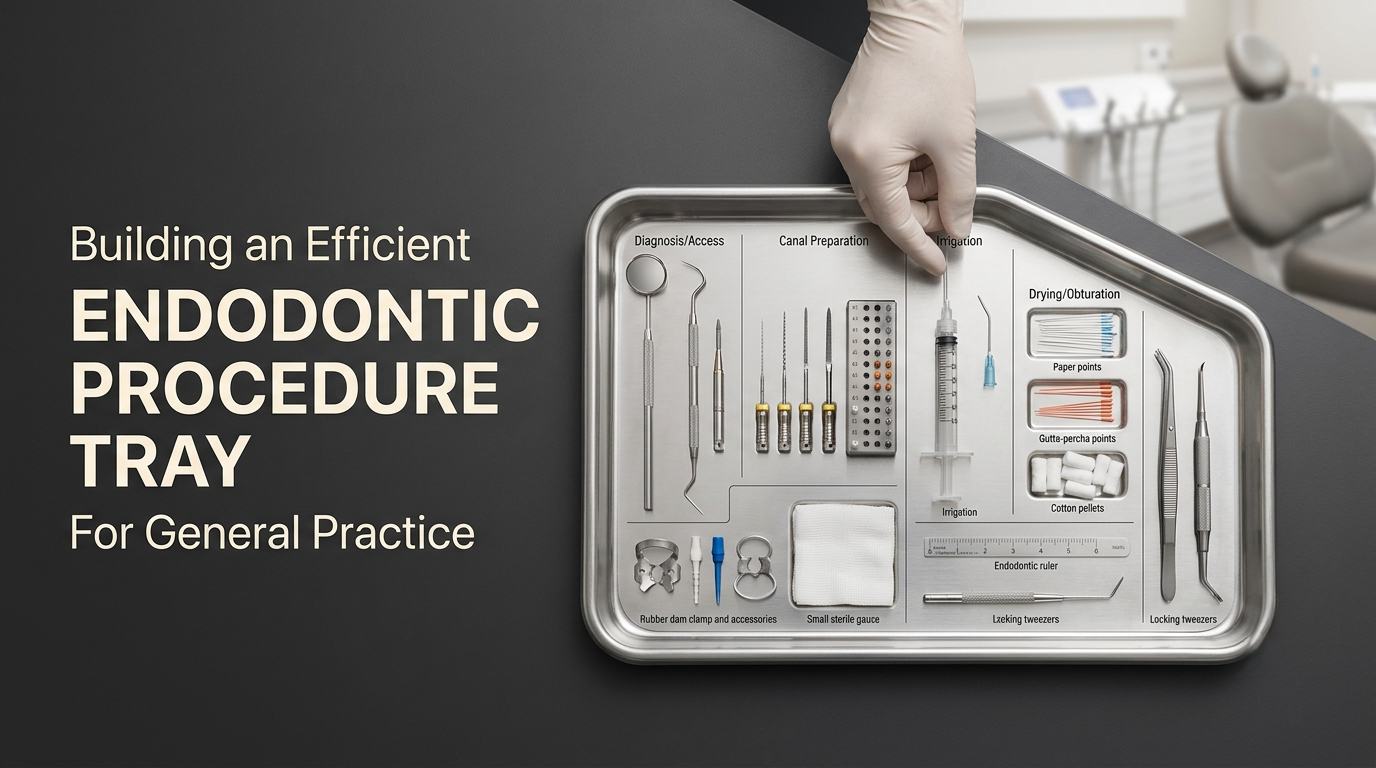
Endodontic Procedure Tray Setup for General Dental Practice
How Do You Build an Endodontic Procedure Tray for a General Dental Practice?Build the tray in three layers:A lean core tray used for every root canal treatment.

Bulk Buying Endodontic Supplies for Dental Clinics
What Should a Dental Clinic Consider Before Buying Endodontic Products in Bulk?Before buying endodontic products in bulk, check four things:How much your clinic

Dental Group Endodontic Purchasing Policy and Best Practices
How Can Dental Groups Create a Standard Endodontic Purchase Policy?A dental group or chain creates a standard endodontic purchase policy in five steps. First, a