
Dr.Yukti
Dental Content Contributor
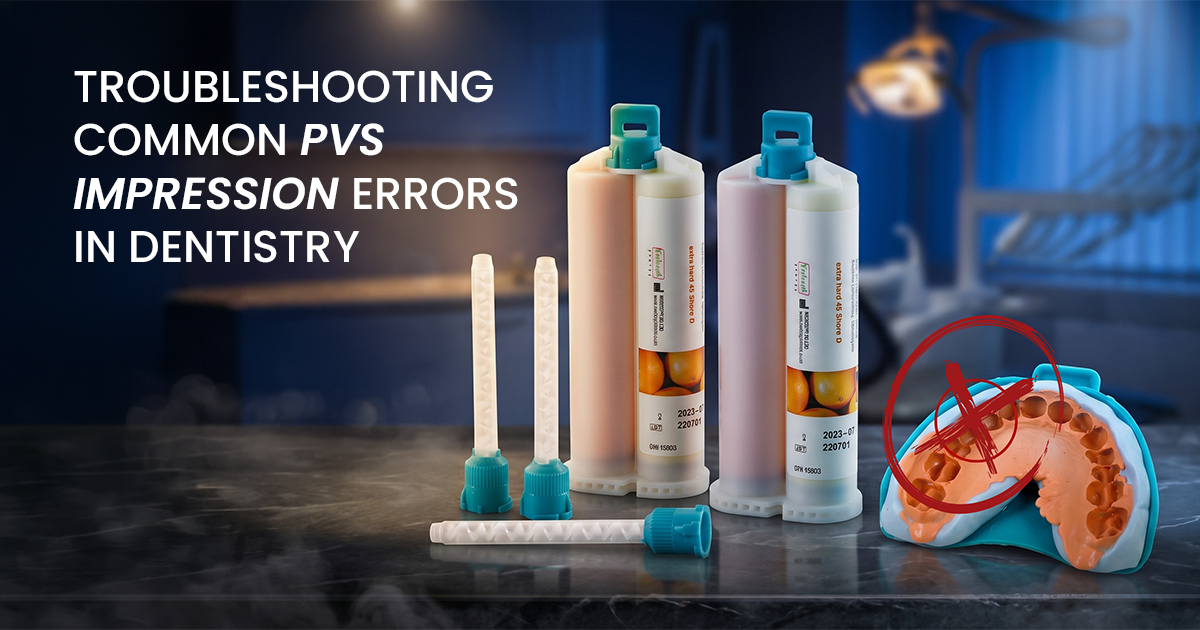
Troubleshooting Common PVS Impression Errors in Dentistry
A Practical Clinical Guide
Common PVS impression errors stem from moisture contamination, inadequate material support, premature removal, and improper tissue management. Mastering the PVS impression material is foundational for precise restorations, minimizing costly remakes and patient dissatisfaction in a busy practice.
Table of Contents
Why Is My PVS Impression Tearing?
PVS impression tearing at the margins is primarily caused by an inadequately thin wash material layer, premature removal before complete polymerization, or 'pull-back' during tray seating. These issues compromise the material's tear strength, leading to fractures at critical marginal areas.
Vinyl polysiloxane has excellent tear strength once fully set, but this property is thickness-dependent. A wash layer thinner than 0.2 mm is prone to tearing upon removal, especially around sharp line angles or deep subgingival margins. Adhering strictly to the manufacturer's recommended intraoral setting time, typically 4-6 minutes, is critical; removing the tray even 30 seconds too early can result in a significant loss of tear resistance. Browse our full range of high-quality impression materials to ensure predictable results.
- Inadequate Space: Ensure at least 1.5-2.0 mm of occlusal/axial reduction to provide bulk for the heavy-body material, which supports the wash.
- Premature Removal: Verify the material is fully set by checking the excess material on the mixing pad; it should be firm and non-tacky before removing the tray.
- Thin Wash Material: Syringe the light-body wash material twice around the preparation—once clockwise, then counter-clockwise—to ensure complete, uniform coverage.
- Deep Subgingival Margins: Utilize a double-cord retraction technique to displace tissue vertically and laterally, creating adequate space for the material to flow and gain sufficient thickness.
Chairside Tip: The Rebound Test
Before removing the impression, press a blunt instrument into the excess PVS material outside the mouth. If it rebounds completely without leaving a permanent indentation, the material has achieved sufficient elastic recovery and is safe to remove.
How to Prevent Voids and Air Bubbles
Voids and air bubbles in a PVS impression are typically caused by improper syringing technique, moisture or debris on the preparation surface, or air incorporation during material mixing and dispensing. These defects obscure critical details and necessitate a remake.
While modern PVS materials are hydrophilic, they cannot displace gross moisture, blood, or saliva. The key is to maintain a dry field and employ a meticulous application technique. When syringing the light-body material, the automix tip must remain submerged in the expressed material at all times. Lifting the tip introduces air, which becomes trapped at line angles and in the sulcus. We offer a comprehensive selection of prosthodontic products to support every step of this process.
- Bleed the Cartridge: Always dispense and discard a small pea-sized amount from a new automix cartridge to ensure an even base/catalyst mix.
- Control the Syringe: Use a slow, continuous motion, starting at the most distal aspect of the preparation and moving mesially, keeping the tip in contact with the tooth surface.
- Dry the Field: Gently dry the prepared teeth and sulcus with an oil-free air stream immediately before syringing the wash material.
- Seat the Tray Correctly: Insert the loaded tray with a single, slow, and decisive motion to allow the heavy-body material to displace the light-body material without trapping air.
THREE STEPS TO A VOID-FREE IMPRESSION
Always express a small amount of material from a new cartridge before attaching the mixing tip.
Keep the intraoral tip buried within the extruded material to prevent air from being introduced.
Insert the tray in one slow, continuous motion to avoid creating air pockets between viscosities.
What Causes Drags in PVS Impressions?
Drags and pulls in a heavy-body PVS impression result from tray movement during setting, premature contact of the tray with tooth structure, or using a material that has already entered its polymerization phase. These defects appear as stretched or blunted areas, indicating distortion.
Every PVS material has a defined working time (typically 1.5-2.5 minutes) and setting time (4-6 minutes). Any disturbance after the working time has elapsed will introduce permanent deformation. Using a rigid, well-fitting tray with proper adhesive is non-negotiable. The adhesive layer requires at least 7-10 minutes to dry completely to form a chemical bond, preventing the material from pulling away from the tray during removal.
- Tray Stabilization: Use firm finger rests on adjacent teeth or the opposing arch to hold the tray completely motionless for the entire setting duration.
- Respect Working Time: Mix and load the tray swiftly. Do not attempt to seat or adjust the tray after the manufacturer's specified working time has passed.
- Avoid Tray Push-Through: Ensure adequate material thickness (at least 2 mm) over all occlusal and axial surfaces.
- Check Tray Fit: A custom tray should have uniform spacing. A stock tray must be rigid and not impinge on any soft or hard tissues during seating.
Adhesive Application is Critical
Applying adhesive and immediately loading the impression material is a common error. This traps solvent, preventing a secure bond. Apply a thin, even coat and wait at least 7 minutes for it to fully dry for maximum adhesion.
Managing Gingival Bleeding and Moisture
Effective management of gingival bleeding and moisture relies on meticulous tissue retraction and hemostasis, typically achieved using retraction cords soaked in a hemostatic agent. Blood and sulcular fluid are contaminants that inhibit the setting reaction and obscure marginal detail.
The goal is to achieve both mechanical displacement of the gingiva and chemical control of fluids. Astringents like 15-25% aluminum chloride are effective for hemostasis without interfering with PVS setting. For more challenging cases with persistent bleeding, ferric sulfate can be used, but it must be rinsed away thoroughly as residue can inhibit polymerization. The double-cord technique is the standard of care for achieving predictable isolation of subgingival margins.
- Hemostatic Choice: Aluminum chloride is generally preferred as it is less aggressive on tissues and does not stain dentin, unlike ferric sulfate.
- Double-Cord Technique: For sulcus depths over 2 mm, place a small cord (e.g., 000) that remains in the sulcus, followed by a larger cord (e.g., 0 or 1) that is removed just before syringing.
- Rinse and Dry: After removing the top cord, rinse the sulcus vigorously with an air-water spray to clear debris and coagulum, then gently dry with a light air stream.
- Wait Before Syringing: After achieving hemostasis, wait approximately 1-2 minutes for any residual seepage to stop before placing the wash material.
Choosing Your Retraction Method
Frequently Asked Questions
The main advantage of a PVS impression material over alginate is its superior dimensional stability and accuracy. PVS exhibits minimal distortion (<0.2%) and can be poured multiple times, even days after being made. Alginate, a hydrocolloid, is prone to syneresis and imbibition, requiring an immediate pour within 15 minutes to prevent clinically significant inaccuracies.
The primary difference lies in viscosity and handling. The putty-wash technique uses a very high-viscosity putty for a preliminary impression, which is then relined with a low-viscosity wash. The heavy/light-body technique uses two different flowable materials simultaneously (one-step) or sequentially (two-step), generally providing better detail reproduction and less hydraulic compression of the wash material than putty.
An accelerated setting time for PVS is often caused by high ambient temperature and humidity, common in many Indian clinics. Storing materials above the recommended 25°C can speed up the reaction. Another common cause is latex contamination from gloves, as sulfur inhibits the platinum catalyst, leading to an incomplete or unpredictable set. Always use nitrile or vinyl gloves when handling PVS.
For open-tray implant impressions, a medium-body (monophase) or a combination of heavy-body and light-body PVS is ideal. This provides sufficient rigidity to capture and stabilize the impression copings accurately without locking onto components. The lower viscosity wash material ensures precise detail of the soft tissue architecture and adjacent teeth, which is critical for esthetic outcomes.
No, you must never reuse an automix tip. The material inside the tip will polymerize, blocking the orifices and causing an imbalanced base-to-catalyst ratio in the next use. This will result in streaks of unset material and a completely failed impression, wasting both chair time and materials. Always use a fresh tip for each application.
Written by
Dr.Yukti
Dental Content Contributor
Dr. Yukti Jain is a BDS-qualified dental professional and Product Specialist at Dentalkart with expertise in dental materials, equipment, and clinical innovations. Passionate about evidence-based dentistry, she creates insightful, research-driven content that simplifies complex topics and empowers dental professionals to make informed clinical and purchasing decisions.
Keep reading
Browse all →Optimizing Your Dental Lab Vibrator Technique
Optimizing Your Dental Lab Vibrator TechniqueA Guide to Bubble-Free Casts A dental vibrator machine uses controlled vibrations to remove trapped air from gypsum

When Should You Use a Dental Vacuum Former?
When Should You Use a Dental Vacuum Former?A Guide to Clinical Applications A dental vacuum former is best used for fabricating single-arch appliances like blea

Should You Prescribe a Flexible Partial Denture?
Should You Prescribe a Flexible Partial Denture?A Clinical Case Selection Guide Flexible partial dentures are metal-free removable prostheses ideal for patients