
Dr. Bhavishya Arora
Chief Dental Editor
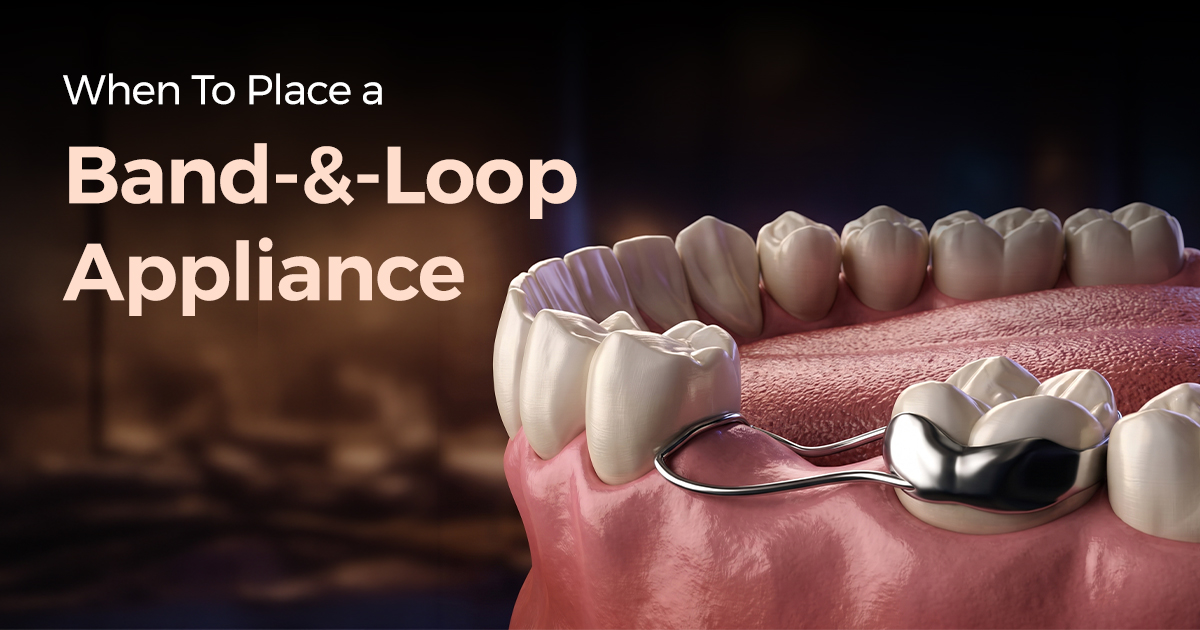
When To Place a Band-and-Loop Appliance
An Evidence-Based Selection Protocol
A band-and-loop is a unilateral, fixed appliance preserving mesiodistal dimension after premature single primary molar loss. Proper selection prevents space loss, arch collapse, and future malocclusion.
Table of Contents
What Are the Core Indications for a Band-and-Loop?
Primary indication for a band-and-loop is premature, unilateral loss of a single primary first or second molar, with the permanent successor present but unerupted. Most effective when the permanent first molar has erupted, providing a stable posterior abutment. It prevents mesial drift of posterior teeth and distal movement of anterior segments, maintaining arch perimeter for the succedaneous tooth.
Clinically, the abutment tooth must be structurally sound, with sufficient root support and no impending exfoliation. Radiographic evaluation is mandatory to confirm the permanent premolar's presence and developmental stage. Ideal scenario involves a successor with less than two-thirds root formed, indicating non-imminent eruption, ensuring the maintainer serves its purpose without impeding natural exfoliation and eruption.
- Single Tooth Loss: For unilateral primary molar loss.
- Healthy Abutment: Banded tooth (primary second or permanent first molar) must be caries-free with adequate periodontal support.
- Successor Present: Radiographs must confirm the developing permanent premolar.
- Favorable Eruption Sequence: Loss occurs before expected premolar eruption.
Pre-Placement Selection Checklist
Verify single primary molar is missing.
Ensure anchor tooth is sound, caries-free, and lacks mobility.
Confirm presence and developmental stage of permanent premolar.
Patient must demonstrate ability to maintain adequate oral hygiene around fixed appliance.
Assess These Contraindications Before Placement
Band-and-loop is contraindicated when the permanent successor is congenitally missing (anodontia) or when gross crowding necessitates space closure as part of a larger orthodontic plan. Placing a maintainer then preserves space that won't fill naturally or needs orthodontic elimination. Poor oral hygiene or high caries risk makes any fixed appliance a liability, increasing decalcification and caries risk on the abutment tooth.
Structural issues are a key contraindication. If the abutment tooth has insufficient clinical crown height, is severely decayed, or is periodontally compromised, it cannot provide stable anchorage. If space is already compromised with over 2 mm mesial drift, a simple space maintainer is insufficient; a space-regaining appliance or orthodontic intervention is required. This underscores the need for timely intervention after premature extraction.
- Anodontia: Permanent successor is congenitally absent.
- Poor Oral Hygiene: High plaque index; patient/parent cannot clean appliance.
- Compromised Abutment: Abutment is non-restorable, has poor periodontal support, or is nearing exfoliation.
- Significant Space Loss: Mesial drift has already closed most edentulous space.
- Multiple Tooth Loss: Bilateral or multiple adjacent missing teeth require different appliance.
Critical Contraindication: Congenital Absence
Never place a band-and-loop without radiographic confirmation of the succedaneous tooth. Maintaining space for a congenitally missing premolar commits the patient to avoidable complex future prosthodontic or orthodontic treatment.
Patient Age and Dental Development: The Deciding Factors
Patient selection hinges more on dental age and eruption sequence than chronological age. Critical factor is unerupted permanent successor's root development. According to Nolla's stages, if premolar's root is over two-thirds formed (Stage 8+), eruption is likely within 6-12 months, and a space maintainer may be unnecessary. Conversely, if root is less than half-formed (Stage 6-), eruption is distant, and space maintenance is crucial.
Permanent first molar's eruption status is another key determinant. If a primary second molar is lost before the permanent first molar erupts, a band-and-loop is ineffective. In this scenario, a distal shoe appliance guides the erupting permanent molar. Once fully erupted and in occlusion, the permanent first molar serves as a reliable distal abutment for a traditional band-and-loop if the primary first molar is lost.
- Assess Dental Age: Prioritize radiographic root development (Nolla's stages) over chronological age.
- Monitor First Permanent Molar: Eruption status dictates appliance type, especially for primary second molar loss.
- Calculate Leeway Space: Consider arch development and available leeway space in mixed dentition.
- Timing is Key: Greatest space loss occurs within 6 months post-extraction; prompt assessment is vital.
Appliance Selection Based on Development
Band-and-Loop vs. Other Space Maintainers: When to Choose?
Choosing a band-and-loop depends on unilateral/bilateral space loss and missing tooth. It's the standard for single, unilateral posterior tooth loss: a simple, cost-effective, fixed appliance with minimal patient compliance. Its unilateral nature prevents midline shifts or bilateral anchorage.
When mandibular tooth loss is bilateral, a lingual holding arch provides superior cross-arch stabilization. For bilateral maxillary loss, a Nance appliance or transpalatal arch (TPA) is indicated. If a primary second molar is lost before permanent first molar eruption, the distal shoe is the only appliance guiding the erupting molar. Removable appliances are reserved for multiple missing teeth or patients who won't tolerate a fixed appliance, with success highly dependent on patient compliance.
- Unilateral Loss: Band-and-loop is the first choice.
- Bilateral Mandibular Loss: Lingual holding arch is standard.
- Bilateral Maxillary Loss: Nance or TPA is preferred.
- Pre-Eruption Loss of 2nd Molar: Distal shoe is the only correct choice.
| Appliance | Primary Indication | Compliance Needed |
|---|---|---|
| Band-and-Loop best | Unilateral primary molar loss | Low (Fixed) |
| Lingual Arch | Bilateral mandibular molar loss | Low (Fixed) |
| Distal Shoe | Primary 2nd molar loss BEFORE permanent 1st molar eruption | Low (Fixed) |
| Removable Appliance | Multiple posterior/anterior tooth loss; patient cooperation | High (Removable) value |
Conclusion: The Radiograph is Decisive
Decision to place a band-and-loop must be driven by clear radiographic and clinical assessment, not just an edentulous space. The most critical step is confirming the succedaneous tooth's presence and developmental stage. A properly indicated band-and-loop is a highly effective preventive measure; a poorly selected one can lead to iatrogenic complications, unnecessary costs, and more complex future orthodontic needs.
- Core Indication: Use only for unilateral loss of a single primary molar with a present successor.
- Developmental Rule: Placement is most critical when the successor's root is between one-third and two-thirds formed (Nolla stages 6-7).
- Abutment Integrity: Never band a tooth that is mobile, has extensive caries, or is near natural exfoliation.
- Appliance Limit: For bilateral loss, a band-and-loop is contraindicated; opt for lingual arch (mandible) or Nance/TPA (maxilla).
Frequently Asked Questions
The main purpose of a band-and-loop is to preserve mesiodistal space created by premature single primary molar loss. It prevents posterior molars from drifting forward and anterior teeth from moving back, ensuring adequate room for the permanent successor (premolar) to erupt correctly.
A band-and-loop is a unilateral appliance maintaining space on one side. A lingual arch, in contrast, is a bilateral mandibular appliance with bands on both permanent first molars and a wire contacting incisor lingual surfaces. It maintains the entire arch perimeter and is indicated for bilateral primary molar loss.
A band-and-loop should be removed once radiographic evidence shows the succeeding permanent tooth beginning to erupt through the alveolar crest. Leaving it in place too long can obstruct the eruption path, causing impaction or ectopic eruption. Regular 6-month follow-up appointments are essential to monitor eruption and determine ideal removal time.
No, a band-and-loop is generally not indicated for premature primary canine loss. Canine space loss is less predictable and can contribute to midline shifts. Management is more complex, often involving observation or a bilateral appliance like a lingual arch to prevent lateral incisor drift and midline deviation.
Failure to place a space maintainer after premature primary molar loss typically results in rapid space closure, with most significant loss occurring within 6 months. This leads to mesial drift of permanent molars, crowding, impaction of the succeeding premolar, and potential Class II malocclusion. Correcting this later requires complex and costly orthodontic treatment.
Written by
Dr. Bhavishya Arora
BDS, MDSChief Dental Editor
A contributing clinician at Dentalkart Blogs, Dr. Bhavishya is a compassionate, detail-driven dentist known for thoughtful patient care, clear communication, and a calm chair-side manner that puts patients at ease. Beyond the clinic, she leads product content and category initiatives at Dentalkart India's largest dental marketplace where she bridges clinical understanding with commercial insight to help dentists make better-informed product choices.
Keep reading
Browse all →
Indications for Dental Finishing Strips
Indications for Dental Finishing StripsA Clinical Selection Guide Dental finishing strips are thin, flexible abrasive instruments used for final contouring and

Indications for Caries Detector Dye
Indications for Caries Detector Dye A Case-Based Clinical Guide Caries detector dye aids excavation by staining denatured collagen in carious dentin, but i

Fluoride Varnish vs. APF Gel: A Case Selection Guide
Fluoride Varnish vs. APF Gel: A Case Selection GuideChoosing the Right Topical Fluoride Fluoride varnish is the preferred agent for most patients, especially ch