
Dr.Yukti
Dental Content Contributor
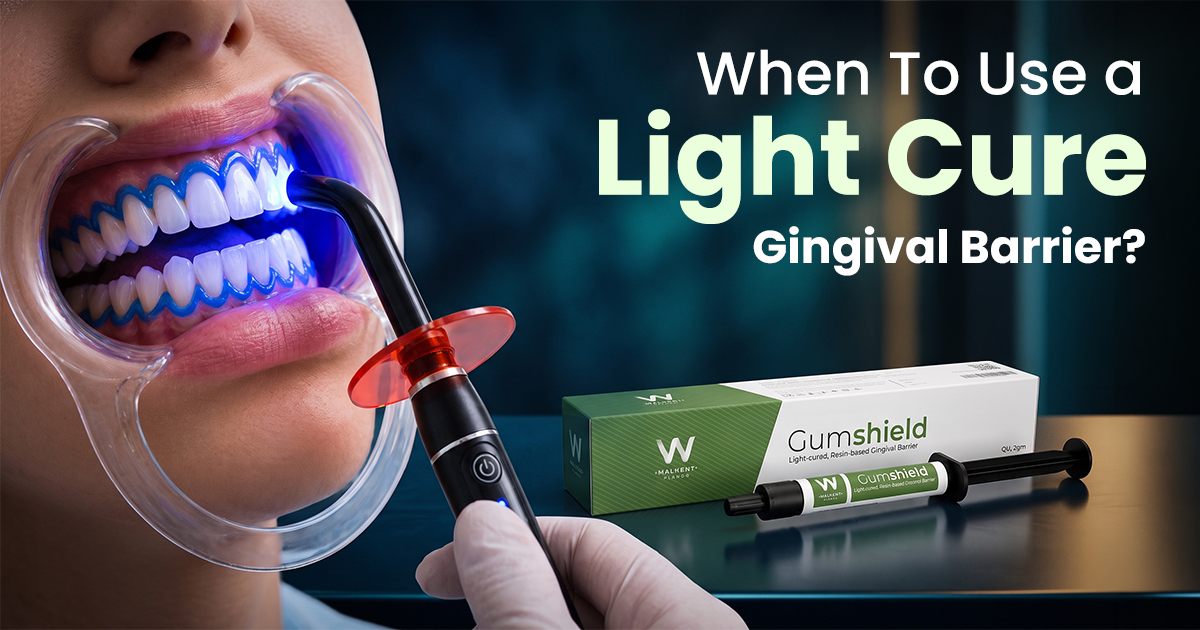
When To Use a Light Cure Gingival Barrier?
A Clinical Selection Guide.
A liquid gingival barrier is a light-curable resin used to isolate and protect soft tissues during specific dental procedures. As demand for in-office bleaching and microabrasion grows in Indian practices, its successful use hinges on precise case selection for predictable, safe outcomes.
Table of Contents
Primary Indications for a Liquid Gingival Barrier
A liquid gingival barrier is primarily indicated for creating a localized, chemical-proof seal around one or more teeth when full quadrant isolation is unnecessary. Its main function is to protect the marginal gingiva and interdental papillae from caustic materials like high-concentration bleaching agents or etchants.
To be effective, the barrier must be applied to a completely dry surface and achieve a passive, non-impinging seal. Apply a continuous bead approximately 1.5-2.0 mm thick and 4-6 mm wide, extending onto the attached gingiva. Cure each segment for 20-30 seconds with a standard LED light cure unit to ensure full polymerization and prevent chemical leakage.
- Chemical Isolation: Protects gingiva from hydrogen or carbamide peroxide gels (>25% concentration) during in-office vital tooth bleaching.
- Abrasive Containment: Shields soft tissue from hydrochloric acid and pumice slurry during enamel microabrasion.
- Sandblasting Shield: Prevents iatrogenic damage to adjacent soft tissues or restorations during intraoral air abrasion procedures.
- Minor Leak Sealing: Acts as an adjunct to a traditional rubber dam to seal small gaps or leaks around a clamp or tooth contour.
Speed and Efficiency
Sets up in minutes, significantly faster than placing a full rubber dam for localized procedures.
Precision Control
Allows for accurate placement along the gingival margin, isolating only the required areas.
Patient Comfort
Avoids the use of clamps and frames, which can improve patient tolerance during short aesthetic treatments.
Procedures Optimized by Gingival Barrier Application
In-office vital tooth bleaching, enamel microabrasion, and chairside air abrasion are the procedures that benefit most from a liquid gingival barrier. Its ability to form a precise, impervious seal is ideal for these chemically-driven, localized treatments where traditional rubber dams would be overly cumbersome.
In bleaching, the barrier is non-negotiable for preventing chemical burns from 35-40% hydrogen peroxide gels, which can cause immediate, painful blanching of the gingiva. For Class V restorations with margins at or slightly above the gingival crest, it can supplement a cotton roll to block crevicular fluid seepage, ensuring a dry field for bonding. This simple step can significantly improve bond strength and marginal integrity.
- In-Office Bleaching: The gold standard for isolating single or multiple teeth in the aesthetic zone from high-concentration peroxides.
- Enamel Microabrasion: Isolates the target tooth surface for controlled application of acid-pumice slurry to remove intrinsic stains.
- Protecting Adjacent Restorations: Shields existing composite or ceramic work from etchants or sandblasting during procedures on a neighboring tooth.
- Sealing a Leaky Rubber Dam: Serves as a quick chairside fix to achieve a perfect seal around a poorly fitting clamp or in areas with difficult contours.
Gingival Barrier Selection Matrix
Contraindications for Liquid Gingival Barriers
A liquid gingival barrier is contraindicated for any procedure requiring absolute moisture control, aerosol containment, or significant soft tissue retraction. It is also unsuitable for patients with a known allergy to methacrylate resins, a component in most formulations.
Its primary limitation is its inability to control moisture from the entire oral cavity (saliva, breath condensation) or retract the tongue and cheeks. Therefore, it is insufficient for most adhesive restorative dentistry, endodontics, or crown and bridge preparations where a contaminated field would lead to procedural failure. The barrier provides a chemical seal but offers no protection against airborne pathogens generated by high-speed handpieces or ultrasonic scalers.
- Aerosol Generating Procedures: Provides zero protection during high-speed drilling, ultrasonic scaling, or air polishing.
- Full Quadrant/Arch Isolation: Cannot retract tissues or control moisture effectively over a large area.
- Deep Subgingival Margins: Impossible to apply and cure properly without causing gingival trauma or leaving a void, leading to leakage.
- Known Resin Allergies: Contains monomers that can trigger allergic contact stomatitis in sensitized individuals.
- Long Procedures: The seal may degrade over time, and it can be uncomfortable for patients during appointments longer than 45-60 minutes.
Aerosol Risk is Absolute
Never rely on a liquid barrier for aerosol management. It provides zero protection against airborne viral or bacterial pathogens. For any procedure using high-speed handpieces or ultrasonic instruments, a properly placed rubber dam remains the undisputed standard of care for operator and patient safety.
Liquid Barrier vs. Traditional Rubber Dam
A liquid barrier offers superior speed for localized anterior isolation, while a traditional rubber dam provides comprehensive field control. The decision is not about which is better overall, but which is appropriate for the specific clinical task. The barrier excels at chemical protection; the dam excels at infection and moisture control.
The rubber dam, a key item among dental disposables, creates a completely separate operating field, reducing microbial contamination in aerosols by over 90%. In contrast, a liquid barrier's purpose is narrowly defined: protect the gingiva from a topically applied chemical in an otherwise dry, controlled environment. Attempting to use it outside this scope compromises both safety and clinical outcomes.
- Application Speed: A liquid barrier can be applied and cured in 1-2 minutes, versus 3-5 minutes or more for a rubber dam.
- Scope of Isolation: The barrier is localized (1-6 teeth), whereas the dam isolates a full quadrant or arch.
- Aerosol Control: The barrier provides no aerosol control, while the dam offers the highest level of protection.
- Tissue Retraction: The barrier provides no retraction, whereas the dam effectively retracts the tongue, cheeks, and lips.
| Feature | Liquid Gingival Barrier | Rubber Dam |
|---|---|---|
| Application Time | 1-2 minutes best | 3-5+ minutes |
| Isolation Area | Localized (1-6 teeth) | Quadrant / Full Arch best |
| Aerosol Control | None | Excellent (>90% reduction) best |
| Tissue Retraction | None | Excellent value |
| Primary Use Case | Chemical protection (Bleaching) | Infection/Moisture control |
Conclusion: Match the Barrier to the Task
The most critical clinical judgment is recognizing that a light cure gingival barrier is a specialized tool for chemical isolation, not a universal replacement for the rubber dam. Its value lies in its speed and precision for aesthetic procedures like in-office bleaching, where it provides excellent, targeted protection. For any procedure involving aerosols or requiring absolute moisture control for adhesive bonding, the rubber dam remains the uncompromised standard of care.
- For Bleaching: Always apply a 1.5-2.0 mm thick barrier to prevent chemical burns from peroxide gels over 25% concentration.
- For Aerosols: Never use a liquid barrier as a substitute for a rubber dam during any aerosol-generating procedure.
- For Application: Ensure enamel and gingiva are completely dry before placing the barrier to guarantee an effective, leak-proof seal.
- For Scope: Reserve liquid barriers for localized isolation (1-6 teeth); select a rubber dam for all quadrant or full-arch restorative work.
Frequently Asked Questions
A liquid gingival barrier is typically composed of a light-curable methacrylate or urethane dimethacrylate (UDMA) resin. It also contains inorganic fillers for viscosity and body, pigments for color contrast against the gingiva, and a photoinitiator like camphorquinone that activates polymerization when exposed to blue light from a curing unit.
No, a liquid gingival barrier is not recommended for crown preparations. It fails to provide the four critical elements required: comprehensive moisture control from saliva, effective soft tissue retraction for margin visualization, protection of the patient's airway, and containment of aerosols generated by high-speed handpieces. A rubber dam is the appropriate standard of care.
To remove the barrier, use a fine-tipped explorer or scaler to gently engage and lift one edge of the cured resin. It is designed to be flexible and should peel off easily in one or two large pieces. Thoroughly inspect the gingival sulcus to ensure no small fragments are left behind, which could cause inflammation.
Yes, the terms 'liquid dam,' 'paint-on dam,' and 'liquid gingival barrier' are used interchangeably in clinical practice. They all describe a syringe-dispensed, light-curable resin applied directly to the gingiva to create a temporary, protective seal during specific dental treatments like in-office bleaching.
A typical 1.5-2.0 mm layer of liquid gingival barrier cures in 20-30 seconds with a standard dental LED light cure unit emitting a wavelength of 450-470 nm and an intensity of at least 1000 mW/cm². Thicker applications or darker colored barriers may require slightly longer curing times to ensure complete polymerization through the full depth.
Written by
Dr.Yukti
Dental Content Contributor
Dr. Yukti Jain is a BDS-qualified dental professional and Product Specialist at Dentalkart with expertise in dental materials, equipment, and clinical innovations. Passionate about evidence-based dentistry, she creates insightful, research-driven content that simplifies complex topics and empowers dental professionals to make informed clinical and purchasing decisions.
Keep reading
Browse all →
Case Selection for Digital Occlusal Analysis
Case Selection for Digital Occlusal AnalysisA Clinical Decision Guide A digital occlusal analysis system provides objective, dynamic data on bite timing and for
Diagnosing Cracked Teeth With Fibre-Optic Transillumination
Diagnosing Cracked Teeth With Fibre-Optic Transillumination (FOTI)A Clinical Selection Guide Fibre-optic transillumination (FOTI) is a diagnostic method using a
Optimizing Bone Graft Outcomes with PRF and PRP — Enhancing Healing in Oral Surgery
Optimizing Bone Graft Outcomes with PRF and PRPEnhancing Healing in Oral Surgery PRF and PRP are autologous blood concentrates that deliver high concentrations
