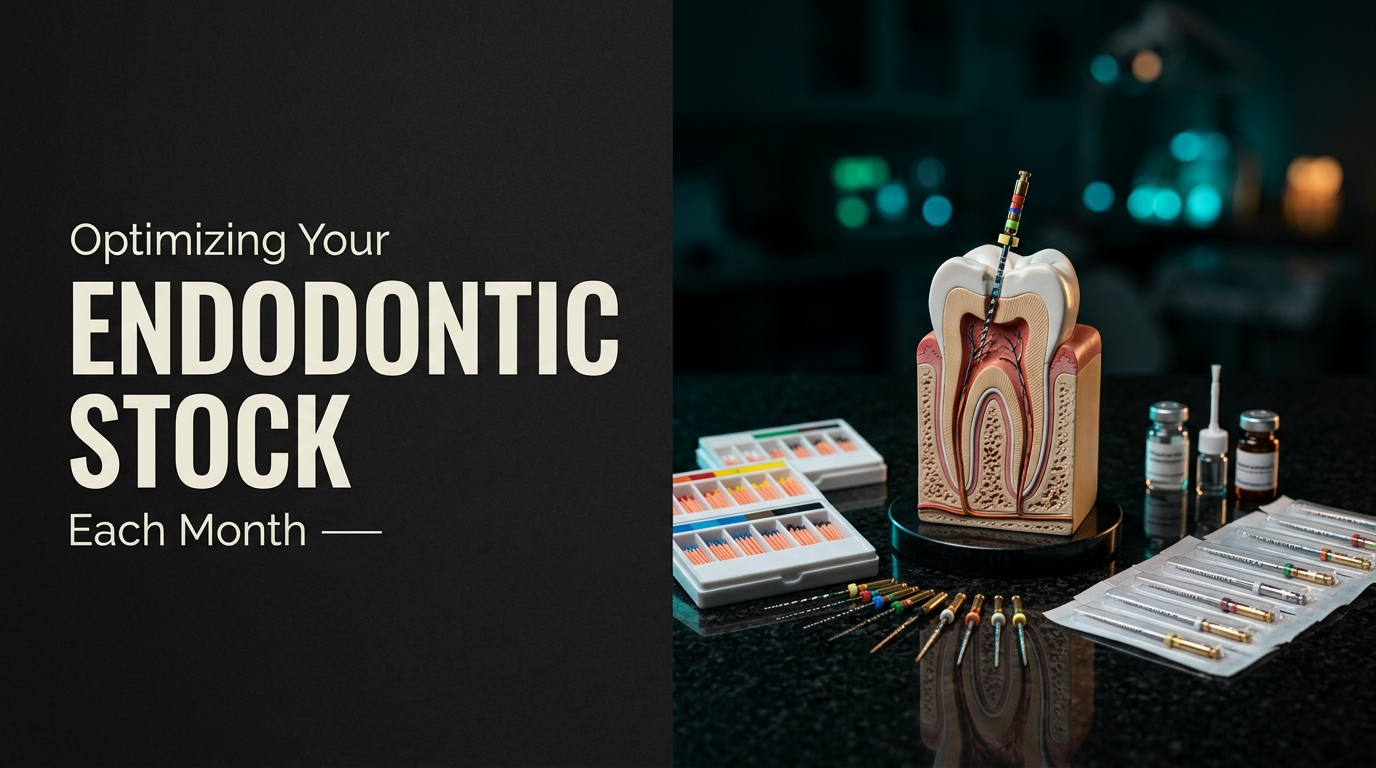
How Many Endodontic Consumables Should a Dental Clinic Stock

Dr. Gurjeet
Contributing Dental Clinician
Stock each endodontic consumable at your average monthly root canal volume multiplied by what each case actually uses, split by tooth type and by size, plus a safety reserve sized to your delivery lead time. Reorder when stock falls to what you will use while waiting for the courier, plus that reserve. Then adjust for pack size and expiry.
Run that calculation per product, size and taper, not per category. That is the difference between a well-stocked endo cupboard and a Saturday afternoon spent hunting for one missing paper point.
Why Counting RCTs Alone Gives the Wrong Number
Most clinics that run short on endo material are not under-buying overall. They are buying the wrong mix. I have seen a clinic doing close to 40 root canal treatments (RCTs) a month with shelves full of paper points, still stopped mid-obturation because there was no 25/.06 left. That week simply had more molars than usual.
Consumption follows canal count and complexity, not appointment count. A maxillary central usually has one canal. A mandibular molar usually has three, and in a maxillary first molar we should always be looking for MB2. Retreatments add solvent, extra irrigant, gutta-percha removal files and more paper points while drying. “RCTs per month” flattens all of this into one misleading figure.
So the planning unit is the SKU: one product, in one size and taper, forecast against your case mix.
Step 1: Build Your Baseline From Records, Not Recall
Pull 3 to 6 months of appointment or billing data. Memory is a poor forecaster; what the team feels runs out fast is usually whatever ran out last week.
Suppose the last six months ranged from 34 to 42 RCTs, an average of about 38 cases a month. Note that spread too, because it sets your safety stock later.
Now classify the same cases by tooth group. Most practice management software can filter by tooth number. If yours cannot, a fortnight of manual tagging at the front desk is enough to establish the ratio.
Step 2: Measure Consumption Per Case, by Tooth Group
The per-case figures below are hypothetical, to illustrate the method. Replace them with your own recorded usage.
Case type | Cases/month | Paper points per case (hypothetical) | Monthly use |
|---|---|---|---|
Anterior | 8 | 4 | 32 |
Premolar | 12 | 8 | 96 |
Molar | 15 | 15 | 225 |
Retreatment | 3 | 20 | 60 |
Total | 38 | - | 413 |

That works out to about 11 paper points per case. Plan on a flat 8 per case and you would run about 100 short every month. Molars and retreatments use roughly two-thirds of the points from fewer than half the cases. That is where your forecasting attention belongs.
Step 3: Set Safety Stock From Lead Time and Variability
The total of 413 tells you how many paper points you use. It does not tell you which box will be empty on Saturday. For that, split the monthly figure by the sizes your file system actually finishes to.
Hypothetical clinic finishing anteriors and larger retreated canals at 40/.06, premolars and the wider molar canals at 30/.06, and narrow molar canals at 25/.06.
Size/taper | Where it is used | Monthly use |
|---|---|---|
25/.06 | Narrow molar canals and retreatments | 180 |
30/.06 | Premolars and wider molar canals | 171 |
40/.06 | Anteriors and larger retreated canals | 62 |
Total | 413 |
Now the opening problem makes sense. The 25/.06 points carry almost half of the monthly use. A clinic stocking evenly across sizes would run out of 25/.06 first, every time. Run Steps 4 and 5 for each size separately, not for “paper points” as a whole.
The same logic applies to every matched item: gutta-percha cones in the same sizes and tapers, and file sequences.
A quick note on files
Rotary files are the biggest cost on the endo shelf, so get their numbers right too. If your system is labelled single-use, 38 cases means roughly 38 sequences a month, plus extra files for long or calcified canals. If your file’s IFU permits reprocessing and your protocol limits a sequence to, say, three anterior or premolar cases (hypothetical), your monthly need falls from about 38 sequences to about 25, because molars and retreatments still get a fresh sequence each. Always follow the IFU: reuse is only an option where the manufacturer allows it, and a file is never reused simply because stock is low.
Step 4: Fix Minimum, Reorder and Target Levels
Safety stock absorbs a heavy week, a run of emergency walk-ins or a delayed courier. A flat 20% buffer is a reasonable starting rule. For fast movers, base it on lead time: hold enough extra to cover your heaviest days during your slowest recent delivery, over and above what you normally use while waiting for stock. For the 25/.06 paper points in this hypothetical clinic, where deliveries usually take 4 days but have taken up to 6, that comes to about 44 points.

Clinics in metros with next-day delivery can keep this low. In tier 2 and tier 3 towns, where delivery windows stretch during festivals or the monsoon, use your observed worst-case lead time, not the quoted one.
Do not buffer slow movers and short-expiry items. Extra stock of a sealer you use twice a month is not safety. It is future waste.
Step 5: Fix Your Reorder Rule
Option A: Three levels per SKU (multi-chair clinics)
Level | Definition | 25/.06 paper point example |
|---|---|---|
Minimum | The safety stock floor; dipping below it means risk | 44 |
Reorder point | Use during lead time + safety stock | 72 |
Target | Stock after delivery lands | 224 (monthly use plus safety stock), rounded up to pack size |
If 25/.06 points come in packs of 200 (check your actual pack size), a target of 224 rounds up to 2 packs. Rounding up raises your effective safety stock a little, which is fine for a fast mover with a long shelf life and less so for anything perishable. When stock touches 72, the order goes out, and delivery should land while you are still above 44.
Option B: The two-bin system (single-chair clinics)
For a single-chair practice, three numbers per SKU is often more paperwork than the clinic will maintain. A two-bin system does the same job with no spreadsheet:
Keep each fast-moving item in two labelled containers.
Work only from the first bin.
When the first bin is empty, that is your reorder signal. Place the order and start using the second bin.
The second bin holds enough for your lead time plus a small reserve, which for the 25/.06 example is about 72 points (one pack, with room to spare).
In our clinic, the assistant clips a reorder card to the second bin, so nobody can open it without seeing that an order is due.
Organise Stock Around the Treatment Sequence
Shelving by product category hides gaps. Shelving by procedural stage exposes them, because the team can see at a glance whether every stage of tomorrow’s molar is covered:
Anaesthesia: local anaesthetic cartridges, needles, topical anaesthetic
Isolation: rubber dam sheets, clamps for the planned teeth
Access and negotiation: burs, small hand files
Shaping: rotary or reciprocating files in the system and sizes you use
Irrigation: sodium hypochlorite, EDTA or your chelator, side-vented needles, syringes
Interim dressing (multi-visit cases): calcium hydroxide or your chosen intracanal medicament, sterile cotton pellets
Obturation: paper points, matching-taper gutta-percha, sealer, mixing tips
Interim seal: temporary filling material

Obturation is the usual failure point. It needs four matched items at once, and a missing size in any one of them forces either a compromise or a rescheduled patient.
Standardising on one file system, where it suits your cases clinically, cuts SKU count considerably. Every extra system multiplies the sizes, tapers and matching cones you must keep in date. DentalKart’s Endo Section groups endodontic consumables by category, which makes cross-checking a stage list quick.
Track Consumption, Not Purchases
Purchase history tells you what came in, not what was used. A monthly sheet per key SKU should capture opening stock, quantity received, quantity used, closing stock, units expired or damaged, and every emergency purchase or stockout.
Emergency purchases are the most useful signal on that sheet. Each one marks a forecasting gap: a wrong per-case figure, an underestimated lead time, or a shift in case mix the baseline missed.
Check weekly for shortfalls against reorder points. Review monthly for trend: is molar volume rising, are expiries creeping up, has a supplier’s delivery time changed? Recalculate fully after a change of file system, a new associate with a different protocol, or growth in referred retreatments.
Four measures show whether the system is working:
Stockouts and emergency orders per month
Percentage of stock expiring unused
Forecast accuracy (planned versus actual use per SKU)
Appointments delayed or rescheduled because of a missing consumable
Where Inventory Decisions End and Clinical Ones Begin
Your front desk or inventory staff can own the numbers, but never the substitutions. Swapping a gutta-percha taper, a sealer chemistry or an irrigation needle design because the planned item is out of stock is a clinical decision for the treating dentist. Single-use status, reprocessing and compatibility between systems follow the manufacturer’s IFU.
Frequently Asked Questions
Only for items that are fast-moving, long-dated and stable in storage, such as rubber dam sheets or paper points in your standard sizes. Even then, weigh the discount against the cash tied up and the share that might expire. Storage matters as much as shelf life: latex rubber dam deteriorates with heat and sunlight, and several manufacturers specify cool, dry storage below about 25 °C. A store room next to the autoclave or under a tin roof in May will age it fast. Sealers and some irrigants have shorter lives once opened, so their bulk discounts rarely survive the waste.
Start from planned chair hours and expected RCT bookings for the first month, use conservative per-case figures from your protocol, and keep a higher safety stock while lead times are unknown. Switch to recorded data after 6 to 8 weeks, then tighten the buffers.
Central stocking reduces total safety stock because demand swings across chairs partly cancel out. It only works if transfer between sites is reliable within your lead time. Each branch still needs enough obturation stock on hand to finish every case booked for that day.
Written by
Dr. Gurjeet
Contributing Dental Clinician
Dr. Gurjeet is a practising dental clinician contributing to Dentalkart Blogs, sharing chair-side experience, treatment protocols, and equipment insights for the wider dental community.
Keep reading
Browse all →Navigating Gates-Glidden Drill Sizes
Navigating Gates-Glidden Drill SizesA Clinical Selection Guide Gates-Glidden (GG) drills are latch-type, side-cutting rotary instruments for shaping the coronal

Gauging Canal Status with Absorbent Paper Points
Gauging Canal Status with Absorbent Paper PointsA Clinical Selection Guide Using absorbent paper points for diagnosis provides critical, real-time feedback on c


Ideal Cases for Intraligamentary Anaesthesia
Ideal Cases for Intraligamentary AnaesthesiaAn Evidence-Based Guide Intraligamentary anaesthesia is a supplemental injection technique that forces a local anaes
