
Dr.Yukti
Dental Content Contributor
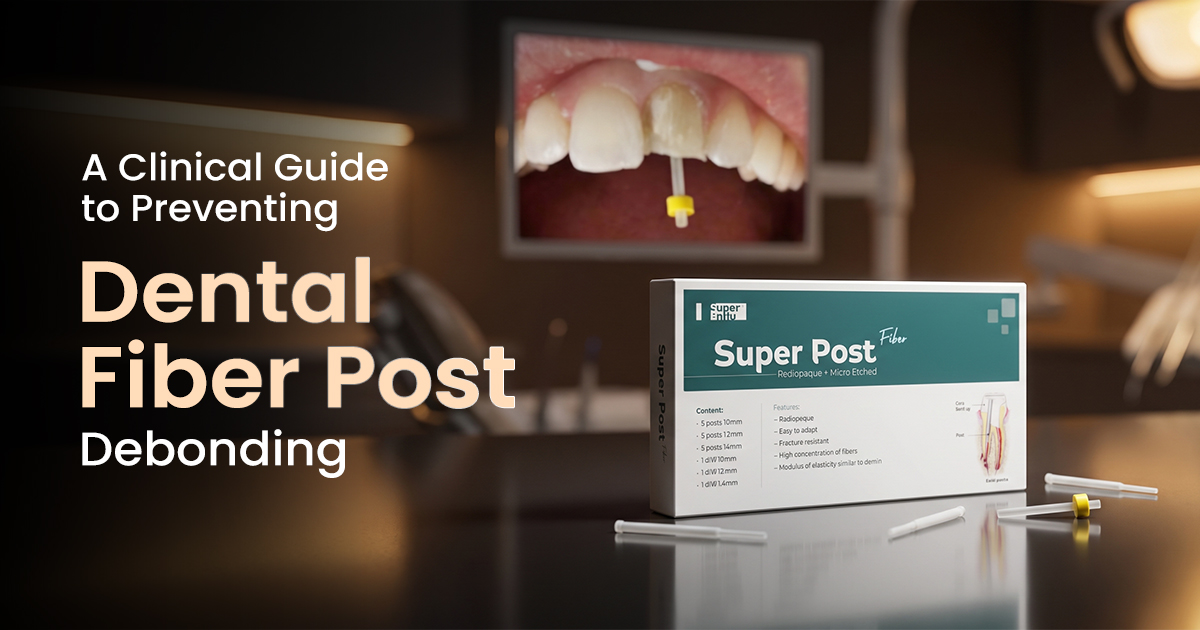
A Clinical Guide to Preventing Dental Fiber Post Debonding
Troubleshooting Clinical Failures
Fiber post debonding is the most common failure in post and core restorations, and it primarily results from adhesive failure, canal contamination, and improper placement technique. Understanding these failure points is crucial for long-term restoration success in endodontically treated teeth and maintaining patient trust.
Table of Contents
What Causes Fiber Post Debonding?
The main causes of fiber post debonding are adhesive failure (dentin-cement or cement-post interface), post space contamination, and polymerization stress. The apical third of the canal is most vulnerable, where achieving adequate bonding and light-curing is challenging.
Moisture, blood, or salivary contamination during bonding severely compromises hybrid layer formation, leading to microleakage and bond failure. Chemical incompatibility between acidic resin cements and certain bonding agents can inhibit adhesive layer polymerization, creating a weak link. This is common with total-etch adhesives if the bonding agent isn't adequately light-cured before cement insertion.
- Contamination: Saliva and blood are primary contaminants. Rubber dam use is crucial for predictable outcomes.
- Adhesive Incompatibility: Some simplified universal adhesives may not be compatible with dual-cure resin cements, causing poor polymerization.
- Polymerization Shrinkage: High C-factor (bonded-to-unbonded surface ratio) within the canal generates significant stress, disrupting the bond before full maturation.
- Inadequate Curing: Insufficient light penetration, especially beyond 5-6 mm in the canal, results in under-cured apical cement and a weak bond.
THREE COMMON FAILURE INTERFACES
Failure often caused by moisture contamination or improperly formed hybrid layer.
Indicates inadequate luting cement polymerization due to insufficient light or chemical incompatibility.
Debonding results from a contaminated post surface or lack of a silane coupling agent.
How Canal Preparation Influences Post Retention
Proper canal preparation is foundational for post retention, preserving coronal and radicular tooth structure while creating adequate post space. The most critical factor for tooth survival is a ferrule—a 360-degree collar of sound dentin, ideally 1.5-2.0 mm high, coronal to the crown margin.
Post space preparation must be conservative. Post diameter should not exceed one-third of the root diameter at its narrowest point to avoid weakening the root and increasing fracture risk. Post length must retain the core but leave at least 4-5 mm of gutta-percha for an apical seal. Over-enlarging with aggressive drills creates a non-passive fit, introducing stress and reducing fracture-resistant dentin.
- Ferrule Effect: A minimum 1.5 mm of solid vertical tooth structure is mandatory to resist functional lever forces.
- Post Length: Aim for a length two-thirds the root length or at least equal to the clinical crown height.
- Apical Seal: Always maintain 4-5 mm of apical gutta-percha to ensure endodontic seal integrity.
- Passive Fit: The post must fit passively. A binding post indicates under-preparation, creating internal stresses upon cementation.
Pre-Cementation Canal Preparation Checklist
Confirm at least 1.5 mm of circumferential vertical sound tooth structure.
Ensure 4-5 mm of gutta-percha remains undisturbed on the post-op radiograph.
Post should slide into place without binding, with slight removal resistance.
Irrigate with NaOCl, rinse with saline or chlorhexidine, then dry with paper points.
Which Luting Cement Is Best for Fiber Posts?
Reliable fiber post cementation is what holds the whole post and core together, so the luting agent choice matters as much as the post itself. This provides the highest bond strengths to root dentin, especially in the apical region where light penetration is limited.
Self-adhesive resin cements offer a simplified, faster workflow by eliminating separate etching and bonding, but their dentin bond strength is generally lower than conventional systems. Performance can be less predictable in canals not perfectly dry. For clinicians prioritizing bond strength and longevity, a conventional dual-cure cement from prosthodontic products remains superior. The chemical-cure component ensures complete polymerization throughout the post space.
- Dual-Cure Resin Cements: Highest bond strength, but technique-sensitive. Requires separate etching and bonding agent application.
- Self-Adhesive Resin Cements: Simple, fast, and less technique-sensitive. Generally exhibit lower bond strengths.
- Self-Etch Resin Cements: Offer a compromise: good bond strengths with a moderately simplified procedure.
- Post Surface Treatment: Regardless of cement, treating the post surface with a silane coupling agent is critical to establish a strong chemical bond between the post's resin matrix and the cement.
Dual-cure Resin Cement
- Highest bond strengths to root dentin.
- Reliable polymerization in deep apical areas.
- Technique-sensitive and requires multiple steps.
- Higher potential for procedural errors.
Self-Adhesive Cement
- Simplified, faster clinical workflow.
- Reduced chance of post-operative sensitivity.
- Lower bond strengths compared to etch-and-rinse systems.
- Performance is highly dependent on moisture control.
What Are Critical Cementation Workflow Errors?
The most critical errors in adhesive cementation are moisture or residual sealer contamination, and incomplete curing of adhesive and cement. These errors directly undermine stable bond formation between post, cement, and dentin.
Common mistakes include failing to completely remove the smear layer and eugenol-containing sealer remnants from canal walls, as eugenol inhibits resin polymerization. Another error is pooling of the bonding agent at the post space base, creating a thick, weak layer that never fully polymerizes. Finally, insufficient light-curing time or low-output curing lights (below 600 mW/cm²) can leave coronal cement under-cured, compromising the restoration's foundation.
- Inadequate Canal Cleaning: Residual gutta-percha or eugenol-based sealer on canal walls inhibits cement polymerization.
- Improper Drying: Over-drying desiccates dentin collagen, preventing hybrid layer formation. For total-etch systems, leave the canal moist, not wet.
- Pooling Adhesive: Remove excess bonding agent with a paper point before light-curing to avoid a thick, weak film.
- Insufficient Light Curing: Light-cure for at least 40-60 seconds occlusally using a high-power LED curing light.
Avoid Eugenol-Based Sealers
Never use eugenol-containing root canal sealer (e.g., Zinc Oxide Eugenol) in a tooth planned for a fiber post. Residual eugenol potently inhibits resin polymerization, almost certainly leading to post debonding, regardless of the cement system.
Frequently Asked Questions
The ferrule effect refers to the 360° collar of solid tooth structure (at least 1.5-2.0 mm high and 1 mm thick) that a crown encircles coronal to its margin. This structural band is critical as it protects the root from fracture by counteracting functional lever forces concentrated at the post-dentin interface. A restoration without an adequate ferrule places excessive stress on the post and cement, leading to premature failure.
Yes, a debonded fiber post can often be re-cemented, provided the post and remaining tooth structure are intact and fracture-free. The protocol involves thoroughly cleaning old cement from both post surface and canal, typically using ultrasonic scalers and sandblasting. After cleaning, meticulously repeat the full adhesive cementation protocol, ensuring proper isolation and surface treatment for success.
The primary difference lies in their design and retention method. Passive dental fiber posts, most common, have parallel or slightly tapered sides, relying entirely on luting cement for retention. Active posts have a threaded design engaging dentin walls for mechanical retention. However, active posts are rarely used today as they induce significant internal stress, increasing root fracture risk.
For a post and core using a fiber post, a dual-cure resin cement with a compatible adhesive is the gold standard. It bonds reliably to both dentin and the post, and the dual-cure mechanism ensures the deep apical cement fully sets where light can't reach.
Effective canal cleaning involves chemical and mechanical methods after post space preparation. First, irrigate with sodium hypochlorite (NaOCl) to dissolve organic debris, then rinse with saline. Next, use 17% EDTA for one minute to remove the inorganic smear layer. A final rinse with 2% chlorhexidine can be used for antimicrobial properties. Finally, gently dry the canal with appropriately sized paper points, avoiding desiccation.
Written by
Dr.Yukti
Dental Content Contributor
Dr. Yukti Jain is a BDS-qualified dental professional and Product Specialist at Dentalkart with expertise in dental materials, equipment, and clinical innovations. Passionate about evidence-based dentistry, she creates insightful, research-driven content that simplifies complex topics and empowers dental professionals to make informed clinical and purchasing decisions.
Keep reading
Browse all →
Which Luting Cement for Zirconia Crowns?
Which Luting Cement for Zirconia Crowns?A Clinical Decision Guide The ideal luting cement for zirconia crowns is typically a self-adhesive resin cement, prized

Mastering Direct Chairside Denture Relining: A Clinical
Mastering Direct Chairside Denture Relining: A Clinical ProtocolImprove Fit, Function, and Comfort Direct chairside relining readapts a denture's intaglio surfa

Digital Dental Shade Matching for Predictable Aesthetic
Digital Dental Shade Matching for Predictable Aesthetic RestorationsPrecision Beyond the Eye A dental spectrophotometer is a device that objectively measures to