
Dr. Prerna Sahrawat
Contributing Dental Clinician
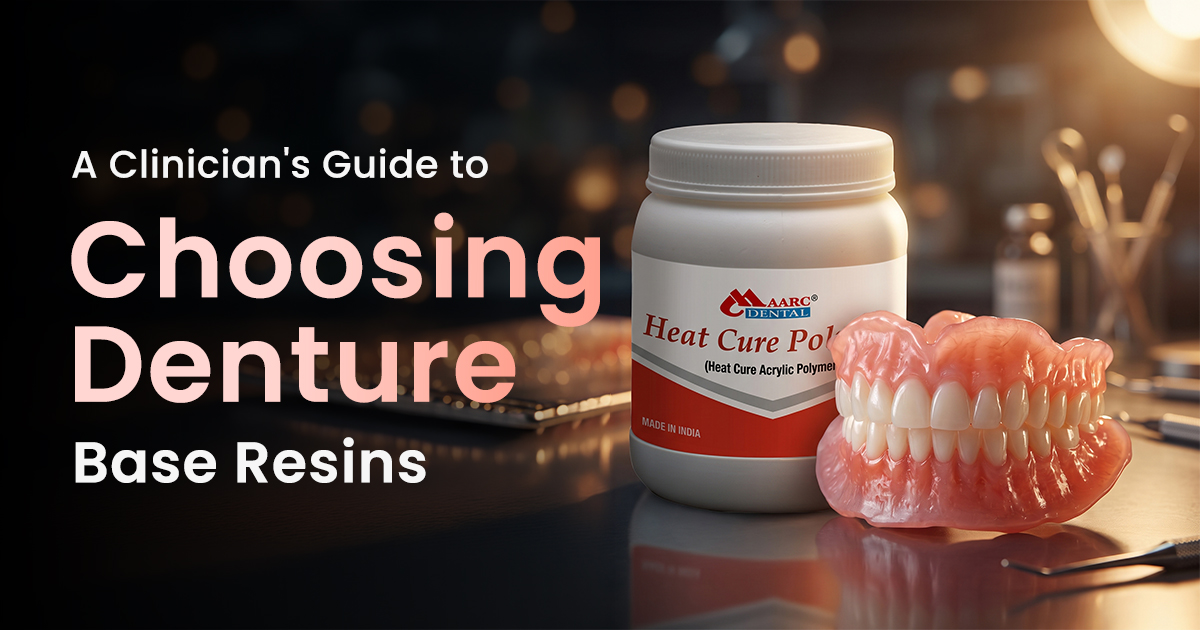
A Clinician's Guide to Choosing Denture Base Resins
Material Selection Simplified
Selecting the correct acrylic denture resin is fundamental to fabricating durable, well-fitting, and aesthetic removable prostheses. This choice directly impacts clinical success and patient satisfaction, requiring a balance of mechanical properties, biocompatibility, and ease of processing for your practice.
Table of Contents
Heat-Cure vs. Cold-Cure Acrylic Resins
The primary clinical difference between heat-cure and cold-cure resins lies in their polymerization method and resulting physical properties. Heat-cure resins use thermal energy for a more complete monomer-to-polymer conversion, yielding a stronger, denser, and more color-stable final prosthesis, making them the standard for new fabrications.
Cold-cure (autopolymerizing) resins use a chemical activator, resulting in faster setting but a less complete conversion, leaving 3-5% residual monomer compared to under 0.5% in heat-cure acrylics. This makes them ideal for rapid chairside procedures like repairs or relining but less suitable for long-term prostheses. The higher residual monomer can also be a greater concern for patient sensitization. All new full and partial dentures benefit from the superior qualities of properly processed heat-cure denture base materials.
- Strength: Heat-cure resins exhibit superior transverse and impact strength due to a higher degree of polymerization.
- Biocompatibility: Lower residual monomer in heat-cure acrylic reduces the risk of contact stomatitis or allergic reactions.
- Color Stability: Heat-cure resins are more stable over time, as the tertiary amine activator in cold-cure resins can oxidize and cause discoloration.
- Primary Use: Heat-cure is for definitive prostheses; cold-cure is for temporary applications and repairs.
| Property | Heat-Cure Resin | Cold-Cure Resin |
|---|---|---|
| Polymerization | Heat-activated (e.g., 74°C water bath) | Chemical-activated (tertiary amine) |
| Residual Monomer | < 0.5% | 3-5% |
| Transverse Strength | Higher best | Lower |
| Color Stability | Excellent | Fair (can yellow over time) |
| Primary Application | New definitive dentures | Repairs, relines, custom trays |
When to Use High-Impact Denture Acrylics
High-impact acrylics should be the material of choice for prostheses at a high risk of fracture. These are specifically indicated for patients with heavy masticatory forces, a history of repeated denture breakage, or in clinical situations with minimal inter-arch space that limits denture base thickness.
These advanced resins are PMMA modified with rubber-graft copolymers (like butadiene-styrene) that act as shock absorbers, interrupting crack propagation. While their flexural modulus might be slightly lower than conventional acrylics, their impact strength can be over 50% greater. This makes them essential for single complete dentures opposing natural dentition and for implant-supported overdentures, where occlusal forces are concentrated. Their processing is similar to standard heat-cure resins, making them an easy upgrade for any dental lab. Upgrading to these materials is a key part of providing robust prosthodontic products.
- Fracture History: The number one indication is for patients who have previously fractured a conventional acrylic denture.
- Bruxism: For patients with parafunctional habits, high-impact resin provides a crucial safety margin against catastrophic failure.
- Opposing Dentition: Essential when opposing natural teeth or a fixed prosthesis, which transmit higher forces.
- Thin Sections: Ideal for dentures where base thickness is compromised, such as over bulky maxillary tori.
High-Impact Resin Selection Criteria
Managing Polymerization Shrinkage for Better Fit
Polymerization shrinkage is the volumetric contraction that occurs as liquid monomer converts to solid polymer, a primary cause of denture misfit. This unavoidable phenomenon, typically around 6% by volume for PMMA, creates internal stresses that can warp the denture base and compromise the posterior palatal seal.
Clinically, this manifests as a denture that lifts from the posterior palate, rocks on the residual ridges, or requires significant chairside adjustment. While all acrylics shrink, the effect can be minimized through meticulous processing. Injection molding systems, which feed acrylic into the mold under continuous pressure, compensate for shrinkage more effectively than traditional compression molding. For dentures that have lost their fit over time due to ridge resorption or other factors, using quality denture relining materials is the appropriate corrective procedure.
- Clinical Effect: The most common result is a loss of suction in maxillary dentures due to a gap in the posterior palatal seal area.
- Stress Introduction: Shrinkage induces stress within the acrylic, which can later be released as warpage, especially if cleaned in hot water.
- Technique Matters: A long, slow curing cycle (e.g., 9 hours at 74°C) allows stresses to dissipate more gradually than a rapid cycle.
- Injection Molding: This technique is the gold standard for minimizing shrinkage and achieving the most accurate fit.
Unmanaged Shrinkage Compromises Retention
A 0.5% linear polymerization shrinkage across a 50 mm wide palate can create a 0.25 mm gap. This is more than enough to break the peripheral seal, leading to poor retention, patient complaints, and increased chair time for adjustments.
Flexural Strength vs. Porosity in Dentures
Flexural strength and porosity are two critical, inversely related properties of a denture base. Flexural strength measures the material's ability to resist fracture from bending forces during mastication, with a minimum of 65 MPa required by ISO standards. Porosity refers to internal voids that act as stress concentrators, drastically reducing strength and creating hygiene problems.
Porosity is a processing error, not a material defect. It's often caused by a curing cycle that is too rapid, causing the monomer to boil (at 100.3°C) and create gaseous voids. It can also result from under-packing the flask or an incorrect powder-to-liquid ratio. A porous denture is not only weak and prone to midline fracture but also harbors microorganisms, leading to staining, malodor, and denture stomatitis. Proper bonding of denture teeth sets to a dense, non-porous base is also essential for the overall integrity of the prosthesis.
- Fatigue Failure: Most denture fractures are due to fatigue from repeated flexing, which starts at a microscopic void or stress point.
- Causes of Porosity: Insufficient dough in the flask, packing the acrylic when it's too soft, or raising the temperature too quickly during curing.
- Porosity Detection: A well-processed denture base should be uniformly translucent; opaque or chalky white spots indicate internal porosity.
- Hygiene Impact: Voids become a protected niche for Candida albicans, a primary cause of denture-related stomatitis.
Achieving a Dense, Void-Free Cure
To prevent porosity, always use the manufacturer-recommended powder-liquid ratio and allow the mix to reach a non-sticky, doughy stage before packing. Employ a long, low-temperature curing cycle (e.g., 9 hours at 74°C) to prevent monomer from boiling.
Frequently Asked Questions
The main component of an acrylic denture resin is Polymethyl methacrylate (PMMA), which is supplied as a powder (polymer) and a liquid (monomer). The powder also contains an initiator like benzoyl peroxide, while the liquid contains inhibitors and cross-linking agents like ethylene glycol dimethacrylate to improve the physical properties and craze resistance of the final cured prosthesis.
The main difference is in handling and physical properties. Pourable (or fluid) resins are mixed to a low-viscosity consistency and poured into a hydrocolloid or silicone mold for faster processing. However, they typically exhibit higher polymerization shrinkage and lower strength compared to heat-cure acrylics, which are packed as a dough under pressure and cured with heat for superior density and durability.
For patients with suspected allergies to acrylic, a high-quality, heat-cured resin with very low residual monomer (<0.5%) is the first choice. Ensure the material is specified as cadmium-free, as this was a historical source of toxicity. If a true PMMA allergy is confirmed, alternative materials such as flexible nylon-based thermoplastics or high-performance polymers like PEEK must be considered.
Recurrent midline fractures in a maxillary denture or fractures near a clasp on a partial denture are typically due to fatigue failure. This can be caused by heavy occlusal forces, an unbalanced occlusion concentrating stress in one area, or inadequate material thickness. Switching to a high-impact acrylic denture resin or incorporating a cast metal mesh or framework can effectively reinforce these high-stress areas.
Porosity creates a network of microscopic internal voids within the denture base, which are impossible for a patient to clean effectively. These voids harbor oral fluids, bacteria, and fungi like Candida albicans, leading directly to persistent malodor, staining, and an increased risk of denture stomatitis. A dense, well-polished surface is paramount for maintaining prosthesis hygiene and mucosal health.
Written by
Dr. Prerna Sahrawat
Contributing Dental Clinician
Dr. Prerna Sahrawat is a dentist with over 4 years of experience in clinical dentistry and dental content writing. She is passionate about simplifying complex dental concepts into practical, evidence-based content that helps dentists make informed clinical and purchasing decisions while staying updated with the latest advancements in dentistry.
Keep reading
Browse all →Optimizing Your Dental Lab Vibrator Technique
Optimizing Your Dental Lab Vibrator TechniqueA Guide to Bubble-Free Casts A dental vibrator machine uses controlled vibrations to remove trapped air from gypsum

When Should You Use a Dental Vacuum Former?
When Should You Use a Dental Vacuum Former?A Guide to Clinical Applications A dental vacuum former is best used for fabricating single-arch appliances like blea
Should You Prescribe a Flexible Partial Denture?
Should You Prescribe a Flexible Partial Denture?A Clinical Case Selection Guide Flexible partial dentures are metal-free removable prostheses ideal for patients