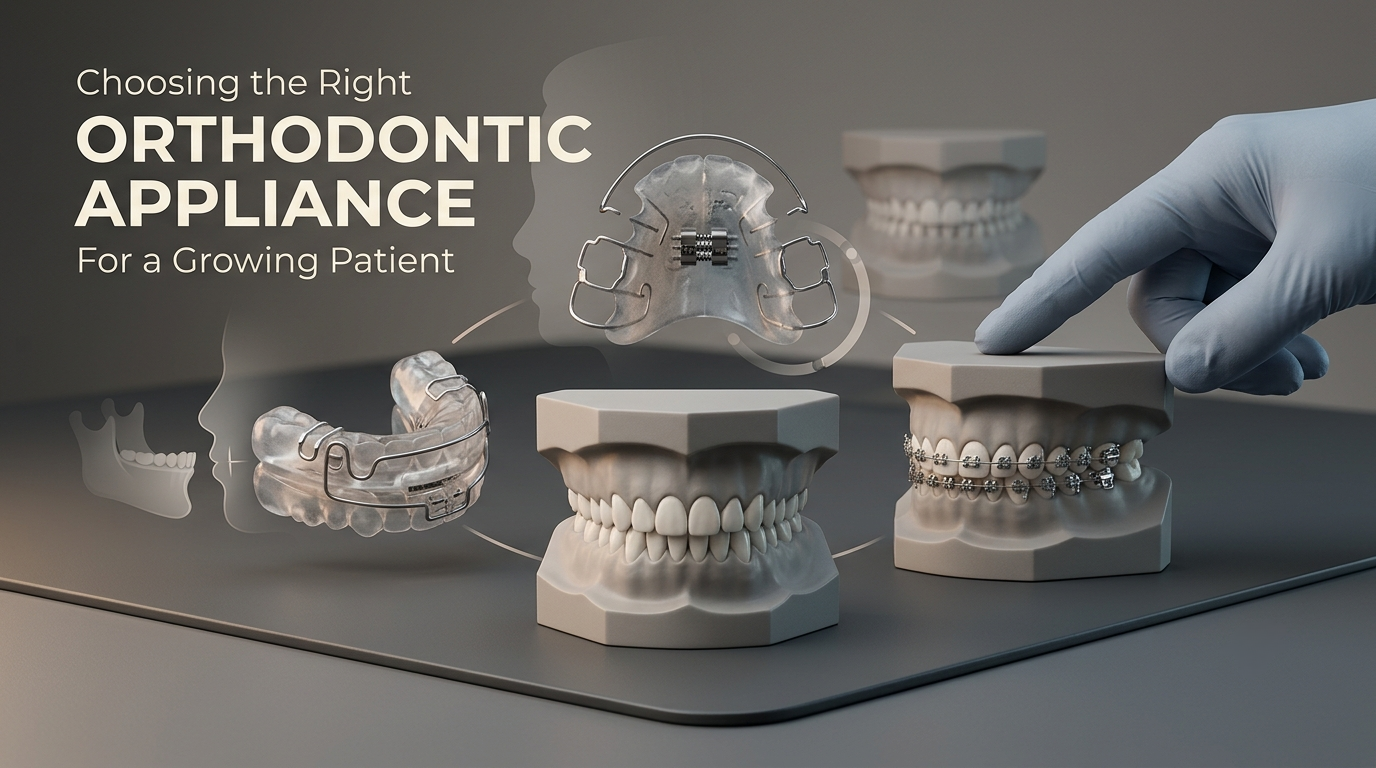
How to Choose Orthodontic Appliances for Growing Patients

Dr. Gurjeet
Contributing Dental Clinician
How Do You Choose Between a Functional, Removable, or Fixed Orthodontic Appliance?
In a growing patient, choose the appliance by the level of the problem first, then check the growth stage and likely compliance:
Functional appliance: for a skeletal discrepancy, typically Class II with a retrusive mandible, in a patient approaching or at the pubertal growth peak.
Removable appliance: for simple tipping of one or a few teeth, space maintenance or habit control.
Fixed appliances: when you need bodily movement, rotation or torque across the arch.
If compliance is doubtful, a fixed or fixed-functional design is usually the safer choice.
A wrong choice rarely fails because of the appliance itself. It fails because the growth window was spent on the wrong mechanics, or because a year of half-worn acrylic left Phase 2 harder than it needed to be.
Start With the Level of the Problem

Level | Typical problem | Appliance family | What it can and cannot do |
Skeletal | Class II with retrusive mandible, large overjet | Functional (Twin Block, Herbst, fixed-functional) | Modifies growth and dentoalveolar position; does not detail individual teeth |
Transverse skeletal | Posterior crossbite with narrow maxilla | Fixed expander (RME) | Opens the midpalatal suture before it matures |
Single tooth or segment | Anterior crossbite, palatally placed incisor, habit | Removable | Tips crowns; cannot move roots bodily |
Whole dentition | Crowding, rotations, space closure, torque | Fixed brackets and archwires | Full 3D control; needs good oral hygiene |
Most growing patients have problems at more than one level. A Class II child with crowding, for example, needs the skeletal problem treated first and the crowding detailed later. Deciding the order of treatment is half the decision.
Why the Mechanics Decide the Indication
Removable appliances hold teeth only at the crown, through clasps and an acrylic baseplate. A spring pressing on a crown applies a single force with no counter-moment, so the tooth tips around a centre of rotation in the root. That is ideal for proclining a single incisor out of crossbite. It is the wrong tool for closing an extraction space, where the roots must move too.
Fixed appliances combine force with moment. A rectangular wire in a bracket slot can control root position, which makes bodily movement, torque and derotation possible. The archwire sequence moves from flexible NiTi to stiffer stainless steel as levelling gives way to working mechanics. Our guide to selecting orthodontic archwires covers that sequence, and our guide to choosing self-ligating brackets explains how bracket design affects friction and chair time.
Functional appliances work differently again. They hold the mandible forward, and the stretched muscles and soft tissues generate forces on the teeth and jaws. In a Twin Block, inclined bite blocks guide the mandible into the advanced position every time the patient closes. A Herbst produces the same posture with a telescopic mechanism fixed to the teeth.
Timing: Growth Stage Over Birthday
Functional appliances only have a skeletal effect while there is growth to redirect. Treatment is usually planned to start shortly before or during the pubertal growth spurt. Estimate that timing from skeletal maturity, for example with cervical vertebral maturation staging, rather than from age. Two 11-year-olds can be years apart on the growth curve.
Transverse problems run to an earlier timeline. The midpalatal suture becomes more interlocked through adolescence, so a maxillary expander gives a more predictable skeletal response in younger patients. Our article on rapid palatal expansion case selection covers the criteria.
Removable appliances depend less on timing. A space maintainer is needed when a primary molar is lost early, at any growth stage. Our guide to paediatric space maintainer selection covers the fixed versus removable decision.
What the Evidence Shows for Functional Appliances
The Cochrane review by Batista and colleagues (2018) pooled trials of Class II Division 1 treatment. For one-phase treatment in adolescence (ages 12 to 16), compared with untreated controls at the end of treatment:
Overjet reduction (mean difference) | ANB reduction (mean difference) | |
Removable functional appliances | 4.62 mm (3 trials, 122 participants) | 2.37° (2 trials, 99 participants) |
Fixed functional appliances | 5.46 mm (2 trials, 61 participants) | 0.53° (3 trials, 89 participants); the review found no clear evidence of a difference from untreated controls |
The authors rated all of this evidence as low quality.

In practice, functional appliances reliably reduce overjet in growing patients, but only a modest and variable share of that change is skeletal. The rest is dentoalveolar: upper incisors tip back and lower incisors tip forward. I set expectations with parents accordingly: "the overjet will very likely come down; how much of that is the jaw rather than the teeth varies from child to child."
Compliance: The Variable That Decides Removable Outcomes
A removable functional appliance only works while it is in the mouth.
Worked example (hypothetical): a Twin Block is prescribed for about 22 hours a day over 12 months. The child actually wears it for 12 hours a day, mostly overnight.
That is just over half of the prescribed wear.
Over the year, it adds up to roughly six and a half months of full-time wear.
So the calendar shows a full year of treatment, but the growth window received only about half of it.

This is why compliance belongs in case selection, not only in follow-up. A child who has already struggled with a removable appliance, or a family that cannot support full-time wear, is a better candidate for a fixed-functional design such as a Herbst. Fixed designs take wear time out of the equation, but they need more chairside work and make hygiene harder.
Design | Daily wear depends on patient? | Main trade-off |
Removable functional (e.g., Twin Block) | Yes, near full-time | Effect falls with poor wear |
Fixed functional (e.g., Herbst) | No | Breakages, hygiene, chair time |
Removable active plate | Yes | Limited to tipping |
Fixed brackets | No | Decalcification risk with poor hygiene |
Fitting and Review: Where Failures Usually Start
At the fit appointment, check that:
the appliance seats fully and the clasps retain it;
there are no sharp acrylic edges;
the occlusion in the appliance is correct.
Before they leave, both the child and the parent should insert and remove a removable appliance in front of you. Give wear time, cleaning and breakage instructions in writing.
Keep activations light and reviews regular, typically every four to six weeks for active removable appliances. Overactivated springs tip teeth faster than the bone can respond, which loosens them. Functional appliances need the acrylic trimmed, or the advancement adjusted, as the bite changes.
For fixed work, decalcification around brackets and molar bands is the most preventable failure. Start hygiene instruction and fluoride support on day one.
If the plan includes headgear for maxillary restraint, remember that extraoral appliances bring their own compliance demand. Allow for that before combining headgear with a removable functional appliance.
Plan Phase 2 Before Phase 1 Begins
In a growing patient, the first appliance is rarely the last. A functional or interceptive first phase reduces the skeletal discrepancy or corrects a crossbite. Fixed appliances then detail the occlusion in the second phase.
Before Phase 1 starts, decide:
What the functional appliance must achieve before brackets go on.
How the correction will be held between phases, often with a part-time functional appliance or a retainer.
What retention will follow at the end. Our comparison of Hawley and Essix retainers helps with this step.
A good Phase 1 shortens Phase 2. A poor one can leave dental compensations, such as heavy incisor proclination masking a skeletal problem, that fixed appliances then have to undo.
Frequently Asked Questions
Usually, yes, if three conditions are met: 1. the incisor has enough space mesiodistally 2. it can be tipped labially, without needing root movement 3. there will be enough overbite to hold the correction once the incisor clears the lower teeth. If the crossbite is skeletal, or there is no overbite to retain it, a removable spring alone is unlikely to hold.
In selected cases, yes. Some clinicians combine sectional fixed appliances with a functional appliance, or attach a fixed-functional device to a full bracket set-up. This can shorten overall treatment time, but it adds complexity and needs careful anchorage planning.
Generally, no. Once skeletal maturity indicators show the growth peak has passed, a functional appliance produces mainly dental change. Camouflage with fixed appliances is usually more appropriate, or a surgical plan for severe cases.
Written by
Dr. Gurjeet
Contributing Dental Clinician
Dr. Gurjeet is a practising dental clinician contributing to Dentalkart Blogs, sharing chair-side experience, treatment protocols, and equipment insights for the wider dental community.
Keep reading
Browse all →
When Interceptive Orthodontics Is Needed for an Overbite
When Does an Overbite Case Call for Interceptive Orthodontics Instead of Waiting?Interceptive orthodontics is justified in an overbite case in two situations: w
How VTO in Orthodontics Helps Plan Treatment and Outcomes
How Is a Visual Treatment Objective (VTO) Used to Plan an Orthodontic Case?A Visual Treatment Objective is used to test a plan before treatment starts. On the l
Facial Divergence in Orthodontics and Treatment Planning
How Does Facial and Photographic Analysis Change an Orthodontic Treatment Plan?Facial analysis changes the plan by setting soft-tissue limits on tooth movement.